
In this article
Original article by Maddy Scheckel, published July 12, 2024. This rewrite does not imply review by the original author.
An annual fee gives a credit card a job interview every year. The card has to explain what it is adding to your life and whether that addition is worth the bill.
The interview does not need to be complicated. Start with the rewards you would earn elsewhere, count benefits you genuinely use and subtract the costs. If the paid card comes out comfortably ahead, the fee can be reasonable. If the case depends on buying subscriptions you do not want or assigning imaginary value to perks, keep looking.
Here is a practical way to make the decision for a new card or an upcoming renewal.
Our take: compare the extra value, not the gross rewards
Suppose a card earns $558 in annual rewards and charges a $95 annual fee. It leaves $463. That looks comfortably above the fee–but a suitable no-fee 2% card earning $480 on the same purchases would leave you $17 better off.
The paid card has not failed to earn rewards. It has failed to beat the relevant alternative in that example.
Use this equation:
Annual incremental value = paid-card rewards − alternative rewards + benefits actually added − annual fee − other added costs.
The alternative should be a card or setup you can realistically obtain, use and redeem. An unavailable product or a redemption route you would never use is not a useful comparison. The main cash-back guide provides a consistent household baseline and conditional alternatives.
A fee decision has three separate questions
| Question | What belongs in the answer |
|---|---|
| Does the paid card beat a suitable free option? | Extra rewards and usable benefit differences, after costs. |
| Is the first year attractive? | The exact welcome offer, introductory fee waiver and planned qualifying spending. |
| Should I keep it at renewal? | The coming year’s ordinary value after the recurring fee, without reusing the opening bonus. |
A “yes” to the first-year question is not automatically a “yes” to renewal. A paid card can have a strong opening offer and a mediocre ordinary role, or a modest opening offer and a very useful long-term role.
Likewise, a card can beat one free alternative while losing to another. Clearing the fee is a necessary comparison; it does not establish that the card is the best choice in the whole market.
The grocery break-even is a useful example
Blue Cash Preferred earns 6% on the first $6,000 of qualifying U.S. supermarket purchases each calendar year, then 1%, with a $95 recurring fee. Blue Cash Everyday earns 3% on its first $6,000, then 1%, without an annual fee. Preferred terms Everyday terms
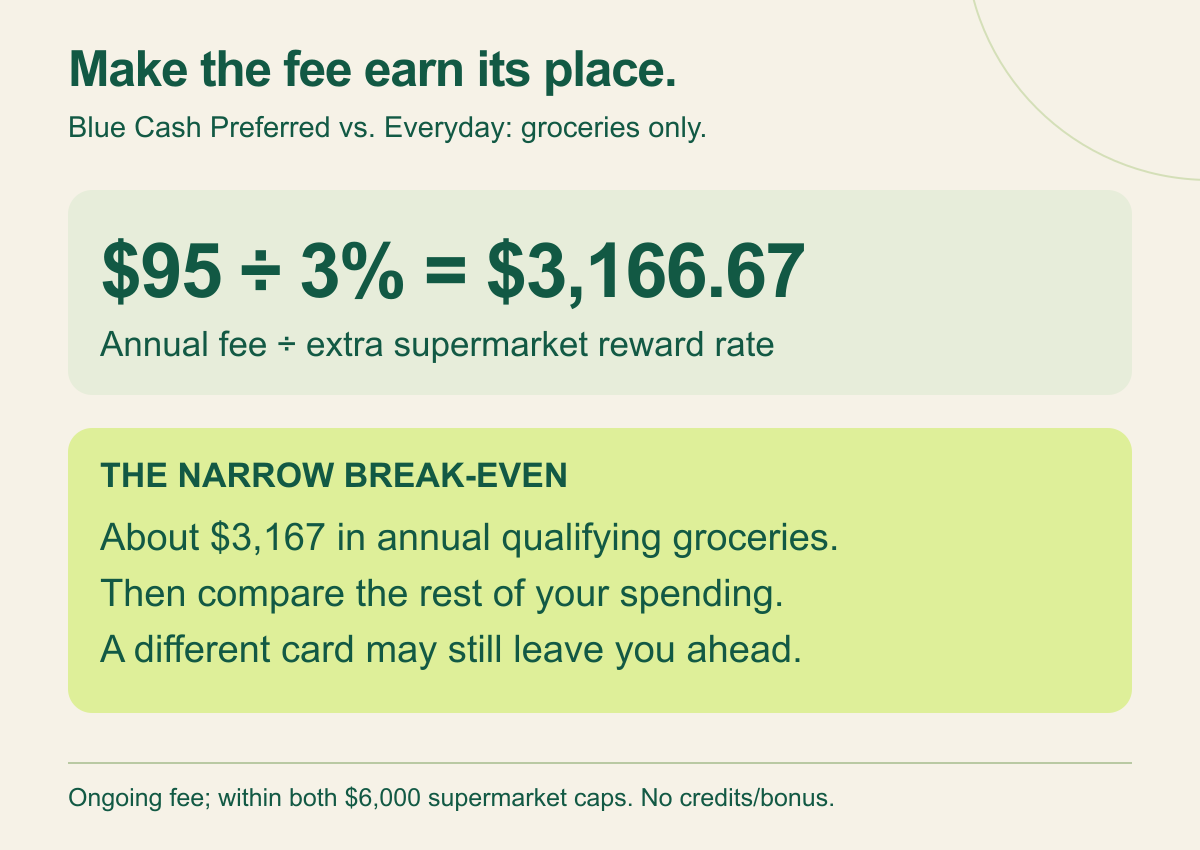
If every other reward and benefit difference is set to zero, Preferred adds three percentage points on qualifying supermarket purchases below the cap. Its grocery-only break-even against Everyday is:
$95 ÷ 3% = $3,166.67 per year, or about $264 per month.
| Annual qualifying supermarket purchases | Extra Preferred grocery reward before fee | After the $95 fee |
|---|---|---|
| $2,400 | $72 | −$23 |
| $3,600 | $108 | $13 |
| $4,800 | $144 | $49 |
| $6,000 | $180 | $85 |
| $9,600 | $180 | $85 |
The last row is important. Above $6,000, both cards earn 1% on additional qualifying supermarket purchases, so Preferred’s advantage over Everyday stops increasing. The higher advertised percentage is not an unlimited rate.
This is also a qualifying-supermarket calculation, not a total-food-budget calculation. Superstores and warehouse clubs are excluded under Amex’s supermarket definition. Amex categories
The complete budget can tell a different story
Our shared $24,000 annual household includes $4,800 qualifying supermarkets, $2,400 gas, $3,600 dining, $3,600 online retail including Amazon, $1,200 warehouse purchases and a specified mix of bills, streaming, transit and other spending.
| Card on the same household | Gross annual rewards | Recurring card fee | Net before optional benefits |
|---|---|---|---|
| Blue Cash Everyday | $456 | $0 | $456 |
| Blue Cash Preferred | $558 | $95 | $463 |
| Suitable flat 2% card | $480 | $0 | $480 |
| AAA Daily Advantage under the stated qualifying model | $516 | $0 | $516 |
Preferred leads Everyday by only $7 after the fee. Everyday’s online-retail category offsets part of Preferred’s supermarket, streaming and transit advantage. The full Amex comparison shows the ledger and the revised break-even for that non-grocery mix.
AAA Daily is another relevant free alternative under its own merchant definitions, cash access and shared $500 calendar-year reward cap across grocery, gas and wholesale categories. It should not be omitted simply because the fee comparison began with two Amex cards. AAA terms
These results are illustrations, not a claim that an editor personally earned those amounts. They keep planned spending identical, use cash values and exclude optional credits and opening bonuses so the ordinary fee decision remains visible.
A specialist role can justify a fee that a one-card role does not
Preferred used alone earns $463 after its fee in the shared household. Give it only the qualifying purchases where it earns more than a suitable 2% fallback, and the pair earns $621.40 after the same $95 fee.
That is $141.40 more than the single 2% card’s $480, or about $11.78 a month. The fee now has a clearer case because the fallback fixes the specialist’s weak ordinary return.
But compare free pairings too. Everyday plus the same fallback earns $588, leaving Preferred ahead by $33.40 annually. AAA Daily plus the fallback earns $666 under the stated eligibility and cap assumptions, ahead of Preferred’s pairing by $44.60.
The paid card can be worth its fee without being the highest-value available setup. That distinction helps you make a comfortable choice without treating “paid” as either automatically premium or automatically wasteful. The one-card or two-card guide explains each routing rule.
Credits are worth the spending they actually replace
A benefit advertised as “up to” a certain amount is a limit, not your personal savings. Ask whether you already buy the service, whether your billing method qualifies and whether the credit arrives at a useful time.
Preferred’s current qualifying Disney subscription credit is up to $10 monthly after enrollment. Everyday offers up to $7 monthly on related qualifying subscriptions. If a household already keeps an eligible monthly subscription costing at least $10 and uses every credit, Preferred’s incremental advantage is $3 a month, or $36 a year. Preferred credit Everyday credit
Add that $36 to Preferred’s $7 one-card lead over Everyday and the advantage becomes $43. Counting Preferred’s full $120 maximum while ignoring Everyday’s comparable $84 would overstate the difference.
If you would not otherwise subscribe, buying a new service to receive a credit does not create savings equal to the credit. Annual billing can also mean only one qualifying purchase month rather than twelve monthly credits. Third-party billing and unused months matter.
For travel benefits, use the same discipline. A lounge visit is worth what it realistically saves or adds for you, not automatically the advertised walk-in price. A hotel credit that requires a more expensive booking route needs the price difference deducted. Cash-back comparisons should not give one side optimistic travel valuations while keeping the other at cash value.
Separate annual card fees from other requirements
A card with no annual fee may still require a paid membership for the advertised rate. Prime Visa and Costco Visa are examples where the membership can be worthwhile independently, but it remains a separate decision. Count only the incremental cost attributable to the card choice, and count it once.
A qualifying bank balance is different from a fee. The deposit remains your asset under the account’s rules; the relevant costs are fees, foregone returns and restrictions created by keeping it there. Our relationship-rewards guide compares those costs with the added reward.
Foreign fees and bill-payment charges can also change the result. If a paid card has a useful fee waiver for purchases you already make, that saving belongs in the comparison. If another free card provides the same waiver, only the difference is attributable to paying the annual fee.
The no-annual-fee cost guide helps identify those conditions before you assume the annual-fee line is the whole price.
The welcome offer belongs to the first year
Preferred’s reviewed offer has a $0 first-year annual fee and a public prospect bonus advertised as high as $300 after $3,000 in qualifying purchases in six months from account opening. The actual offer can differ; a separate observed member channel showed $150 with the same spending requirement and period. Preferred prospect terms Observed member terms
On the shared household, ordinary gross rewards of $558 plus a received-and-earned $300 offer would produce $858 in the fee-waived first year. With the observed $150 offer, that conditional total would be $708. Without a bonus, it would be $558.
In an ordinary later year, the same purchases produce $463 after the $95 fee before optional benefits. Those are different years with different conditions, not a permanent $858 annual benefit.
Use planned purchases to meet any bonus requirement. Spending more solely to make a fee card’s opening offer look attractive can erase the benefit before the first renewal arrives. The welcome-bonus guide shows how to check the threshold and deadline.
Give renewal a short, honest review
About a month before an expected renewal, gather the last year’s rewards, credits actually used and any fees. Then estimate the coming year rather than assuming the past repeats exactly.
- Identify a suitable alternative and calculate what it would earn on the same purchases.
- Remove the opening bonus and any fee waiver that will not repeat.
- Include only benefits you expect to use without unwanted spending.
- Subtract the recurring fee and other added costs.
- Decide whether the remaining advantage is large enough for the account’s work and restrictions.
If the result is negative or marginal, ask the issuer about available product changes and their terms. Confirm effects on rewards, benefits, fees, credit line and offer eligibility before accepting. Do not assume a downgrade automatically refunds a posted fee or an upgrade receives a new-account bonus.
If you are carrying interest-bearing debt, borrowing costs may be the more important problem. Start with the interest guide before spending time defending a small rewards advantage.
Frequently asked questions
Is any annual fee automatically a bad deal?
No. A paid card can provide more usable incremental value than it costs. Compare it with a suitable free alternative on the same purchases and benefits.
Is earning more than the annual fee enough?
No. The alternative would also earn rewards. Subtract that value before deciding whether the paid card adds enough to cover the fee.
Should I value every credit at its maximum?
No. Count only eligible benefits you would use without unwanted spending and only their advantage over the alternative. Unused credits have no realized value.
Does a great welcome offer justify keeping the card?
It can justify a first-year comparison if earned on planned purchases. Renewal needs a fresh calculation without the one-time offer or an expired fee waiver.
Can I switch to a no-fee version?
Ask the issuer what product changes are available and how they affect the account. Availability, fee treatment and offer eligibility are not guaranteed.
How we reviewed it: We used current issuer terms to illustrate incremental annual-fee value, compared suitable no-fee alternatives and specialist pairings, and separated optional benefits and offer channels from ordinary rewards. Calculations assume planned eligible purchases, cash redemption, no interest or returns and full statement payments that preserve the purchase grace period. Original publication history is retained; this rewrite does not imply review by the original author.
Sources & references5 sources
The issuer terms and other references behind this article.
- Observed Blue Cash Preferred member-channel $150 offer terms
- Blue Cash Preferred current application pricing, reward and benefit terms
- Blue Cash Everyday current application pricing, reward and benefit terms
- American Express eligible retail and rewards category definitions
- AAA Daily Advantage and Travel Advantage current rewards and conditions