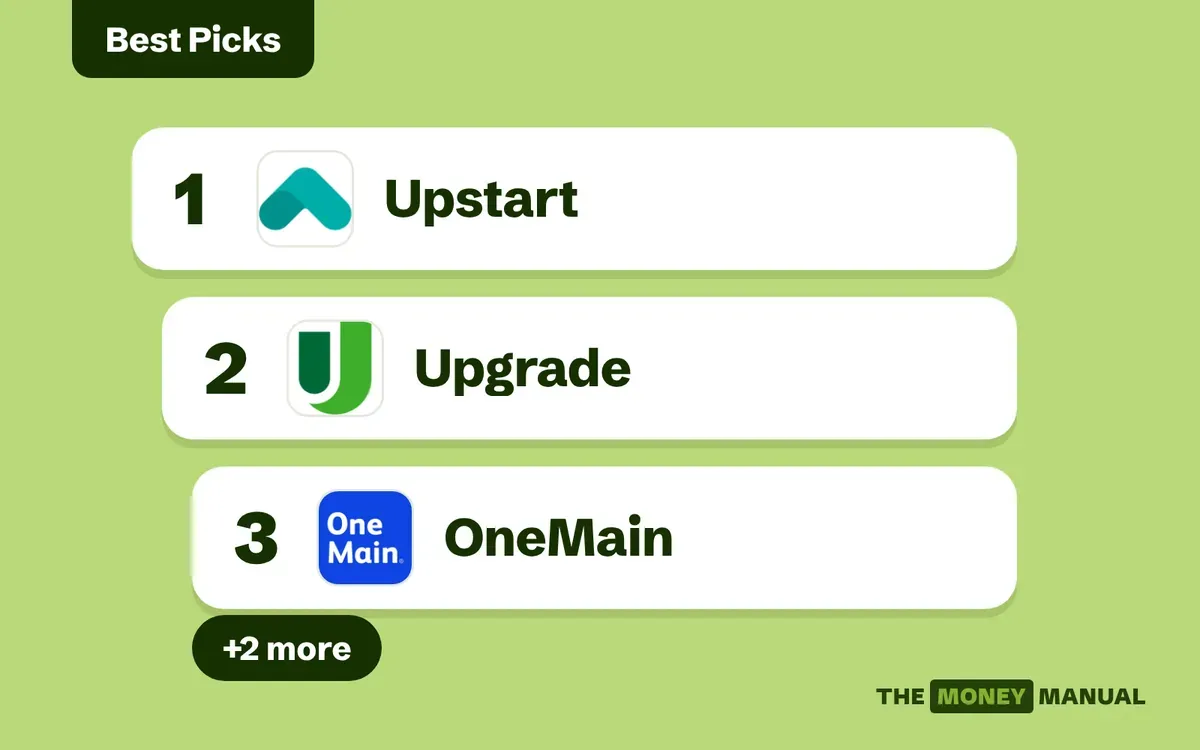
Our picks at a glance
 UpstartInspect the fee and the final lender
 UpgradeDo not confuse the loan amount with the payout
 OneMainWeigh collateral against affordability
 Happen BankCompare direct payoff with the cost of the new loan
- Credit unionsAsk about two different products
Jump to any pick for the full assessment, costs and conditions.
Start with these options, then compare actual offers
No lender below guarantees approval, and there is no universal “best” loan for a low credit score. We compared published product structures and fees rather than assigning invented approval odds. State availability, income, existing obligations, and the requested amount affect the result.
| Option | Why investigate it | Main tradeoff |
|---|---|---|
| Upstart marketplace | Online offer comparison that considers more than a score alone | Origination fees can reduce the cash deposited; lender underwriting still applies |
| Upgrade | Published installment-loan structure and debt-payoff options | Origination fee must be included in the cost comparison |
| OneMain Financial | Secured and unsecured structures worth examining | State-specific charges and possible vehicle collateral |
| Happen Bank, formerly LendingClub | Fixed-rate loans and a direct-creditor payment option | Approval and fees depend on the offer; a lower payment can reflect a longer term |
| A credit union's small personal loan | Existing membership or local underwriting may offer a useful comparison | Membership and lending requirements vary |
| A participating federal credit union's payday alternative loan | A structured alternative for smaller borrowing needs | Not every credit union offers the product or approves every member |
| A creditor hardship arrangement | May solve an existing bill without a new loan | The creditor decides available terms; get reporting and cost details |
This list deliberately includes alternatives outside an affiliate application funnel. If you only need a few hundred dollars, a several-thousand-dollar personal loan may be the wrong product even when a lender approves it.
Upstart: inspect the fee and the final lender
Upstart is a marketplace; its participating financial institutions make the loans. Its rate check begins with a soft inquiry, with a hard inquiry later if you proceed. Published disclosures explain that the offer depends on the applicant and that origination fees can be deducted from proceeds. Source: Upstart disclosures.
The potential value is another underwriting perspective when a conventional lender has declined you. That is different from a promise that a low score will be overlooked. Check which institution is making the loan, its final agreement, the net deposit, and any security interest. Compare the offered APR rather than a marketing claim about how its model performs on average.
Upgrade: do not confuse the loan amount with the payout
Upgrade's current help page lists an origination fee of 1.85%–9.99%, deducted from the loan before funds are sent. The specific offer determines the applicable charge. Source: Upgrade origination fee.
A deducted fee deserves particular attention when you are covering a fixed bill. A hypothetical $5,000 loan with an 8% deduction delivers $4,600. If the bill is $5,000, the shortfall has not been solved. Asking for more increases the obligation. For consolidation, verify whether the money goes to creditors directly and whether it covers each payoff completely.
OneMain: weigh collateral against affordability
OneMain publishes state-dependent origination charges and offers loans with different collateral arrangements. Larger amounts may require an eligible vehicle lien, and the provider's stated requirements still include an ability to repay. Source: OneMain fees and requirements.
This option deserves closer examination when you want to understand a secured offer alongside an unsecured one. It is a poor fit if pledging a vehicle puts essential transportation at unacceptable risk. Obtain both the payment and the amount of cash after fees. Our OneMain review explains the documents and scenarios to assess before accepting.
Happen Bank: compare direct payoff with the cost of the new loan
Happen Bank, the current name on the former LendingClub personal-loan materials, publishes fixed-rate personal loans, potential origination charges, and an option to send funds to creditors. Source: Happen rates and fees.
Direct payment can reduce the administrative burden of paying several accounts, but it does not establish savings. Compare your old debts' remaining repayment with the new offer, including its fee and term. A lender paying a card balance does not prevent new charges from rebuilding it.
Credit unions: ask about two different products
Ask a credit union about its ordinary small-dollar personal loan and whether it offers an NCUA payday alternative loan. Those are not necessarily the same product. The NCUA describes PALs programs, but availability depends on the credit union.
Explain the cash amount needed, membership status, and repayment source. Request a written cost comparison rather than assuming a credit union must be cheapest. A modest loan that fits your need can be more practical than meeting a larger lender's minimum by borrowing extra.
Evaluate the offer with a three-part test
First, does it solve the actual expense? Compare net proceeds with the bill, not the approved principal with the bill. If a fee is financed or deducted, write that treatment down.
Second, can you sustain the payment? Use reliable take-home income after housing, food, utilities, transportation, and existing required payments. Keep a buffer for irregular expenses. A payment that depends on overtime you do not consistently receive is not a stable plan.
Third, is there a less costly way to solve the same problem? Ask the medical provider, utility, mechanic, or existing creditor about payment arrangements. Compare postponing part of an expense or using a smaller amount of savings without wiping out emergency cash.
For a hypothetical $4,000 need, a $4,000 loan with a $300 deducted fee leaves $3,700. If a provider instead accepts four payments of $1,000 with no added charge, that arrangement avoids borrowing cost but requires a much higher monthly payment. Cost and affordability must both pass.
What a low score does not tell you
A low score may reflect missed payments, high revolving balances, a limited file, or an error. Those are different circumstances. Review the reasons in any denial notice and check your reports before submitting repeated applications. If an incorrect account is driving the decision, another expensive application may be less useful than correcting it.
Avoid treating a cosigner as a shortcut. The other person can become responsible for the debt, and their ability to borrow may be affected. Discuss the payment plan and what happens after income loss before either person signs.
A secured offer also requires an asset-risk calculation. Ask yourself whether you could still work and pay essentials if the pledged vehicle became unavailable. A lower interest rate cannot answer that question.
When to stop shopping for another loan
If every available offer consumes money needed for essentials, the problem is not a shortage of lender names. Investigate bad-credit consolidation alternatives or nonprofit credit counseling. If income has stopped, use assistance resources first.
Be especially cautious of guaranteed-approval ads, pressure to pay by gift card, and offers that hide the lender until after collecting sensitive information. Read the state's licensing information and the real agreement. A prominent “approved” message is not a substitute for understanding the repayment.
Frequently asked questions
What is the easiest personal loan to get with bad credit?
There is no dependable universal answer. Underwriting and state rules vary. An easier approval can also come with higher cost or collateral risk, so compare the actual terms rather than approval marketing.
Is a soft rate check a guarantee?
No. Verification, a later hard inquiry, income documents, or other conditions can change the outcome. Save the preliminary offer, but rely on final disclosures before accepting.
Can a loan help rebuild my credit?
Reported on-time payments may help over time, but no score increase is guaranteed. Fees and interest are a real expense; borrowing solely to chase a score is not a substitute for correcting errors and paying existing obligations.
Should I accept a longer term to lower the payment?
Only after comparing the additional total cost and the alternative of not borrowing. A longer term can relieve cash flow, but it may keep you paying for an expense long after it is gone.
Are payday loans the same as payday alternative loans?
No. The NCUA's PALs framework applies to qualifying products at participating federal credit unions. Similar wording in an online advertisement does not establish that a lender follows that program.
Sources and method
This article uses published regulator and provider information, checked October 30, 2026. It is a research-based assessment; no loan application, borrowing, or customer-service test is claimed. Examples identified as hypothetical are editorial calculations, not offers.