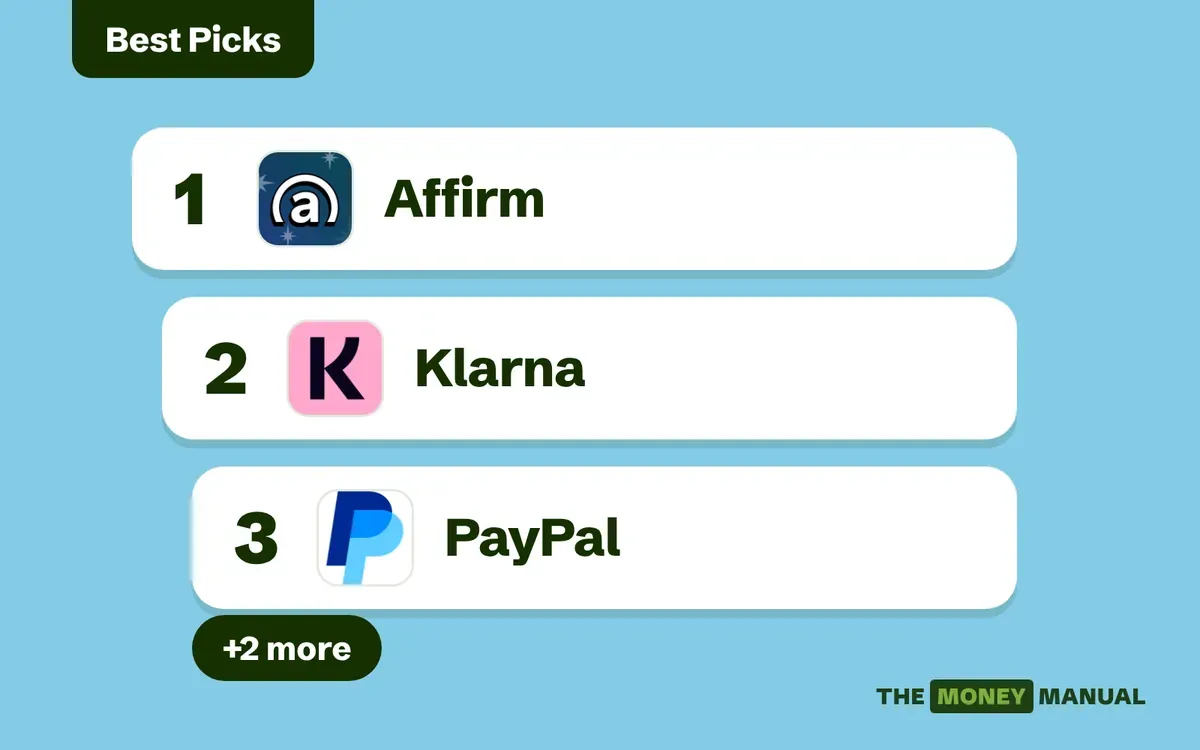
Our picks at a glance
 AffirmCompare the loan, not a single brand-wide rate
 KlarnaIdentify the product before comparing
 PayPalShort and monthly plans have different economics
 Afterpay“pay in four” does not always mean no finance charge
 ZipCompare the fee and APR together
Jump to any pick for the full assessment, costs and conditions.
How this comparison is organized
This shortlist covers five established US checkout and app-based options with materially different structures. We compare documented costs, repayment design, merchant access and practical limitations. We do not rank them by approval odds, promise that any applicant will qualify or assume that an app's maximum advertised capacity is a sensible spending target.
The terms shown at your checkout control. A provider may offer different products for different merchants, purchases or customers. Current source checks are dated October 30, 2026; revisit the offer before borrowing.
| Provider | Main distinction to inspect | Cost issue | Best comparison question |
|---|---|---|---|
| Affirm | Pay in 4 versus longer pay-over-time plans | 0% Pay in 4 differs from interest-bearing loans | What APR and total payments did I actually receive? |
| Klarna | Pay in 4, pay-later and monthly financing are distinct | Financing can carry interest; payment terms vary | Which product am I accepting and what happens if late? |
| PayPal | Pay in 4 versus Pay Monthly | Short plan is interest-free; monthly financing differs | Does the offered schedule fit existing obligations? |
| Afterpay | Partner Pay in 4 versus other transactions and monthly financing | Some transactions have finance fees; late fees may apply | Is this specific purchase genuinely fee-free if paid on time? |
| Zip | Short installment options with disclosed origination fees | A small dollar fee can produce a high APR | What is the full finance charge and repayment total? |
Affirm: compare the loan, not a single brand-wide rate
Affirm's current disclosures list Pay in 4 at 0% APR and other pay-over-time plans at 0%–36% APR, subject to eligibility. A down payment may be required. Its fee explanation states that it does not charge late fees, but that does not make every loan free or missed payments harmless.
Affirm is worth comparing when it is available for a planned purchase and presents a clear total cost. It is less appealing when the offered interest makes an optional purchase substantially more expensive or the payment period extends beyond the item's useful role in your life.
Read the full Affirm review for the distinction between checkout estimates, actual approval and refund handling. Keep your own affordability check separate from the provider's purchasing-power display.
Klarna: identify the product before comparing
Klarna's US product disclosure guidance distinguishes Pay in 4 from Pay in 30 and monthly financing. Its financing guidance lists a 0%–35.99% APR range for the described monthly product, with credit approval and other conditions.
The meaningful comparison is the agreement presented for your transaction. Do not carry an interest-free description from one Klarna product over to every other plan. Check initial payment, fees, credit information and the process for an order problem.
Our Klarna review focuses on these decisions. If you cannot clearly identify the product and total repayment before accepting, pause the purchase rather than relying on the familiarity of the logo.
PayPal: short and monthly plans have different economics
PayPal's current US page lists Pay in 4 for eligible purchases from $10 to $2,000, with the first payment at purchase and three later interest-free payments. It describes no late fees. Pay Monthly is a separate product with different terms and potential interest.
PayPal may be convenient if it is already a supported checkout method, but convenience is not an affordability test. Review the available plan, merchant eligibility and any restrictions before assuming the option will appear or be approved.
Eligible purchase protection has conditions. Read those conditions and keep order records. Do not assume the presence of a payment platform guarantees that every dispute ends in a refund.
Afterpay: “pay in four” does not always mean no finance charge
Afterpay's US cost page says partner-merchant Pay in 4 is free when paid on time, while certain non-partner single-use or gift-card transactions can have finance fees. It also describes possible late fees and separate monthly financing.
That distinction matters when moving from a merchant checkout to an app-based purchase elsewhere. Do not assume the cost of one route carries over to another. Read the final disclosure before authorizing the transaction.
Afterpay's payment guidance describes hardship support and restrictions on new purchases after a missed payment. Contact the provider early if the schedule stops being workable; another purchase is not a solution to an existing shortfall.
Zip: compare the fee and APR together
Zip's US disclosures illustrate how an origination fee contributes to the total repayment and APR. Its displayed examples vary by repayment option and purchase amount. The fee shown at your checkout matters more than a remembered flat fee from an older review.
A short repayment period can make a modest fee look small in dollars while producing a high annualized rate. Both perspectives are useful: the dollar charge tells you what this purchase costs, while APR helps compare credit products.
Zip may offer a route for an eligible transaction where another provider is unavailable. That is not a reason to accept costly financing for an optional purchase. Compare waiting or choosing a lower-cost item before choosing a provider simply because it approves the transaction.
Use one worksheet for every offer
Record purchase amount, down payment, number of installments, dates, APR, finance charge, required fees and total payments. Add the remaining balances of every existing plan. Check whether any payments fall before the next dependable income arrives.
In a hypothetical comparison, Plan A divides a $400 purchase into four $100 payments with no finance charge. Plan B requires total payments of $408 for the same purchase and timing. Plan B costs $8 more. Whether either is affordable still depends on the household's other obligations.
If a longer plan lowers the payment, compare the additional total cost and time committed. A $40 payment for many months can be less flexible than a larger short schedule, even though it feels easier at checkout.
Credit effects need an exact-product check
Application inquiries, account reporting, payment history and collections are different. A statement that a soft check does not affect a score is not a promise that the entire borrowing relationship has no credit consequences.
Read the provider's current disclosure and ask about the exact product if unclear. Do not use an old brand-wide “no credit impact” claim as a reason to borrow. Approval may be evaluated for each purchase, and prior use does not guarantee a new approval.
Refunds and disputes can outlast the shopping decision
Follow the merchant's return process and the lender's reporting process. Keep proof and verify any payment pause or adjustment in writing. A returned item, store credit and a lender refund are different outcomes.
The CFPB withdrew its 2024 BNPL interpretive rule in May 2025. Do not assume every BNPL arrangement automatically has the same protections as a conventional credit card. Product terms, applicable law and the type of problem matter.
If reliable dispute handling is important to the purchase, compare payment methods before paying. Our BNPL versus credit-card guide explains that tradeoff.
When to choose none of these apps
Delay the purchase if the installments would use money already needed for essentials, depend on uncertain income or add to a growing stack of plans you cannot track. A sale ending soon does not change that arithmetic.
For an essential purchase, compare repair, a suitable lower-cost replacement, assistance or a directly negotiated payment arrangement. Evaluate each option's actual terms. If an existing payment is already at risk, use the missed-payment steps before taking on more obligations.
Frequently asked questions
Which BNPL app is cheapest?
The cheapest eligible offer is determined by the specific APR, fees and total repayment, not the brand alone. Several products can be interest-free while other products from the same provider are not.
Which app approves everyone?
None should be presented that way. Eligibility, merchant rules and transaction-level checks apply, and an advertised limit is not a promise.
Can I use several providers at once?
That can create overlapping obligations. Track the combined balance and dates; one provider's approval may not reflect everything owed elsewhere.
Is no late fee the same as no consequence?
No. A missed payment can still affect account access, collection activity or credit depending on the agreement and circumstances.
Does BNPL save money?
Splitting a purchase changes timing. Savings come only from a genuinely lower total purchase or financing cost compared with a suitable alternative, not from the installment format itself.
Sources
- Affirm consumer disclosures. Checked October 30, 2026.
- Affirm: Why Affirm. Checked October 30, 2026.
- Klarna US financing disclosure guidance. Checked October 30, 2026.
- Klarna: US Pay in 4 and Pay in 30 disclosures. Checked October 30, 2026.
- PayPal US: Buy now, pay later. Checked October 30, 2026.
- Afterpay US: Costs. Checked October 30, 2026.
- Afterpay: Payment and hardship process. Checked October 30, 2026.
- Zip US product disclosures. Checked October 30, 2026.
- CFPB: BNPL regulatory resources. Checked October 30, 2026.