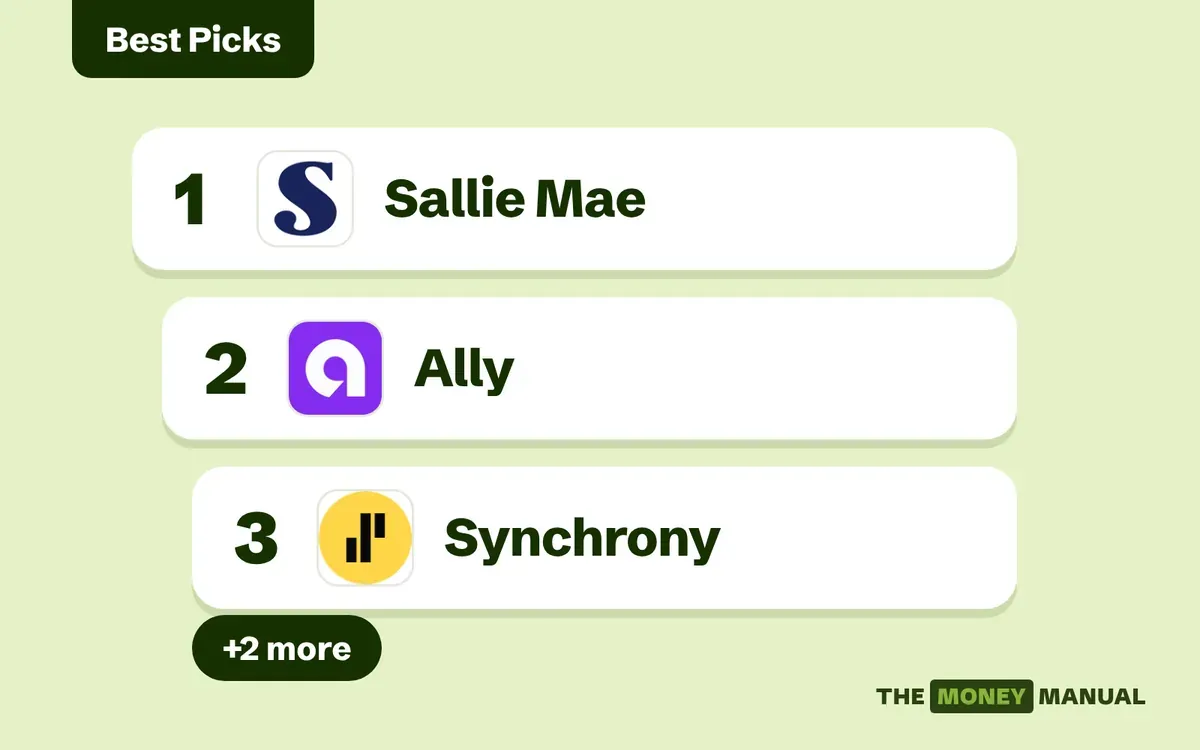
Our picks at a glance
 Sallie MaeA rate-and-checkwriting candidate
 AllyBroader payment access, with a withdrawal policy
 SynchronyAccess features without a minimum balance
 Navy FederalMembership and the dividend threshold matter
 CITCompare with its savings products before choosing
Jump to any pick for the full assessment, costs and conditions.
What we compared
Official product and rate pages were checked October 30, 2026. We considered minimums, applicable APY, checks or card access, transaction rules and institutional eligibility. This is a practical shortlist rather than an exhaustive national rate ranking.
This comparison evaluates published account terms checked October 30, 2026; it does not measure support or transfer speed.
| Account | Rate observation | Opening/balance point | Access point |
|---|---|---|---|
| Sallie Mae Money Market | 3.60% APY observed October 30 | No opening or ongoing minimum listed | Checkwriting and transfers |
| Ally Money Market | 3.20% APY dated October 29 | No opening minimum or monthly maintenance fee | Debit card, checks and ATM access; limits on certain withdrawals |
| Synchrony Money Market | Check current APY with provider | No minimum deposit/balance or monthly fee listed | Checks and optional ATM access |
| Navy Federal Money Market Savings | Tiered; no current rate quoted here | At least $2,500 needed to earn ordinary MMSA dividends | Checks and account access for eligible members |
| CIT Money Market | 1.55% APY observed October 30 | $100 opening minimum | Verify supported payment features for intended use |
Rates are variable, fees may reduce earnings, and product rules can change. A money market account should not be assumed to have the same features at every institution.
Sallie Mae: a rate-and-checkwriting candidate
Sallie Mae's rate table showed 3.60% APY with no minimum balance to open or earn that APY. Its product page describes checkwriting, transfers and no monthly maintenance fee, while noting a charge for outgoing wires.
This is useful for someone who wants a savings-style account with the ability to write occasional checks. It can reduce an extra transfer step when the account's rules fit the payment.
Do not turn occasional check access into an assumption of unlimited everyday checking. Read the agreement, transfer limits and funds-availability rules. Keep a separate operational buffer if a payment cannot wait for a new deposit to become available.
Ally: broader payment access, with a withdrawal policy
Ally's rate page showed 3.20% APY and described checks, a debit card and ATM access. It also limits certain withdrawal and transfer types to ten per statement cycle, while distinguishing ATM withdrawals and noting consequences for repeated excess activity.
That combination can suit a reserve you occasionally spend directly. It is less suitable if you intend to run every household transaction through the account. Use an ordinary checking product for frequent payment activity when that is the better fit.
Ally also offers other deposit products, which can simplify an existing customer's setup. The convenience should be weighed against the dollar difference in yield, not treated as either automatically superior or irrelevant.
Synchrony: access features without a minimum balance
Synchrony's money market page lists no opening minimum, ongoing minimum or monthly fee, with checks and an optional ATM card. It also describes limits on ATM-fee reimbursement and separate charges for some services.
This can be worth comparing for a small reserve or someone who values cash access without maintaining a particular balance. Find the actual ATM route near you and distinguish an ATM card from a full everyday debit-card feature set.
Check Synchrony's current APY with the provider before comparing earnings. Its checks and ATM access are useful features to weigh against any rate difference.
Navy Federal: membership and the dividend threshold matter
Navy Federal's savings FAQ says its ordinary Money Market Savings Account does not require an opening balance but needs at least $2,500 to earn dividends. It also describes a separate jumbo product with a $100,000 threshold for the jumbo rate and check access.
This distinction matters for an emergency balance. An account that can be opened with little money may still earn nothing below a dividend threshold. The minimum to open and minimum to earn are different decisions.
Navy Federal membership is limited to its eligible field. For a qualifying household already using the institution, the convenience may be useful. For an ineligible reader or a balance regularly below $2,500, start elsewhere.
CIT: compare with its savings products before choosing
CIT's product table showed its Money Market account at 1.55% APY with a $100 opening minimum. The same table showed higher listed savings rates for other CIT products, subject to their conditions.
That makes CIT a useful reminder: money market does not automatically mean higher yield than savings. If you do not need a feature unique to the money market product, compare the exact savings account at your balance.
Our CIT review explains Platinum's threshold and Savings Connect. Do not select an account purely because its name sounds more sophisticated or familiar.
The dollar value of access
Hypothetical example: A $20,000 balance at 3.60% APY earns $720 over a year if the rate remains unchanged. At 3.20%, it earns $640. The $80 difference is meaningful, but it must be weighed against the access features you use and any fees.
If the lower-rate account saves you a recurring $10 monthly cost elsewhere, the overall arrangement could leave you ahead. If you never use its extra features, the lower yield may have little justification.
For a $2,000 balance, the same 0.40-point gap is only $8 annually. A small maintenance or service charge can dominate the comparison. Use your actual balance and frequency of transactions.
Do not confuse an account with a fund
A money market mutual fund is an investment with a yield measure and risk structure different from a deposit account. It does not become FDIC-insured because a brokerage offers checkwriting.
The account-versus-fund guide explains APY versus fund yield, FDIC/NCUA versus brokerage protections, and redemption considerations. Keep fund products out of a deposit-account rate table unless the distinction is explicit.
If you are choosing between a deposit account and a CD, the main issue is flexible access versus a term commitment. Our money-market-versus-CD comparison develops that decision.
Insurance and account ownership
At an insured institution, qualifying money market deposits aggregate with your other deposits in the same ownership category. A separate checking account, savings account and CD do not automatically receive separate standard limits.
For a large balance, include accrued interest and identify the legal bank behind a brand or division. For a credit union, verify federal share insurance and membership. Use the insurance guide before depositing near a limit.
Insurance concerns institution failure. It does not guarantee a constant APY, immediate transfer access or reimbursement of every payment mistake.
A useful opening checklist
Confirm the applicable rate for your balance, the minimum to earn it, the monthly fee and the exact payment tools. Ask which withdrawals count toward any limit and what happens if it is exceeded. Check new-deposit holds, transfer caps and outgoing-wire costs.
Then fund with an amount that can tolerate the initial availability process. Test a small ordinary payment or transfer before relying on the account for a large bill. Retain the agreement and set reminders for any balance threshold you need to monitor.
Questions people ask
Does every money market account pay more than savings?
No. CIT's reviewed product table is a clear example of savings products listing higher rates than its money market account. Compare the actual product and balance conditions.
Can I use it like checking?
Only if its features and transaction rules fit the activity. Some accounts limit certain withdrawals or lack a full debit-card setup. Frequent bills may belong in checking.
Is there still a universal six-withdrawal rule?
Do not assume every institution uses the same limit. Providers can impose their own account policies; Ally's reviewed page, for example, describes ten for specified transactions. Read the current agreement.
Is a jumbo money market account automatically better?
No. The higher-balance threshold, rate and insurance aggregation all matter. A regular savings account can pay more without requiring a jumbo balance.
Why are some APYs missing here?
Rates can change, and some products use balance tiers or account-specific offers. Where the table directs you to the provider, obtain the APY for your exact product and balance before calculating earnings.