
In this article
Your credit card should fit the grocery run, the phone bill and the occasional takeout order. Those ordinary purchases are where a useful rewards routine lives.
The difficulty is that card pages rarely show the same household. One leads with a grocery rate, another with a welcome bonus, another with a return available only after a substantial banking commitment. Each can sound like the obvious winner until you put them on the same budget.
We have done that below. There is a quick shortlist by job, a consistent comparison of the 20 reviewed cards, and a wider-market screen so the choice is not limited to familiar names. The recommendation is allowed to be simple: keep one good card if the extra work is not worth the extra dollars.
Start with the job you need the card to do
| Your priority | Our starting shortlist | The question that decides it |
|---|---|---|
| One dependable everyday rate | Active Cash, Double Cash, PNC Cash Unlimited | Which earning, redemption, fee and application conditions fit you? |
| Qualifying groceries plus ordinary online shopping | Blue Cash Everyday and AAA Daily Advantage | Do your stores qualify, and how much room do the caps leave? |
| Groceries and restaurants with a short routing rule | Capital One Savor | Would its qualifying 3% categories improve enough purchases over your fallback? |
| A substantial qualifying supermarket budget | Blue Cash Preferred | Does its extra value exceed the ongoing annual fee and the best no-fee alternative? |
| Household bills | U.S. Bank Cash+ and available Elan Max Cash Preferred offers | Will category eligibility and payment fees leave you ahead? |
| Shopping tied to a membership you already use | Prime Visa or Costco Anywhere Visa | How much of the reward comes from a useful existing relationship? |
| An existing bank relationship | BofA rewards cards or Smartly | What is the extra reward after qualifying-account costs and foregone returns? |
These are starting points for different needs, not claims that every applicant qualifies or that one issuer wins for everyone. AAA Daily's category cap and Elan's partner-bank conditions are addressed below and in the linked category guides.
If you expect to carry an interest-bearing purchase balance, begin with rewards versus interest. A card that helps you repay at a lower total cost may do more for your finances than another percentage point of rewards.
Our comparison uses the same $24,000 household
The model spends $2,000 a month, evenly across the year. It is a worked example, not a claim about the average American household.
| Annual purchase group | Amount |
|---|---|
| Standalone supermarkets | $4,800 |
| Dining | $3,600 |
| Ordinary gas stations | $2,400 |
| Other online retail | $2,400 |
| Amazon | $1,200 |
| Warehouse purchases at Sam's Club | $1,200 |
| Utilities | $1,800 |
| Internet | $600 |
| Phone | $600 |
| Streaming | $360 |
| Drugstores | $240 |
| Transit | $600 |
| Other purchases | $4,200 |
| Total | $24,000 |
The groups do not overlap. Amazon and other online retail can combine to $3,600 for a card whose online category covers both. Warehouse spending remains separate from standalone supermarkets. The common warehouse is Sam's Club so the purchase basket can be compared across networks; the Costco card still requires its own Costco membership.
There are no travel-portal bookings, Costco gas purchases or entertainment tickets in the base basket. Optional credits, insurance claims and travel-transfer valuations receive $0. We assume eligible planned purchases, no returns or added payment fees, and full on-time payments that preserve the purchase grace period.
A suitable 2% card earns $480. That is our benchmark. Every extra half percentage point across the entire budget adds $120 annually. Every extra percentage point on only $1,000 adds $10. Keep those dollar scales in mind when a headline rate catches your eye.
What the 20 reviewed cards earn on that budget
This table compares ongoing annual cash value, before welcome bonuses and temporary first-year boosts. Membership costs are treated as already useful elsewhere unless the note says otherwise; the ongoing Blue Cash Preferred annual fee is deducted.
| Card | Modeled annual value | What drives the result |
|---|---|---|
| Wells Fargo Active Cash | $480 | 2% on eligible purchases |
| Citi Double Cash | $480 | Purchase and eligible-payment stages completed; cash value used |
| Chase Freedom Unlimited | $417.60 | 3% dining/drugstores, 1.5% ordinary fallback |
| Chase Freedom Flex | $376.80 | $1,500 total annual rotating-category spending, plus permanent categories |
| Capital One Quicksilver | $360 | Ordinary 1.5% rate |
| Capital One Savor | $415.20 | $8,760 in qualifying 3% food/streaming categories; 1% elsewhere |
| Discover it Cash Back | $300 | $1,500 total annual rotating-category spending; first-year match excluded |
| Blue Cash Everyday | $456 | Separate grocery, gas and online-retail caps |
| Blue Cash Preferred | $463 | Grocery/streaming/gas/transit rewards, less $95 ongoing fee |
| BofA Customized Cash Rewards | $372 | Dining selected; ordinary rates without a relationship bonus |
| BofA Unlimited Cash Rewards | $360 | Ordinary 1.5%, without a relationship bonus |
| U.S. Bank Cash+ | $398.40 | Utilities and TV/internet/streaming at selected 5%; groceries at selected 2% |
| U.S. Bank Smartly | $480 | Base 2%, with no qualifying-balance uplift |
| U.S. Bank Altitude Go | $423.60 | Dining below the quarterly cap; points redeemed to an eligible deposit at full cash value |
| PNC Cash Rewards | $383 | Shared $8,000 rewards-program-year cap applied in the stated order |
| PNC Cash Unlimited | $480 | Ordinary 2%, without TotalRewards uplift |
| Costco Anywhere Visa | $384 | Ordinary eligible gas and dining; no Costco gas in this basket |
| Prime Visa | $354 | $1,200 qualifying Amazon spending; much of the budget earns 1% |
| PayPal Cashback Mastercard | $405 | $3,000 qualifying PayPal transactions; remaining purchases at 1.5% |
| Venmo Credit Card | $396 | Stable statement-period ranking: Grocery first, Dining second |
Each linked review shows its calculation and issuer sources. Rate support includes Wells Fargo, Citi, Chase Unlimited, Flex, Quicksilver, Savor, Discover, Amex Everyday, Preferred, BofA Customized, BofA Unlimited, Cash+, Smartly, Altitude Go, PNC Cash Rewards, Cash Unlimited, Costco, Prime, PayPal and Venmo.
The rotating-card examples assume $1,500 of the existing annual basket qualifies for activated 5% categories, within each quarter's cap and outside Flex's permanent dining and drugstore categories. That is a hypothetical allocation, not a forecast of future calendars. PayPal's $3,000 qualifying checkout share consists of the $2,400 other online retail plus $600 of Other purchases; Amazon is not assumed to accept that checkout route.
For PNC Cash Rewards, the model begins a rewards-program year in month one, with each month's gas assigned its Reward Date first, dining second and supermarkets third. The issuer uses Reward Date, which can occur after posting, to allocate rewards to the program year. That shared cap is why a calculation that applies 4%/3%/2% to the entire annual basket would be wrong. PNC allocation rules
The table is not a league ranking. It shows how one budget interacts with different rules. A card near the bottom can still be useful for a narrow job, while a card near the top can be unsuitable because of access, fees or redemption.
For one card, look beyond the 2% headline
Active Cash, Double Cash and PNC Cash Unlimited reach the same ordinary total here through different arrangements.
Active Cash's straightforward purchase reward is easy to use as a domestic baseline. Double Cash divides earning between purchases and eligible payments. That does not require paying interest: full qualifying payments can complete the ordinary reward. PNC Cash Unlimited combines 2% with no foreign transaction fee and no minimum cash redemption, but requires approval for at least a $5,000 credit line.
Our Active Cash versus Double Cash comparison explains the payment accounting. The no-annual-fee guide considers the costs that remain after the annual fee is zero.
The wider market deserves a look too:
| Additional flat-rate candidate | Why it belongs in the comparison | Condition to check |
|---|---|---|
| Fidelity Rewards Visa Signature | 2% value when deposited into an eligible Fidelity account | You need an open, funded eligible Fidelity account for this cash value. Fidelity |
| Bread Cashback American Express | 2% with no annual or foreign transaction fee | Network acceptance and the available cash route. Bread |
| Synchrony Premier Mastercard | 2% credited automatically to the statement | Rewards arrive as statement credit; the 3% foreign transaction fee matters abroad. Synchrony |
| Navy Federal cashRewards Plus | 2% for eligible members approved for the Plus version | Membership and at least a $5,000 line; lower-line cashRewards earns 1.5%. Navy Federal |
| PenFed Power Cash Rewards | 2% with Honors Advantage rather than ordinary 1.5% | Qualifying military or checking relationship. Free Checking requires a $500 minimum daily balance or $500 monthly direct deposits, with statement-cycle timing rules. PenFed |
Alliant's current public Visa Signature offer shows 1.5%. We would not carry an older 2.5% claim into a new-card decision. Alliant
Robinhood Gold Card is a different, access-dependent option: 3% ordinary rewards with an annual $50 Gold subscription and a waitlist/invitation process. At $24,000, the simple result is $720 gross or $670 after a subscription bought solely for the card. Full cash value requires the appropriate cash route to a Robinhood brokerage account; statement credits can be worth less. New accounts opened on or after July 1, 2026 face a 3% foreign-currency transaction fee under current guidance. Gold Card access, redemption and fee conditions
That could be attractive to an eligible reader, but it is not interchangeable with an immediately available, unrestricted 3% cash offer. Access and the whole account arrangement belong beside the rate.
For groceries and dining, compare the whole food routine
Savor is appealing when qualifying supermarket and restaurant purchases are both substantial. The rule is easy to remember, but a sole-card calculation still includes 1% on much of the remaining budget. Here, it earns $415.20 alone and $567.60 when paired appropriately with 2% elsewhere.
Blue Cash Everyday covers a different routine: qualifying U.S. supermarkets, gas stations and online retail, each with its own annual cap. That makes it useful for a household whose food budget is only one part of several ordinary errands.
Blue Cash Preferred's supermarket rate is higher, but the ongoing fee and Everyday's online-retail reward narrow the gap. In this budget, Preferred earns only $7 more when used alone. With suitable 2% fallbacks, the gap is $33.40. That is a better decision frame than comparing 6% with 3% in isolation.
AAA Daily Advantage is a strong additional grocery candidate for this basket: 5% on qualifying groceries and 3% on gas, wholesale clubs, streaming and pharmacy purchases. It has no annual or foreign transaction fee, and AAA membership is not required. Groceries, wholesale clubs and gas share a $500 calendar-year reward cap, not a universal $10,000 mixed-spending allowance; those categories earn 1% afterward. Cash can go to statement credit or direct deposit. AAA rates, cap and redemption
Here, $4,800 of groceries earns $240, and $4,200 across the qualifying 3% groups earns $126. The shared-cap categories contribute $348, below their $500 limit. The remaining $15,000 earns $150 alone or $300 on a suitable 2% fallback, producing $516 alone or $666 paired. That is worth a look if your stores qualify.
Use the grocery shortlist to start with the stores you use, then the dining guide if restaurants are a separate priority. A supermarket bonus is not automatically a Walmart, Target or warehouse bonus.
For gas and household bills, the payment route can decide the winner
Costco Anywhere Visa can be compelling for qualifying Costco gas, particularly with an independently useful membership. PNC Cash Rewards gives gas and dining a focused job within a shared annual allowance. AAA Travel Advantage offers another fuel option, with a separate $350 calendar-year reward cap on its 5% gas/charging category. The gas comparison puts those caps and station exclusions side by side. AAA fuel terms
Two other fuel candidates need different treatment. U.S. Bank Altitude Connect earns 4 points per dollar on the first $1,000 of eligible gas/EV purchases each quarter; station exclusions and the cash-redemption route matter. PenFed Platinum Rewards advertises 5 points on fuel and EV charging, but we have not verified a comparable full-value cash route. We therefore do not turn that points headline into a 5% cash recommendation. Altitude Connect PenFed Platinum
The pump price comes first. On a $60 purchase, a three-percentage-point reward advantage is $1.80. That is the additional value available to offset a detour or price difference–not proof that the higher-rate station is cheaper.
Cash+ can give selected utility and TV/internet/streaming bills a useful role, provided you activate the categories and stay within their combined quarterly allowance. Elan Max Cash Preferred offers through participating banks also merit a look for bills, with the specific bank's terms checked. Wells Fargo Autograph includes eligible phone plans and streaming among its useful cash-valued categories. Elan example Autograph
A biller charging 3% to accept a card can consume most or all of the benefit. A lost phone autopay discount can do the same. The recurring-bill guide asks which bills qualify; the payment-fee guide asks whether the final cost improves.
A second card should earn its extra work
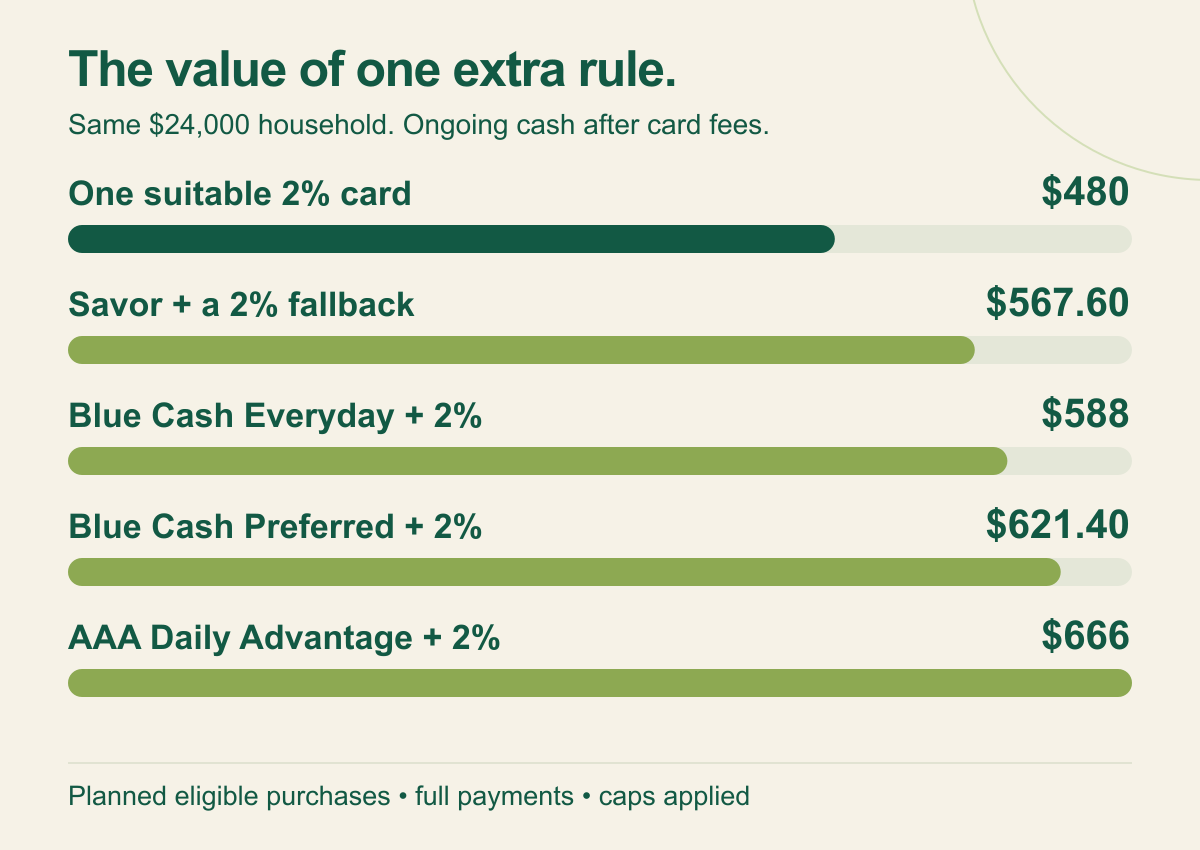
For this household, several simple pairings improve on $480 at 2%:
| Specialist plus a suitable 2% fallback | Ongoing annual value | Extra over one 2% card | Monthly equivalent of the extra |
|---|---|---|---|
| Savor | $567.60 | $87.60 | $7.30 |
| Blue Cash Everyday | $588 | $108 | $9 |
| Blue Cash Preferred, after its $95 fee | $621.40 | $141.40 | About $11.78 |
| AAA Daily Advantage | $666 | $186 | $15.50 |
The specialist receives only purchases that improve on the fallback, within relevant caps. Bonuses, optional credits and relationship uplifts are excluded. These are candidate arrangements for the stated budget, not instructions to open four cards.
Notice the scale: the strongest listed improvement is $15.50 a month. That is worth considering, but it should not require buying more, paying interest or spending hours rearranging tiny purchases. The one-card versus two-card guide helps make that judgment.
Bank relationships can help–if the banking itself makes sense
The base results for BofA's two cards and Smartly do not include relationship enhancements. Existing eligible customers can have better results, but the programs use different accounts, balances and timing rules.
BofA Rewards increases eligible base rewards by the applicable tier percentage. Customized's temporary first-year category boost is treated separately. PNC TotalRewards also multiplies base rewards: a 25% bonus on a 2% card produces 2.5%, not 27%. BofA program PNC program
Smartly's enhanced levels require qualifying checking/Safe Debit balances and Smartly Savings. Its bonus rates apply to the first $10,000 of eligible purchases each billing cycle, with exclusions such as insurance, taxes and third-party bill payments. An investment or savings balance cannot simply be substituted for the required eligible checking balance. Smartly terms
Suppose moving from 2% to 4% adds $480 a year on $24,000 of eligible purchases. If the required $100,000 earns one percentage point less than an otherwise suitable alternative, the $1,000 foregone annual return exceeds the card improvement. Tax treatment and other account benefits can affect a real decision; the simple comparison shows why the asset balance cannot be ignored.
The relationship-rewards guide compares the actual programs. We would first choose a suitable place for the money, then calculate what the card adds.
Store and wallet cards need a narrower comparison
Prime Visa and Costco Anywhere Visa make more sense when the membership already has independent value. Buying a $139 Prime membership solely for this model reduces Prime Visa's $354 reward to $215 before tax. Buying a $65 Costco membership solely for its card reduces the $384 result to $319. The actual shopping-specific scenarios in their reviews can be stronger. Also compare the no-Prime Amazon Visa: it earns 3% on qualifying Amazon and Whole Foods purchases without buying Prime. When deciding whether to buy the membership, its extra two percentage points deserve more attention than Prime Visa's full 5% headline. Amazon and Prime Visa terms
PayPal Cashback Mastercard depends on the qualifying checkout share. Venmo depends on category concentration each statement period. In our model, both trail 2% as the only card; each can improve a narrower subset of spending. The PayPal-versus-Venmo comparison shows where that changes.
Other store and wallet options belong in their appropriate niche. Apple Card's ordinary 2% depends on Apple Pay rather than every physical-card or card-number purchase. Instacart Mastercard's higher Instacart earning has a defined cap, while delivery costs and shopping prices affect the result. Target's eligible debit-card discount offers a useful comparison before opening store credit. Sam's Club Mastercard requires its own membership and reward-program analysis. Apple Instacart Target Sam's
Those products are not interchangeable with unrestricted cash-back rates. A store discount, cash reward and app credit can all help, but they need the same final-cost comparison.
Why some familiar names are outside the shortlist
Citi Custom Cash still appears in older comparisons, but Citi stopped accepting new applications on May 28, 2026. Existing cardholders can continue using it. That makes it worth reassessing if it is already in your wallet, rather than a card to recommend applying for today. Citi's availability notice
We also screened U.S. Bank Shopper Cash Rewards and Kroger-family cards. Shopper's former product page redirects to the card catalog, and we have not verified a current new-application offer. For Kroger-family cards, the current variant, earning limits and application conditions remain unresolved in our source checks. We leave both outside the numerical shortlist until those details are established; that is a research limit, not a claim that an existing card has stopped working. Shopper product route Kroger product route
This guide focuses on consumer cash-back decisions. Premium travel-transfer strategies, business spending and secured or rebuilding cards need different comparisons. Debit discounts and store loyalty programs appear where they can change the price you actually pay.
Keep the first year separate from the card you will keep
A welcome bonus can legitimately change the initial choice. It should not inflate the recurring reward estimate.
Active Cash's reviewed direct offer provides $100 after $500 of qualifying purchases post within three months. Double Cash's reviewed offer provides $200 after $1,500 in six months. Discover's first-year match can double the eligible first-year reward, but does not repeat in year two. See each review for the exact offer channel and conditions. Active Cash Double Cash Discover
Amex's reviewed prospect offers use “as high as” language, and a different observed member channel displayed lower fixed offers. The individual Everyday and Preferred reviews separate those channels rather than promising the maximum to every applicant.
Write down two results: what the first year could deliver under the offer actually available, and what an ordinary later year delivers. Use planned purchases only. The welcome-bonus guide helps check whether the deadline fits spending already in the budget.
How to make the final choice
Take recent statements and identify the stores, billers and payment methods that matter most. Pick a suitable flat-rate benchmark. Compare one specialist on the purchases it would actually receive, then subtract fees, lost discounts and any new membership or account cost.
Check when the reward becomes usable and where it goes. A statement credit, an eligible-bank deposit, a payment-app balance and Costco's annual certificate create different routines. If the process is awkward enough that rewards sit unused, a nominally higher rate may not feel like a better card.
Finally, choose the arrangement you can maintain comfortably. One card is a valid result. A second should have a clear job and a worthwhile annual improvement. Revisit the decision when your stores, expenses, membership or card terms change.
Frequently asked questions
Is a 2% card always the best cash-back card?
No. It is a useful benchmark. A qualifying category specialist or an already-useful bank relationship can produce more value, while fees or redemption restrictions can make a particular 2% product unsuitable.
Why can a 6% grocery card earn less than a 2% card overall?
The higher rate applies only to qualifying, capped purchases. Other spending may earn 1%, and an annual fee reduces the total. Compare the complete budget or give the grocery card a focused job.
Are welcome bonuses included in the main table?
No. It compares ongoing value. Temporary offers, first-year fee changes and matching promotions are evaluated separately in the product reviews.
Do I need to open a bank account to get a good rate?
Not necessarily. Some cards provide a useful ordinary rate without a relationship balance. Additional banking requirements deserve their own comparison of fees, returns and convenience.
Does a longer list mean a better recommendation?
No. A useful shortlist covers the plausible alternatives and explains why each fits or does not. This guide uses a wider market screen, but the reader's stores, access and costs determine the final choice.
How we evaluated this topic
We reviewed the issuer terms and sources linked below and compared modeled, planned household purchases at documented cash-redemption values. Examples distinguish introductory offers from ongoing value and show relevant caps, exclusions and costs. They are illustrations, not personal card-use claims or approval predictions.
Reviewed-card research refreshed September 15, 2026. Wider-market sources checked September 8–15, 2026.
Sources & references42 sources
The issuer terms and other references behind this article.
- Wells Fargo Active Cash product and rewards disclosures
- Citi Double Cash linked acquisition pricing and reward agreement
- Chase Freedom Unlimited current offer and reward rules
- Chase Freedom Flex offer, category calendar and reward rules
- Capital One Quicksilver Rewards product
- Capital One Savor Rewards offer and category definitions
- Discover it Cash Back offer and Cashback Match terms
- American Express Blue Cash Everyday product and benefit terms
- American Express Blue Cash Preferred product and benefit terms
- Bank of America Customized Cash Rewards acquisition page
- Bank of America Unlimited Cash Rewards acquisition page
- U.S. Bank Cash+ offer, categories and reward disclosures
- U.S. Bank Smartly current tiers, eligible balances and exclusions
- U.S. Bank Altitude Go earn caps and redemption conditions
- PNC Cash Rewards product and offer conditions
- PNC Cash Unlimited product and cash redemption conditions
- Citi Costco Anywhere Visa product and reward conditions
- Chase Prime Visa and Amazon Visa offers and reward terms
- Synchrony PayPal Cashback Mastercard rewards agreement
- Synchrony Venmo Credit Card rewards agreement and category definitions
- PNC Cash Rewards full agreement and Reward Date allocation rule
- Fidelity Rewards Visa Signature cash deposit requirements
- Bread Cashback American Express product details
- Synchrony Mastercard products and automatic statement rewards
- Navy Federal cashRewards and cashRewards Plus terms
- PenFed Power Cash Honors Advantage requirements
- Alliant Visa Signature current cash-back terms
- Robinhood Gold Card waitlist, Gold and fee conditions
- AAA Daily Advantage and Travel Advantage current rewards and conditions
- Fulton Bank Visa Max Cash Preferred current product
- Wells Fargo Autograph product and reward disclosures
- BofA Rewards current tiers, eligibility and benefits
- PNC TotalRewards terms effective June 27, 2026
- Apple Card earn channels and fees
- Chase Instacart Mastercard rewards and offer terms
- Target Circle Card discount rules including debit-card alternative
- Sam’s Club Mastercard reward program terms
- U.S. Bank Altitude Connect category, cap and redemption terms
- PenFed Platinum Rewards points and redemption options
- Citi Custom Cash new-application closure notice
- Former U.S. Bank Shopper product route, currently redirected to catalog
- Kroger-family product route; current acquisition conditions unresolved