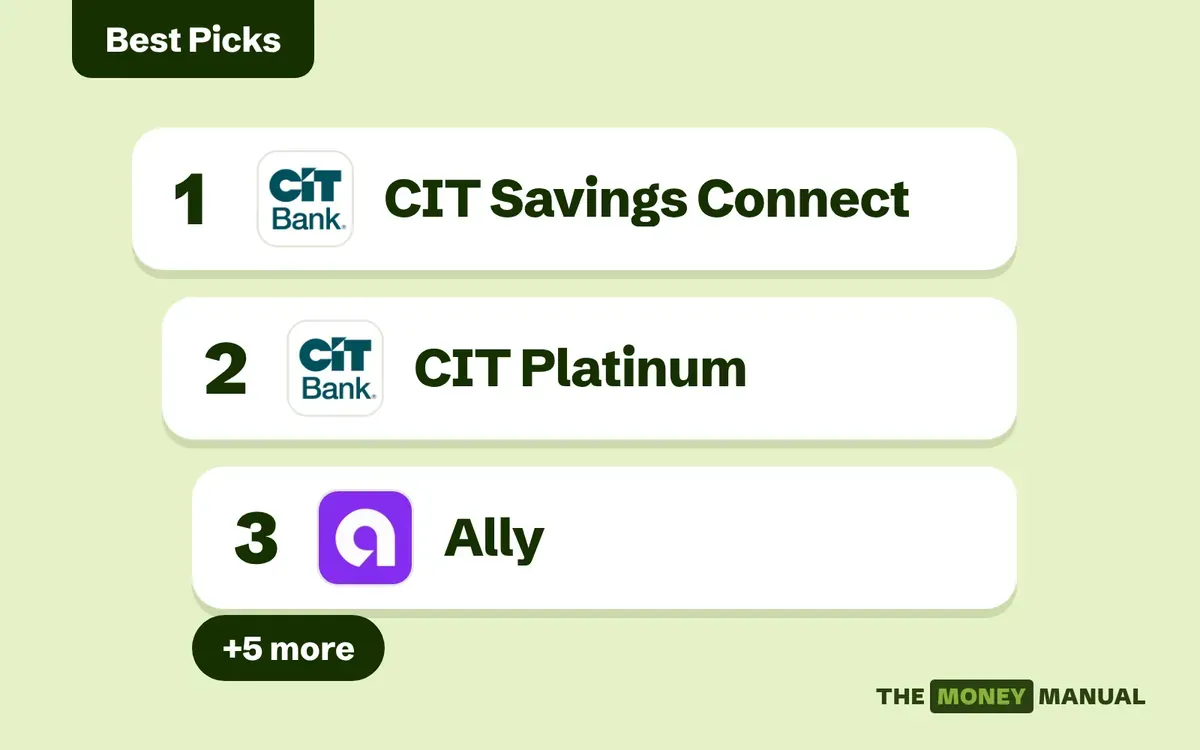
Our picks at a glance
 CIT Savings ConnectUseful when the balance fluctuates
- CIT PlatinumMore relevant for a stable larger balance
 AllyA broader online-bank setup
 MarcusFocused savings and CDs
 Capital OneCompare access as well as yield
 Live OakA separate reserve with a transfer plan
 RaisinA marketplace, with another structure to understand
 Wealthfront CashAn alternative, not an identical account
Jump to any pick for the full assessment, costs and conditions.
What this comparison covers
We reviewed official product pages on October 30, 2026. This is a decision shortlist, not an exhaustive claim to identify the highest rate available anywhere. It includes direct-bank savings options and separately identifies a marketplace and brokerage cash alternative because their structures differ.
This comparison evaluates published account terms checked October 30, 2026; it does not measure support or transfer speed.
| Candidate | Observed rate information | Why it belongs on the shortlist | Main condition or tradeoff |
|---|---|---|---|
| CIT Savings Connect | 3.65% APY observed October 30 | Simpler balance comparison than Platinum | $100 opening minimum |
| CIT Platinum Savings | 3.75% at $5,000 or more; 0.25% below | Stable balances above the threshold | Rate tier changes with daily balance |
| Ally Savings | 3.20% APY, provider date October 29 | Online checking-and-savings relationship | Institution limits certain savings withdrawals |
| Marcus Online Savings | 3.50% APY observed October 30 | Focused savings without a listed opening minimum | Separate transaction account still useful |
| Capital One 360 Performance Savings | Check current APY with provider | Low-fee banking with selected physical access | Confirm live rate and local services |
| Live Oak Personal Savings | Check current APY with provider | Dedicated savings without listed opening minimum | Transfer-based access, no debit card or checks |
| Raisin marketplace | Varies by selected product | Compare participating institutions through one platform | Custodial structure and external transfer process |
| Wealthfront Cash alternative | 3.55% base APY, provider date October 1 | Cash yield with eligible payment features | Brokerage sweep, not a direct savings account |
All quoted savings and cash rates are variable and subject to conditions. The last two rows are not represented as conventional direct-bank high-yield savings accounts.
CIT Savings Connect: useful when the balance fluctuates
CIT's official product table listed Savings Connect at 3.65% APY with a $100 opening deposit. It does not use Platinum's $5,000 rate threshold, making it a useful candidate for a reserve that may dip after an emergency.
The main benefit is avoiding a large change in applicable rate solely because the balance crosses that specific threshold. A slightly lower headline can be preferable when the account must remain useful after you spend some savings.
Compare the transfer workflow and full fee schedule, not only the APY. Our CIT review explains why the exact product name matters for existing and new customers.
CIT Platinum: more relevant for a stable larger balance
The same table listed 3.75% APY at a daily balance of at least $5,000 and 0.25% below. The opening minimum is not the same as the higher-rate threshold.
Hypothetical annual illustration: At an unchanged $10,000 balance and unchanged rates, Platinum's higher tier would earn $375 versus $365 for Savings Connect. The $10 difference is modest. At $4,000, the listed Platinum lower tier would earn $10 versus $146 at 3.65%.
That asymmetry is the decision. Choose using the lowest balance you realistically expect, not simply today's balance or the word Platinum.
Ally: a broader online-bank setup
Ally's rate page showed 3.20% APY for savings, dated October 29, with no opening minimum or monthly maintenance fee. It is worth comparing if you want savings alongside checking, money market and CD options at one online bank.
The convenience can justify a modest rate difference for someone who values fewer institutions. But savings is not unrestricted checking: Ally applies a limit to certain withdrawal types and can act on repeated excess activity.
Use the account for a savings role and keep the payment buffer in an appropriate transaction account. Do not assume internal transfer convenience eliminates new-deposit holds or every operational limit.
Marcus: focused savings and CDs
Marcus's official deposit information showed an Online Savings APY of 3.50% and no listed fee or minimum deposit in the reviewed navigation summary. It is a useful candidate for someone who wants savings separate from daily spending and may also compare CDs.
The focused role can be a benefit if it reduces the temptation to spend the reserve. It is a limitation if you want the same account to provide branch services, cash deposits and a debit-card routine.
Evaluate its actual transfer process and available funds before using the account for a dated expense. A savings provider does not need to replace checking to be useful.
Capital One: compare access as well as yield
Capital One's banking page describes no monthly fees or minimum balances for its consumer banking products. Its selected physical locations can be helpful for readers who want some in-person access alongside digital banking.
Check the current APY in Capital One's savings disclosure before comparing earnings. Use the rate for the exact account you would open or already hold.
Capital One remains relevant even without a rate ranking because access and low recurring cost are real decision criteria. Check the actual branch or café services near you rather than assuming every location performs every banking task.
Live Oak: a separate reserve with a transfer plan
Live Oak's personal savings page lists no monthly maintenance fee or opening minimum, and no debit card or checks. Its official FAQ distinguishes deposit methods and holds, so the way money enters matters to availability.
This can suit savings you do not need to spend directly. It is a weaker fit for money that must pay a bill immediately after being transferred in. Keep a transaction buffer elsewhere.
Check Live Oak's current APY with the provider before funding. Read the Live Oak review to compare transfer access and deposit holds with your needs.
Raisin: a marketplace, with another structure to understand
Raisin's platform explanation describes access to participating savings and CD products without platform or maintenance fees. The selected product, not a single platform-wide rate, determines earnings.
Its bank disclosure explains a custodial arrangement and states that customers do not become direct customers of the selected product institution through the platform. That can simplify shopping while adding a structure to understand.
Use our Raisin review if comparing it with direct bank savings. Include outside deposits at the same underlying bank in your insurance calculation, and distinguish internal availability from an external transfer to checking.
Wealthfront Cash: an alternative, not an identical account
Wealthfront Cash showed a 3.55% base APY dated October 1 and separate conditional boosts. It offers eligible payment features through a brokerage cash-sweep arrangement.
That can be useful for someone who wants cash earning yield while handling supported payments. It is not a conventional savings account held directly with Wealthfront as a bank. Program-bank allocation, other deposits and transfer eligibility matter.
Compare the base account after promotions end. Do not move an investment relationship merely to obtain a small temporary cash-rate benefit.
Calculate the dollar difference
Hypothetical example: A 0.25-percentage-point improvement on $5,000 adds about $12.50 over a year if rates and balances stay unchanged. On $50,000, it adds about $125. The same rate gap can justify different amounts of switching effort.
Subtract expected fees and include any balance you must keep elsewhere to meet conditions. For a capped rate, calculate each balance slice separately. Our savings earnings guide explains the arithmetic.
Avoid turning a variable current APY into a guaranteed forecast. Use scenarios and revisit the comparison when a promotion ends or your balance changes materially.
Keep access and insurance in the decision
Verify the legal insured institution and aggregate same-category deposits there, including CDs and accrued interest. CIT's division relationship and marketplace or sweep partner banks can matter when the brand name differs from the legal institution.
Keep enough immediately available cash for near-term bills. A high-yield account can be an excellent reserve and still be the wrong place for tomorrow's rent. Plan transfers before the deadline and test the workflow with a small amount.
The insurance guide and account-switching checklist address those practical steps.
Questions people ask
Which account has the highest APY today?
This shortlist is not an exhaustive market leaderboard. The table reports dated observations and directs you to providers where a current quote is needed. Compare the account and balance you actually intend to use.
Can the rate fall after I open?
Yes. Savings and cash-sweep rates are generally variable. A CD offers a different commitment and should be compared separately if you want a fixed term.
Should I move for a tiny rate increase?
Calculate the annual dollar difference first. Small balances may produce only a few extra dollars, while the transfer and administration effort remain real.
Are marketplace and brokerage cash accounts the same as savings?
No. They can serve similar cash goals but use different legal and operational arrangements. Understand the underlying banks, custody or sweep terms and access process.
Is interest tax-free if I leave it in the account?
Generally no. IRS interest guidance explains taxable interest and reporting obligations. Reinvesting or retaining the interest does not automatically make it exempt.