
In this article
A higher card rate has an appealing simplicity. Put more of your banking in one place, earn more on the purchases you already make, and stop thinking about category calendars.
Then the balance requirement enters the conversation. Suddenly a decision about groceries and gas is also a decision about where to keep five or six figures of your money.
That is a much bigger job for a credit card. The rewards deserve a place in the calculation, but they should not run the entire meeting.
Our take: choose the banking relationship before chasing its card rate
If you already keep qualifying accounts and assets at a bank you like, an enhanced card rate can be a useful benefit with little extra work. Confirm your enrollment and actual tier, compare the resulting card with your alternatives, and count the additional dollars.
If you would be opening accounts or moving substantial balances just for the card, start with the accounts. Their fees, returns, service and investment choices matter even on days when you do not buy anything.
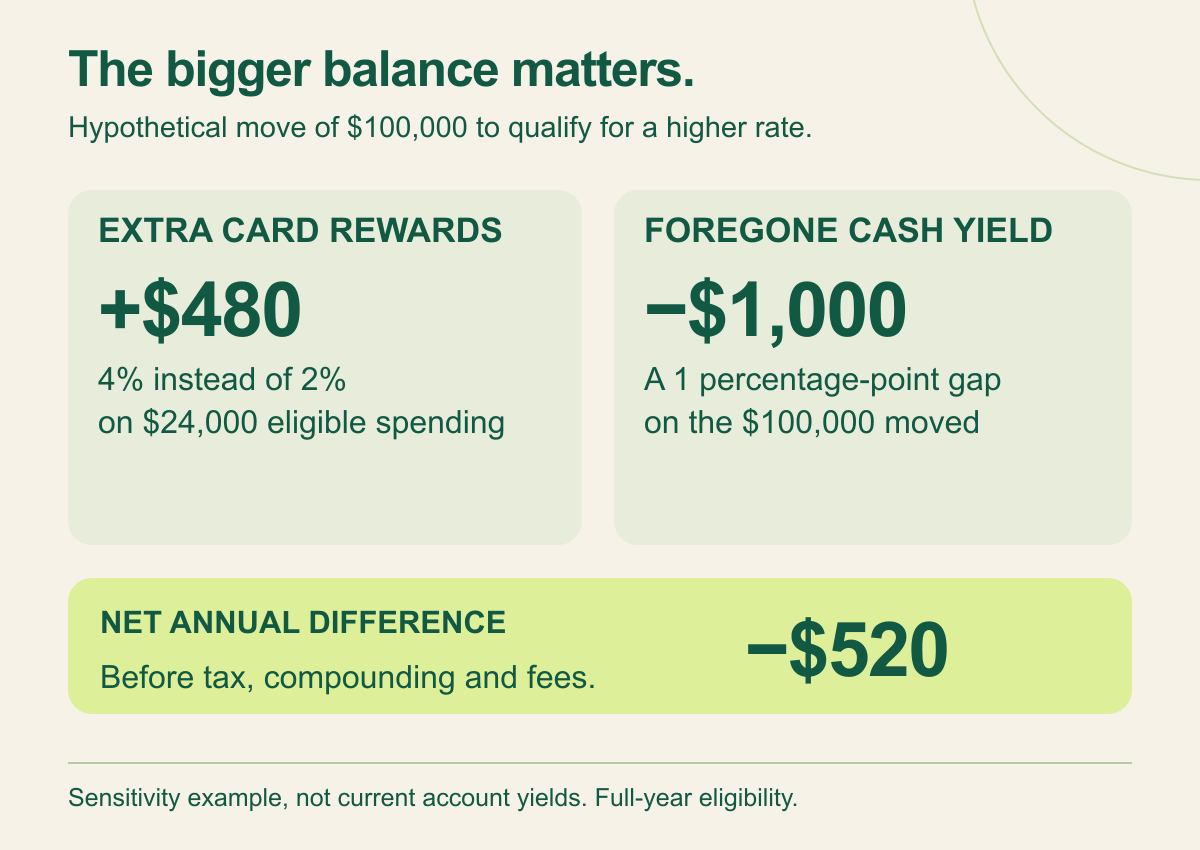
We would be particularly careful about giving up a meaningful return on cash to earn a higher percentage on a much smaller amount of card spending. A hypothetical one-percentage-point yield difference on $100,000 is about $1,000 a year before tax and compounding. A $480 card improvement does not cover that gap.
The most promising relationship reward is often the one that recognizes a sensible banking arrangement you would happily keep anyway.
Three programs, three different definitions of a relationship
Bank of America, U.S. Bank and PNC all offer ways for a qualifying relationship to improve selected card rewards. The qualifying money and timing are not interchangeable.
| Program | What you must investigate | Why it matters |
|---|---|---|
| BofA Rewards | Enrollment, an eligible personal checking account, and qualifying combined Bank of America deposit and Merrill investment balances | Eligible investments can contribute; your checking balance alone may not tell the whole story |
| U.S. Bank Smartly earning enhancement | A Bank Smartly Savings relationship and qualifying balances in Bank Smartly Checking and/or Safe Debit | Do not assume brokerage assets or money in Savings count toward the card’s balance threshold |
| PNC TotalRewards | Enrollment, an eligible consumer checking relationship, and qualifying deposit and investment balances | The eligible-account definitions and quarterly reward calculation need their own review |
The issuer rules linked here are the starting point, especially if you have retirement, trust, business or less common account types. PNC excludes, among other things, employer-sponsored retirement plans, business accounts and specified fiduciary or alternative investment assets from its qualifying balance calculation. BofA Rewards Smartly terms PNC program terms
Membership in a rewards program does not itself guarantee credit-card approval. You still need the relevant card and must satisfy its separate requirements.
Bank of America: multiply the ordinary reward, not the whole first-year offer
BofA Rewards currently starts with a Member tier and increases through Preferred Plus, Preferred Honors and Premier. The ordinary reward bonus rises from 10% to 25%, 50% and 75% as qualifying combined balances reach the applicable levels. Program tiers
Here is what that does to the Unlimited Cash Rewards card’s ordinary 1.5% purchase rate:
| Enrolled tier and qualifying balance | Reward multiplier | Effective ordinary rate | On $24,000 a year | Difference from a suitable 2% card |
|---|---|---|---|---|
| Member: below $30,000 | 1.10 | 1.65% | $396 | −$84 |
| Preferred Plus: $30,000 to below $100,000 | 1.25 | 1.875% | $450 | −$30 |
| Preferred Honors: $100,000 to below $1 million | 1.50 | 2.25% | $540 | +$60 |
| Premier: $1 million or more | 1.75 | 2.625% | $630 | +$150 |
The comparison uses eligible purchases at the stated rate for a full year, before account costs. Without a relationship bonus, the card’s ordinary 1.5% earns $360 on that budget. Unlimited Cash Rewards terms
A 50% reward bonus sounds dramatic. In this example it improves the card from $360 to $540, but it beats the accessible 2% alternative by only $60. Both statements are true; only the second tells you what changing your setup buys.
Customized Cash Rewards can also benefit. In our shared household model, its ordinary $372 becomes $558 at a 50% relationship bonus. That beats the equivalent Unlimited card’s $540 by $18, assuming the chosen category and shared quarterly cap work as modeled. The head-to-head comparison explains that choice.
Do not apply the relationship multiplier to the welcome bonus or the extra introductory category reward as though every first-year dollar receives it. Those offer components have separate rules. Customized acquisition terms
Smartly: count the qualifying purchases as carefully as the bank balance
Smartly’s ordinary purchase rate is 2%. With the required Savings relationship, the current qualifying checking/Safe Debit balance tiers can raise eligible earning to 2.5% at $10,000, 3% at $50,000 and 4% at $100,000. Bank Smartly Savings has a $25 opening minimum; that is separate from the balance required for the enhanced card rate. Smartly product and terms
At $24,000 in evenly distributed, enhancement-eligible annual purchases, the modeled rewards are straightforward:
| Qualifying tier | Modeled annual rewards | Extra over 2% |
|---|---|---|
| 2.5% | $600 | $120 |
| 3% | $720 | $240 |
| 4% | $960 | $480 |
But the enhancement applies only to the first $10,000 in eligible purchases per billing cycle. Certain categories–including insurance, education, taxes, gift cards, business-to-business payments and third-party bill payment services–do not receive the uplift. Otherwise eligible excluded purchases earn the ordinary 2% and do not consume that enhancement allowance. Enhancement conditions
Suppose $6,000 of the $24,000 is insurance spending that earns only 2%. At the 4% tier, the result becomes $720 on the other $18,000 plus $120 on insurance: $840, or $360 more than the 2% baseline.
A large purchase can also change the result. If $15,000 of enhancement-eligible purchases land in one cycle at the 4% tier, the first $10,000 earns $400 and the remaining $5,000 earns $100. That is $500, not $600.
Full cash value is available through the eligible cash-redemption routes, including a statement credit or a deposit into an eligible U.S. Bank account. The Smartly review walks through the account requirements, exclusions and redemption choices in detail.
PNC: a modest boost can still be useful if the relationship already fits
PNC TotalRewards offers eligible card reward bonuses of 5% at Silver, 25% at Gold and 35% at Platinum. The ordinary balance thresholds are $25,000, $100,000 and $500,000 respectively; special qualifying-group arrangements should be evaluated under their own rules. PNC reward details
Applied to Cash Unlimited’s ordinary 2% rate, the modeled result is:
| Tier | Effective ordinary rate | On $24,000 a year | Extra over the card’s base 2% |
|---|---|---|---|
| Silver | 2.1% | $504 | $24 |
| Gold | 2.5% | $600 | $120 |
| Platinum | 2.7% | $648 | $168 |
These are full-year equivalents assuming eligible base rewards and qualifying status at the required calculation times. The actual relationship bonus is calculated quarterly, rather than appearing as a permanently rewritten purchase rate on every transaction. Promotional rewards are excluded. PNC program terms
For someone already maintaining an appropriate PNC relationship, $120 can be a welcome addition. For someone considering moving $100,000 only for that card benefit, it is a fairly small annual budget for all the disruption and possible costs involved.
The PNC Cash Unlimited review covers the card itself. A bank bonus cannot fix a card that does not otherwise meet your needs.
Put a price on the money you would move
The central calculation is:
Extra card rewards + benefits you would actually use − added account costs − foregone return = estimated relationship benefit.
Count only useful additional benefits. A fee waiver is worth something if you would otherwise pay the fee for an account you want. A lifestyle offer you would never buy is not a reason to move savings.
The following sensitivity check shows how little annual yield difference could erase the modeled card improvement if you moved the entire threshold amount from a comparable cash account:
| Illustrative move and card improvement | Extra annual rewards | Yield disadvantage that consumes that amount |
|---|---|---|
| $10,000 for Smartly’s 2.5% tier | $120 | 1.20 percentage points |
| $100,000 for Smartly’s 4% tier | $480 | 0.48 percentage points |
| $100,000 for BofA Unlimited’s 2.25% tier | $60 | 0.06 percentage points |
| $100,000 for PNC Cash Unlimited’s 2.5% tier | $120 | 0.12 percentage points |
These are simple break-even estimates, not current deposit rates or forecasts. They assume a full year of the qualifying rate on $24,000 of eligible spending, and omit taxes, compounding, account fees and any separate opening balance. Smartly’s required Savings relationship still has to be established.
Your incremental move may be much smaller. If suitable existing assets already qualify, there may be no lost return to subtract. If you need only a small top-up, calculate the cost of that change rather than pretending every dollar of the account was moved for the card.
Get current rates and account terms for the actual alternatives. A seemingly tiny difference matters when it applies to substantially more money than your annual card spending.
Check when the better reward actually begins
A full-year table is useful for comparison. It is not a promise that a transfer this afternoon produces twelve months of enhanced rewards.
BofA generally uses a combined three-month average balance, with monthly reviews and a special daily review period during the first 30 days of initial enrollment. New benefits may take up to 30 days to activate. A temporary balance drop does not immediately remove the tier: the program reviews it at the anniversary and provides a three-month grace period if the balance requirement is no longer met. BofA qualification timing
Smartly recalculates the average each day using end-of-day balances over the last 30 days, or the shorter period since the initial qualifying account opened. A tier upgrade or downgrade can take up to five business days and can occur within a card billing cycle. Confirm the tier reflected in your account before relying on it for a large purchase. Smartly qualification timing
PNC checks the prior 90-calendar-day average around the fourth business day of each month for upgrades. Its ordinary tier-retention review follows the enrollment anniversary, with a three-month grace period when needed. Initial enrollment benefits generally activate within five business days; tier-change benefits follow the program’s next-business-day rule. The card bonus is calculated around the fourth business day of April, July, October and January on eligible base rewards added during the prior quarter. You must then be enrolled with benefits activated and the card open and in good standing. PNC timing and eligibility
Check account costs during that transition too. BofA’s Member tier does not automatically remove every checking maintenance fee. Smartly Checking’s listed $12 monthly fee can be waived with the eligible Smartly credit card relationship, and Savings has its own $5 fee and waiver conditions. An enrollment fee of $0 does not mean every associated account is cost-free. BofA fee schedule U.S. Bank account details
Make the investment decision on its own merits
Eligible investment assets can make some bank programs easier to justify than a cash-only comparison suggests. Transferring a holding without selling it may preserve the investment exposure you already want.
Still check whether the destination supports the exact holdings, whether a transfer or closure fee applies, and whether advisory or investment expenses would change. If a sale would be necessary, understand the potential tax consequences before acting. A card reward is a poor reason to rush that decision.
Compare like with like. The hoped-for return from a risky investment is not interchangeable with the stated yield on a cash account. Service, access to your money and a workable account setup belong in the decision too.
Our main cash-back comparison includes alternatives without a large bank-balance requirement. Keeping a suitable 2% card and banking where you prefer is a perfectly reasonable result.
Frequently asked questions
Does a 50% relationship bonus mean 50% cash back?
No. It adds 50% to eligible ordinary rewards. A 1.5% rate becomes 2.25%; it does not become 51.5% or pay half the purchase price back.
Do investments qualify for every bank’s higher card rate?
No. BofA and PNC define qualifying deposit and investment assets under their respective programs. Smartly’s current card enhancement uses specified checking/Safe Debit balances plus a separate Savings relationship. Check the exact account types.
Should I move $100,000 to earn 4% instead of 2%?
Only after evaluating the whole arrangement. On $24,000 of fully eligible annual spending, the card improvement is $480. Account fees, excluded purchases, qualification delays and foregone returns can reduce or exceed that benefit.
Does the bank bonus multiply my welcome bonus too?
Do not assume it does. The BofA and PNC rules reviewed here exclude the relevant welcome or promotional rewards from their ordinary relationship multipliers. Separate each offer component before calculating first-year value.
What should I check after moving money?
Confirm enrollment, the actual qualifying tier, account fee waivers and the reward rate or bonus reflected in the account. Revisit the calculation when your balances, spending, available account returns or program rules change.
How we reviewed it: We compared the current issuer program definitions, eligible-account rules and card reward mechanics linked below. Annual examples are modeled at $24,000 of planned purchases with full on-time payments, no interest or returns, and documented cash value. Bonuses, speculative investment returns and optional benefits are excluded. Yield comparisons are explicitly hypothetical sensitivity checks; we did not move assets or personally test a banking relationship for this article.
Sources & references8 sources
The issuer terms and other references behind this article.
- BofA Rewards current tiers, eligibility and benefits
- U.S. Bank Smartly current tiers, eligible balances and exclusions
- PNC TotalRewards terms effective June 27, 2026
- Unlimited Cash Rewards current $250 acquisition offer and pricing
- Customized Cash Rewards linked acquisition terms
- PNC TotalRewards eligibility, tiers and benefits
- Bank of America current personal deposit fee schedule
- Smartly Checking and related Savings maintenance fees and waiver rules