
In this article
The best dining card should work just as well for Tuesday takeout as for an anniversary dinner. It should reward the meals you already buy without making you wonder whether you need a different app, a particular reservation or another subscription.
There are cards with higher headline rates than 3%. Some are worth the extra rule. Others deliver surprisingly little additional cash once you account for caps, redemption and the purchases that fall back to 1%.
We would start with your normal restaurant routine, choose a simple baseline and ask what a more specialized card actually adds. Dinner is complicated enough when everyone wants something different.
Our take: make uncapped 3% the starting comparison
For people who want qualifying supermarket purchases and restaurant bills on the same card, Capital One Savor is an easy shortlist choice. For someone who values a 1.5% ordinary fallback alongside 3% dining, consider Chase Freedom Unlimited. Both have no annual fee. Savor terms Freedom Unlimited terms
Wells Fargo Autograph deserves a look when gas, transit, phone plans, streaming or travel are useful alongside restaurants. Its qualifying 3-point categories can be compared at the documented 1-cent cash value, without assuming a speculative transfer redemption. Autograph terms
U.S. Bank Altitude Go is the more focused candidate: 4 points per dollar on the first $2,000 of qualifying dining each quarter, then 1 point. Our cash comparison requires redemption to an eligible U.S. Bank deposit account at 1 cent per point. A statement credit may be worth less. Altitude Go terms
At $300 a month in dining, Go’s 4-point rate is worth $36 more per year than 3%, at that cash value. That is $3 a month before any account costs. It can be a useful upgrade, but it is not a reason to accept a banking arrangement you otherwise dislike.
Check how the meal is billed
The food on the plate does not assign the reward category. A restaurant bill, a supermarket deli purchase and a meal charged to a hotel room can be submitted under different merchant information.
| Where you buy the meal | The useful check |
|---|---|
| Standalone restaurant or direct takeout | Does it post as an eligible restaurant under the card’s rules? |
| Delivery platform | Does the issuer cover that service and transaction route? |
| Grocery-store prepared food | It may follow the grocery merchant rather than dining. |
| Restaurant inside a hotel, attraction or retailer | The larger business may process the charge. |
| Fast-food restaurant | It may fit both a broad dining definition and a narrower selected fast-food category, depending on the card. |
Chase’s dining definition includes eligible takeout and delivery. Capital One covers qualifying restaurant transactions, and Autograph’s restaurant category includes dining in, takeout, catering and delivery under its terms. None of that makes every food-related charge a guaranteed restaurant purchase. Chase definitions Capital One definitions Autograph definitions
Check the first ordinary transaction at a new restaurant or platform before assuming a full year of higher rewards. For meals bought during the grocery run, use the grocery-card comparison instead of counting the same purchase in both budgets.
Compare candidates by the rule you would actually follow
| Your priority | Useful candidate | Why it fits–and what to watch |
|---|---|---|
| Groceries and restaurants together | Savor | Uncapped qualifying 3%; many other purchases earn 1%. |
| Dining with a better ordinary fallback | Freedom Unlimited | 3% dining and 1.5% elsewhere, with separate additional categories. |
| Dining plus rotating opportunities | Freedom Flex | Permanent 3% dining; selected quarterly opportunities require activation and a shared cap. |
| Steady dining and a useful U.S. Bank cash route | Altitude Go | Higher earning inside the quarterly allowance; redemption and overflow matter. |
| Restaurants plus gas, transit and phone plans | Autograph | Broad eligible 3-point categories; ordinary purchases earn 1 point. |
| Gas and dining on one specialist | PNC Cash Rewards | 3% dining shares an $8,000 anniversary-year allowance with gas and groceries. |
| An existing qualifying BofA relationship | Customized Cash Rewards | Select dining; relationship uplift can help, but the category shares a quarterly cap. |
| Fuel and restaurant rewards without a club membership | AAA Travel Advantage | Eligible 3% dining alongside its separate capped fuel benefit. |
Sources: Flex, PNC, Customized, BofA Rewards, AAA. This is an ongoing-value comparison. Welcome offers and temporary boosts belong on a separate first-year line.
Existing Costco Visa holders already have qualifying 3% dining. Sam’s Club Mastercard also earns 3% on eligible dining, paid in Sam’s Cash under its membership and redemption rules. Prime Visa and Amazon Visa earn 2% on restaurants, so a suitable 3% dining card would improve that category by one percentage point. Check what your current card actually earns before opening another account for the same rate. Prime rules Costco rules Sam’s issuer terms
If an older comparison points you to Citi Custom Cash, note that Citi stopped accepting new applications on May 28, 2026. Existing holders can still evaluate their own card. Citi availability
When four points earn more than 3% cash
Here are annual dining-only results with purchases spread evenly across four quarters. Every charge qualifies, bonuses are excluded, and Go’s points use its eligible 1-cent cash-deposit value.
| Annual dining spend | Suitable 2% card | Uncapped 3% card | Altitude Go at 1 cent |
|---|---|---|---|
| $2,400 | $48 | $72 | $96 |
| $3,600 | $72 | $108 | $144 |
| $6,000 | $120 | $180 | $240 |
| $12,000 | $240 | $360 | $360 |
The first three rows fit inside each quarterly allowance. At $12,000, only $8,000 fits across the four separate $2,000 caps. Those purchases produce 32,000 points. The remaining $4,000 produces 4,000 points. At 1 cent each, the result is $360–exactly the same as an uncapped 3% card on that budget.
The practical question is therefore not “Is four bigger than three?” It is “How much of my dining spending earns four, and what will I receive when I redeem it?”
If your account offers a lower-value redemption, use that actual quote. As a purely hypothetical sensitivity check, 24,000 points at 0.75 cent would equal $180 instead of $240. That is not a claim that 0.75 cent is the current statement-credit value; it shows why the cash route matters.
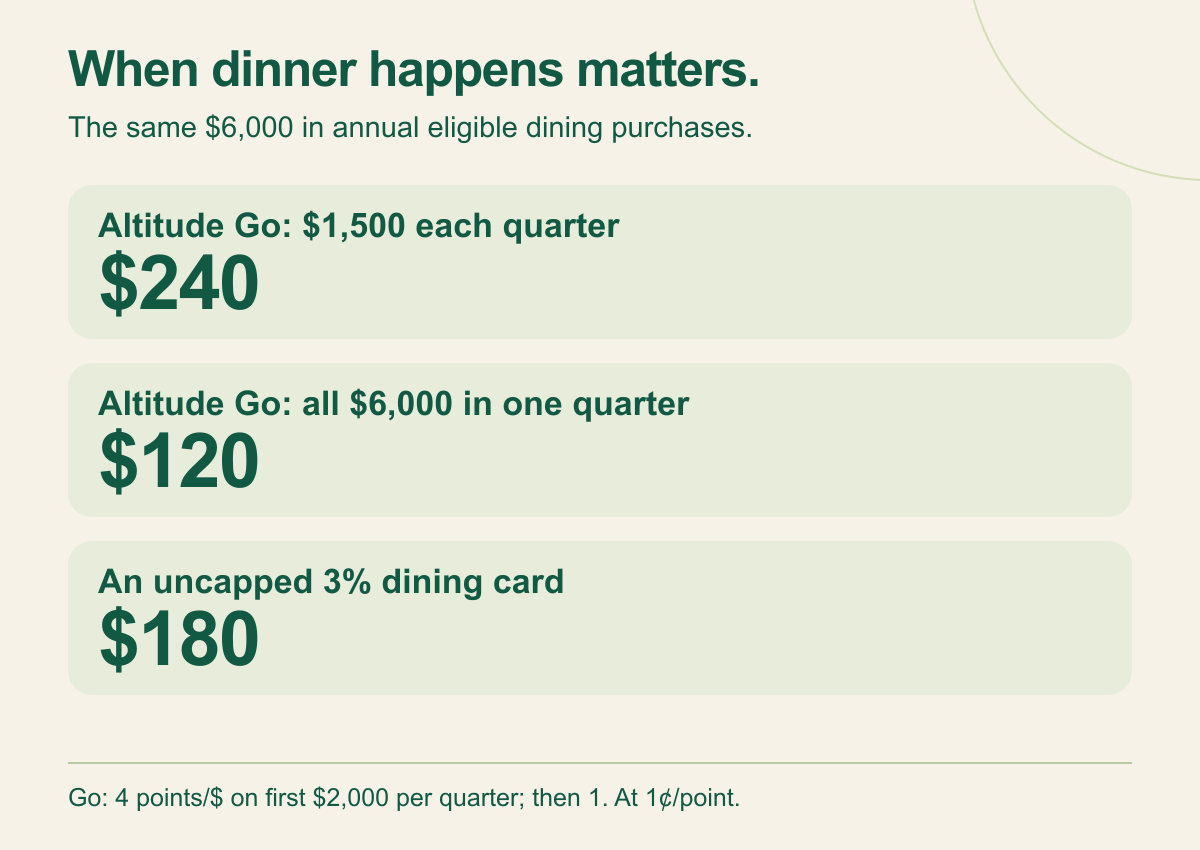
A big dinner quarter can change the winner
Suppose you have $6,000 in annual dining spending. Spread it evenly and Go earns 24,000 points, worth $240 through the modeled route.
Concentrate the full $6,000 in one quarter–perhaps a family celebration plus a period of unusually heavy travel–and the calculation changes:
| Timing | Go’s calculation | Cash at 1 cent |
|---|---|---|
| $1,500 in each of four quarters | $6,000 × 4 points | $240 |
| All $6,000 in one quarter | $2,000 × 4 + $4,000 × 1 | $120 |
| Uncapped 3%, either timing | $6,000 × 3% | $180 |
You cannot move an unused allowance from the quiet quarters into the busy one. That makes an uncapped card attractive for uneven spending, even when the annual total looks safely below $8,000.
A fallback is another option. In the concentrated example, put the first $2,000 on Go and the remaining $4,000 on a suitable 2% card. The result is $80 + $80 = $160, still below the uncapped 3% result of $180. A 3% dining fallback would instead bring the total to $200. More cards can improve a particular calculation, but the extra account must justify its place.
Fast food is a separate opportunity, with a separate definition
If much of your restaurant spending is genuinely fast food, look at U.S. Bank Cash+ and a participating bank’s current Elan Max Cash Preferred offer. Their selected 5% fast-food options share a $2,000 quarterly purchase limit with the other selected 5% category. This is narrower than a blanket restaurant rate. Cash+ categories Elan category definitions Elan rules
On $2,400 of qualifying fast food spread evenly through the year, with sufficient shared allowance available, 5% earns $120. A 3% card earns $72. The improvement is $48 annually, or $4 a month.
That is worth considering if the category fits and you already manage the card. It is less persuasive if it requires constant classification checks or takes allowance away from household bills that would earn the same 5% more reliably.
Cash+ requires category selection each quarter; Elan’s standard rules require initial enrollment, so check the chosen bank’s process. Elan allows statement-credit redemption, while account deposits are restricted to the financial institution associated with the card. Do not assume a full-service restaurant becomes fast food because you pick up the order, or that a restaurant inside another business will submit the expected category. Cash+ rules Elan rules
A great dining rate can still make a weak everyday card
Our shared $24,000 household includes $3,600 in dining, $4,800 at supermarkets, $2,400 on gas and a detailed mix of shopping and bills. At ordinary rates, Savor earns $415.20, Freedom Unlimited $417.60 and Altitude Go $423.60 at the modeled 1-cent cash value. A suitable 2% card earns $480 on the same purchases.
The dining reward is doing useful work. Lower earnings on the rest of the budget are offsetting it. The full household comparison shows every spending bucket so you can see where that happens.
Give Savor its useful qualifying 3% purchases and send the rest to a suitable 2% card, and the shared model reaches $567.60. That adds $87.60 a year, or $7.30 a month, over the single 2% card.
If you use Go only for the household’s $3,600 dining budget and a 2% card for the other $20,400, the result is $144 + $408 = $552. Using an uncapped 3% dining specialist with the same fallback yields $108 + $408 = $516. Go’s extra dining rule is worth $36 in this particular setup.
That is the sort of number we would use to decide whether another account is worth managing. It is honest about the gain without making a small improvement sound life-changing.
Do the delivery math before counting the reward
Suppose a planned meal costs $40 directly from the restaurant and $48 through a platform after fees. If both full charges qualify for 3%, the direct purchase earns $1.20 and has a net cost of $38.80. The delivery order earns $1.44 and has a net cost of $46.56.
You receive 24 cents more in rewards while paying $7.76 more overall. Delivery may be worth that convenience. The extra reward is not the reason it is worth it.
Include different menu prices, service charges, delivery fees, tips and any subscription cost you would add. Count a credit only when you can use it on a purchase you would otherwise make under the current benefit terms. If a credit nudges you from pickup to a more expensive delivery order, the additional cost belongs in the calculation too.
The same principle applies to a restaurant surcharge. On a $100 meal with a 3% card-payment fee, a 3% reward on the full $103 charge returns $3.09. The net advantage over a $100 fee-free payment is just 9 cents. If the fee does not earn rewards, the nominal rates merely offset. Verify the actual terms rather than assuming equal percentages create a useful saving.
Choose a rule you can explain in one sentence
“This card for restaurants; the flat card for everything else” is a workable plan. “This card for groceries and restaurants; the flat card for the rest” is also workable. A plan requiring everyone in the household to remember five exceptions at dinner may not be.
Check one posted purchase at a new platform, review any quarterly or shared allowance, and pay the full statement balance as required to preserve the purchase grace period. If you are carrying interest-bearing debt, the interest cost deserves attention first.
For the next decision, compare one card with a two-card setup. The aim is a wallet that handles normal life well–including the nights when the only dinner plan is takeout.
Frequently asked questions
Do takeout and delivery earn dining rewards?
Eligible transactions can, but the issuer’s definitions and submitted merchant information control. A restaurant order is not a guarantee if another type of business processes the charge.
Is Altitude Go better than Savor for restaurants?
It can earn more on steady qualifying dining within the quarterly cap when redeemed through the eligible 1-cent cash-deposit route. Uneven spending, account costs, other redemption values and Savor’s grocery categories can change the overall choice.
Does a supermarket deli count as dining?
Do not assume so. A purchase processed by the supermarket may follow that merchant category even when the food is ready to eat.
Should I open a new card just for 3% dining?
First check whether a card you already hold provides it. Then compare the incremental annual dollars over your current setup and any other useful categories. The rate alone is not a reason to add an account.
Are premium travel cards included in this ranking?
This comparison focuses on usable cash value. A travel card may suit a traveler, but its annual fee, credits and actual redemption value need a separate calculation; an optimistic points valuation is not directly comparable with cash.
How we reviewed it: We screened broad dining, fast-food, relationship and existing-member options using official terms, modeled identical planned purchases at documented cash values, and tested quarterly timing and whole-household results. Examples exclude bonuses, optional credits, returns and interest unless explicitly illustrated. We assume full statement payments that preserve the purchase grace period and make no personal-use or approval claim.
Sources & references16 sources
The issuer terms and other references behind this article.
- Capital One Savor Rewards offer and category definitions
- Chase Freedom Unlimited current offer and reward rules
- Wells Fargo Autograph product and reward disclosures
- U.S. Bank Altitude Go earn caps and redemption conditions
- Chase Freedom Flex offer, category calendar and reward rules
- PNC Cash Rewards full agreement and Reward Date allocation rule
- Customized Cash Rewards linked acquisition terms
- BofA Rewards current tiers, eligibility and benefits
- AAA Daily Advantage and Travel Advantage current rewards and conditions
- Chase Amazon and Prime Visa current rewards program agreement
- Citi Costco Anywhere Visa linked application pricing and full reward agreement
- U.S. Bank Cash+ offer, categories and reward disclosures
- Elan Max Cash Preferred Visa category definitions
- Elan Max Cash Preferred standard card program rules
- Synchrony Sam’s Club Mastercard dining and reward-program terms
- Citi Custom Cash current new-application availability