
In this article
A payment screen offering “earn rewards with your card” can make a processing fee feel like a small price to pay. Sometimes it is. Sometimes the fee takes more than the card gives back.
You do not need a complicated calculator to tell the difference. You need the actual amount charged, the reward that transaction will earn and the amount you would pay another way.
Start with the receipt. The card’s advertised percentage comes afterward.
Our take: choose the lower final cost, even when it earns no reward
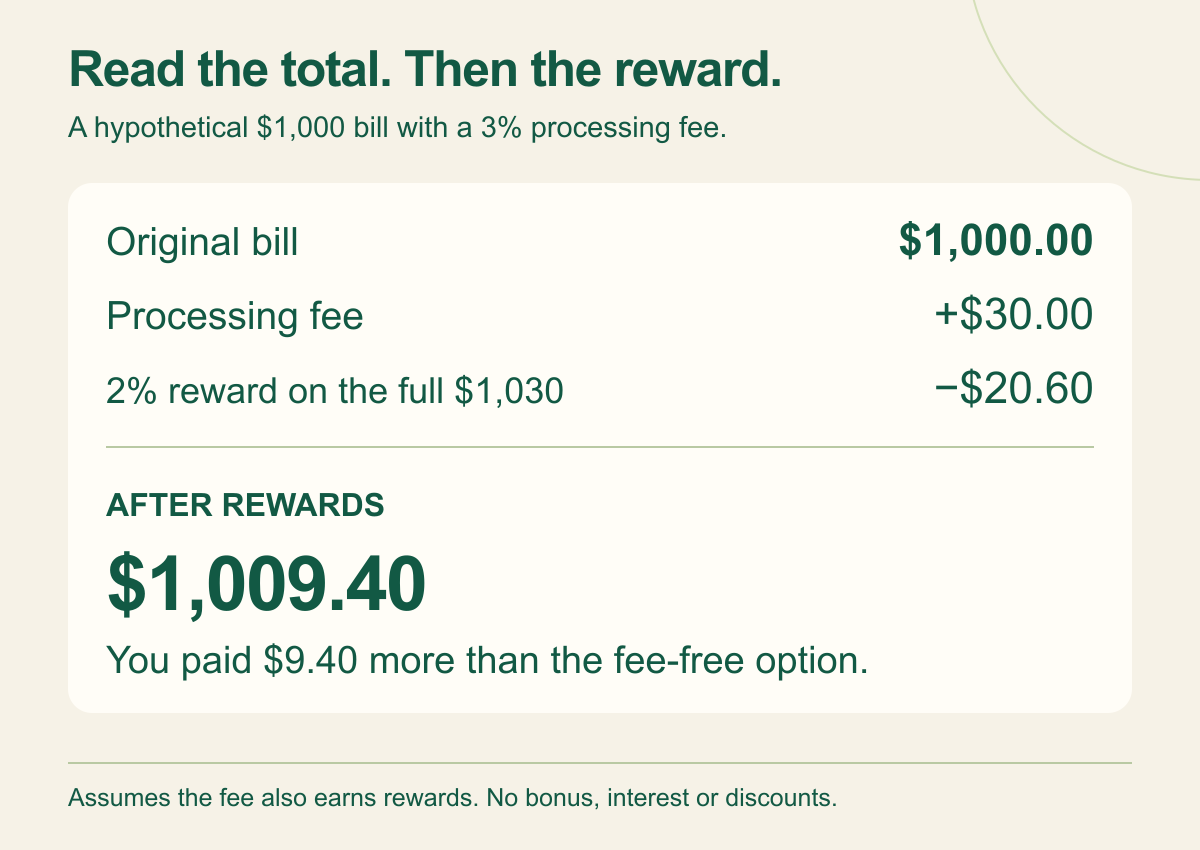
If paying by bank costs $1,000 and paying by card costs $1,030, the card has to recover the extra $30 before it creates any saving. A 2% reward on the full card charge returns $20.60, leaving a $9.40 loss.
That is an easy decision if both payment methods are suitable and you can fund either one. The reward is real; it is simply smaller than the cost of obtaining it.
Before doing the math, confirm the transaction’s actual reward category and eligibility. The utilities and recurring-bills guide handles that step. A payment processor accepting your card does not prove the charge earns a bonus category–or purchase rewards at all.
Use three numbers from the payment screen
Write down:
- The amount paid by the cheapest suitable method. Include any bank-payment discount you would keep.
- The full card charge. Include percentage fees, fixed fees and any higher bill price.
- The usable reward on that actual transaction. Use the verified category, cap and cash value, and check whether a separately billed fee earns anything.
Then compare:
Net card cost = full card charge − usable rewards.
If that is higher than the suitable alternative, the card route costs more before any interest or other account charges. Optional benefits and a truly incremental welcome bonus can be evaluated separately, but they should not obscure the ordinary recurring result.
Four examples show where the money goes
The first, second and fourth examples assume the entire fee-bearing card charge earns the stated rate. The phone example assumes a $200 card bill versus $180 with a qualifying bank-payment discount.
| Situation | Reward | Extra payment cost | Net gain or loss from using the card |
|---|---|---|---|
| $1,000 bill + 3% fee; 2% on $1,030 | $20.60 | $30 | −$9.40 |
| $1,000 bill + 3% fee; 3% on $1,030 | $30.90 | $30 | $0.90 |
| $200 phone bill; 5%; lose $20 discount | $10 | $20 | −$10 |
| $500 bill + $2.50 fee; 2% on $502.50 | $10.05 | $2.50 | $7.55 |
The 90-cent gain in the second row is fragile. If the $30 fee earns no rewards, the $1,000 bill earns $30 and the payment merely breaks even. If the whole $1,030 receives only 1% because the assumed category does not qualify, the reward is $10.30 and the loss is $19.70.
A small positive estimate is a reason to verify the inputs carefully. It is not enough to see two matching 3% figures and declare the payment profitable.
Does the processing fee earn rewards too?
There is no universal answer. A biller may include the fee in one eligible purchase, charge it separately or use a processor whose transaction receives different treatment. The card’s exclusions and the actual posted charges control.
If the full $1,030 earns 2%, the reward is $20.60. If only the original $1,000 earns 2%, it is $20. The fee remains $30 in either case, so the loss is $9.40 or $10.
That 60-cent distinction will not rescue this example. It can matter when a calculation is close to break-even, especially across repeated payments.
Do not assume a cash-like transaction, personal transfer or balance transfer earns ordinary purchase rewards or counts toward a welcome offer. Check the exact agreement. The existing send-money guide covers personal-payment mechanics separately from ordinary utility bills.
A percentage fee and a flat fee behave differently
When the only added cost is a percentage fee and the entire charge earns the same reward, the break-even reward rate is the fee rate divided by one plus that fee rate.
For a 3% fee, that is 0.03 ÷ 1.03 = about 2.913%. A 3% reward is slightly above break-even under those narrow assumptions. A 2% reward is below it.
Look at the same relationship the other way: a 2% reward covers a percentage fee of about 2.041% when the fee itself earns rewards and no other costs apply. If the fee earns nothing, the maximum break-even fee is simply 2%.
For a fixed fee, the size of the bill matters. With a $2.50 fee and 2% on the entire charge, an original bill of $122.50 breaks even because ($122.50 + $2.50) × 2% = $2.50. If only the bill earns rewards, the break-even amount is $125.
| Original bill with a $2.50 fee | 2% reward on full charge | Gain after fee |
|---|---|---|
| $100 | $2.05 | −$0.45 |
| $122.50 | $2.50 | $0 |
| $500 | $10.05 | $7.55 |
Do not prepay money needed for other expenses just to cross a mathematical threshold. The calculation helps choose a method for an existing bill; it does not create a reason to accelerate spending.
The lost discount can be the largest fee on the screen
Suppose a phone bill is $200 by card and $180 with an eligible $20 bank-payment discount. A 5% card reward returns $10, making the net card cost $190. The bank route costs $180. The card loses $10 monthly, or $120 annually.
A hypothetical $20 monthly discount is worth $240 a year. The $200 monthly bill’s 5% reward is worth $120. Those amounts make the choice clearer than the appealing 5% label.
T-Mobile’s current AutoPay rules make payment method relevant: eligible methods include a linked bank account, debit card and T-Mobile Visa, while other credit cards and digital wallets are excluded from that discount. Paying early with an ineligible method can remove the next bill’s discount. This example does not assert that every customer has a $20 discount; use your own plan’s amount. T-Mobile AutoPay rules
If a card offers phone protection, evaluate the coverage separately. Check the deductible, exclusions, claim limits and qualifying bill-payment timing. Do not add the maximum possible reimbursement to annual rewards as though a covered claim were guaranteed. Example benefit guide
A welcome bonus can change one decision
Imagine a planned $1,000 bill is the remaining eligible purchase needed for an otherwise available $200 welcome bonus. The bill has a 3% fee, and the full $1,030 earns 2%.
The ordinary payment loses $9.40. If this payment is genuinely necessary and eligible to earn the $200 bonus, its combined incremental result is $200 − $9.40 = $190.60 before other costs.
Now change one fact: your normal fee-free groceries and other planned purchases will meet the bonus requirement anyway. The bill no longer creates the $200. Paying its fee still loses $9.40.
That is why the bonus must be counted once across the whole spending plan, not attached to every transaction that happens during the introductory period. The welcome-bonus guide helps identify which purchases are necessary and when they must post.
Confirm purchase eligibility, the exact deadline and whether returns reduce the qualifying total. A tax payment or processor-funded bill may be allowed as a card transaction without satisfying every bonus condition.
Interest can erase a positive payment calculation
These reward-only examples assume the purchase does not accrue interest. That usually depends on a purchase grace period and paying the required statement balance in full on time under the account’s terms. Carrying a balance can change how new purchases accrue interest. CFPB grace-period explanation
For scale, a constant $1,000 interest-bearing balance at a hypothetical 25% APR for 30 days produces about $20.55 using a simple daily-rate estimate: $1,000 × 25% × 30 ÷ 365. That can consume a one-time $20 reward on the original purchase. Actual charges depend on daily balances, payment timing and the issuer’s method. CFPB interest calculation
A promotional balance-transfer APR does not automatically apply to new purchases. The transfer can also affect the purchase grace period. Keep that financing decision separate and read the exact terms. CFPB transfer guidance
If the reason to use a card is that cash is not currently available, rewards are a secondary question. Compare borrowing costs and a realistic repayment plan before deciding the reward offsets the payment fee.
Save the inputs, then verify the first bill
When the result is negative, use the cheaper suitable method. When it is meaningfully positive, save the fee quote, expected category, cap status and discount terms. Confirm the posted charge and reward after the first ordinary payment.
Recalculate when the bill amount, processing fee, discount or card terms change. A route that saved a few dollars last year can stop working after a provider changes its payment policy.
The goal is straightforward: reduce the cost of bills you already owe. You do not need to earn cash back on every payment to manage money well. Sometimes the best reward decision is keeping the fee-free bank payment exactly where it is.
Frequently asked questions
Is a 3% fee worth paying for 3% rewards?
Only a tiny gain exists if the full fee-bearing charge earns 3% and there are no other costs. If the fee earns no rewards, the rates simply break even. A lost discount or interest can make it a loss.
Do processing fees earn cash back?
It depends on the biller, processor and card agreement. Check whether the fee is part of an eligible purchase or a separate charge, and verify the actual posted reward.
Should I include a welcome bonus in the calculation?
Only if the payment is eligible and genuinely necessary to earn an otherwise available bonus. If normal fee-free purchases would earn it anyway, the bill payment did not add that value.
Can a payment with no processing fee still lose money?
Yes. A lost bank-payment discount, a higher price, interest or another incremental cost can exceed the reward even when the processing-fee line says $0.
What if the estimated saving is less than a dollar?
Check the category, fee treatment and discounts carefully. A small error can reverse the result, and the extra account work may not be worthwhile for that margin.
How we reviewed it: We modeled complete payment costs with explicit assumptions about fee earning, discounts and bonus attribution, and checked official consumer-finance and biller guidance. Rates and bill amounts in the calculations are labeled illustrations rather than universal offers. Reward-only examples assume eligible planned purchases, no returns or interest and full statement payments that preserve the purchase grace period.
Sources & references5 sources
The issuer terms and other references behind this article.