In this article
The interesting part of this card is what happens after you stop comparing reward percentages.
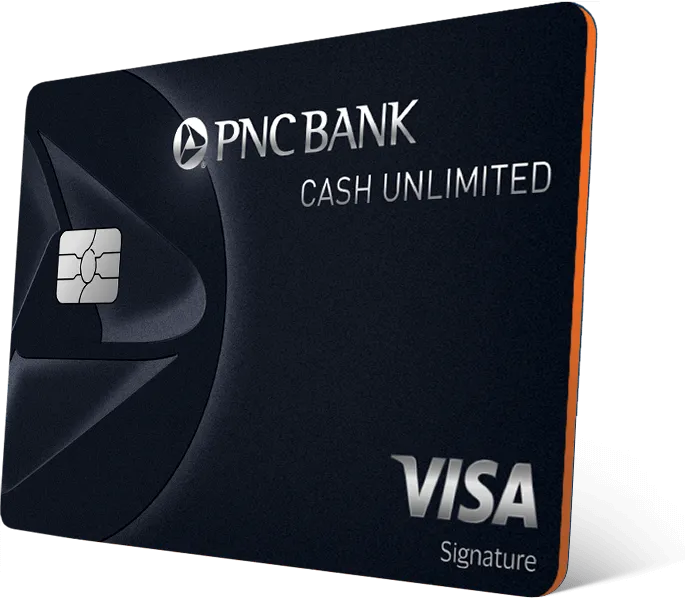
Several cards can return 2% on a properly paid purchase. PNC Cash Unlimited combines that familiar rate with no foreign transaction fee and small-balance cash redemption. For someone who wants the same card to work at the supermarket, on an ordinary online order and during a trip abroad, that combination can be more useful than another category to remember.
There is no need to turn it into an elaborate banking project. The ordinary 2% stands on its own. PNC's relationship program can improve it, but the extra return deserves its own calculation.
Our take: a strong candidate for your everyday fallback
Our recommendation: Put PNC Cash Unlimited on the shortlist for a straightforward everyday card or the purchases your specialist card rewards poorly. Its no-foreign-fee feature makes it particularly relevant when the alternatives would charge for purchases abroad. Current product
- Good fit if: You want one purchase rate, prefer cash rewards and may use the card internationally.
- Consider another card if: Your main need is a purchase-financing promotion, you do not qualify for the required credit line or a competing offer has more useful near-term value.
- The tradeoff: At $24,000 of annual eligible purchases, 2% earns $480. That is $120 more than 1.5%, but it is the same ordinary reward as another suitable 2% card. Compare the rest of the experience before choosing.
We would not move a large savings or investment balance merely because the relationship rate looks attractive. At the Gold tier, the extra reward on this budget is $120 a year. A modest difference in account costs or returns can exceed that.
PNC Cash Unlimited rates and fees at a glance
| Feature | Reviewed consumer Visa Signature offer |
|---|---|
| Annual fee | $0 |
| Ordinary rewards | Unlimited 2% on eligible net purchases |
| Foreign transaction fee | None |
| Cash redemption minimum | None through the reviewed cash routes |
| Purchase APR | 18.74%–28.74% variable |
| Introductory transfer APR | 0% for 15 months after opening on eligible transfers made within 90 days |
| Later transfer APR | 18.74%–28.74% variable |
| Transfer fee | 4%, minimum $5, in the first 90 days; then 5%, minimum $5 |
| Required approved credit line | At least $5,000 |
| Cash welcome bonus in our calculation | $0; no public cash bonus verified in this offer |
These are the reviewed offer's terms, not a prediction of the APR or credit line an applicant will receive. The card's purchase rate applies separately from the transfer promotion. Cash advances carry a 28.74% variable APR and a 5% fee with a $10 minimum. Late and returned payments can each cost up to $38, and a 32.74% variable penalty APR may apply under the pricing conditions. Rates and fees
The $5,000 requirement is easy to misread. It is the minimum credit line PNC says you must qualify for. It is not a spending requirement, a deposit requirement or an invitation to charge $5,000.
What 2% looks like in an ordinary year
Flat-rate rewards are refreshingly easy to estimate. Take planned, eligible purchases and multiply by 0.02. Exclude balance transfers, cash advances, fees and other non-purchase transactions under the agreement.
| Annual eligible purchases | Cash Unlimited at 2% | A 1.5% card | Extra reward from 2% |
|---|---|---|---|
| $6,000 | $120 | $90 | $30 |
| $12,000 | $240 | $180 | $60 |
| $24,000 | $480 | $360 | $120 |
| $40,000 | $800 | $600 | $200 |
At the middle household example, the difference is $10 a month. That can justify choosing the stronger rate for future spending. It does not automatically justify closing a useful existing account or chasing a new card during a major borrowing decision.
Our shared $24,000 budget includes groceries, gas, dining, shopping, household bills and other purchases. Cash Unlimited's modeled reward is $480 because the rate does not depend on which of those categories is largest. First-year modeled rewards are also $480; we have not inserted a cash bonus that the reviewed public offer does not advertise.
All examples assume planned eligible purchases, no returns, cash redemption and full on-time payments that preserve the purchase grace period. They describe a model, not our personal spending experience. Optional benefits and relationship bonuses are excluded unless a section explicitly adds them.
No foreign transaction fee gives the same rate a different job
Imagine $3,000 of eligible foreign purchases, holding merchant prices and exchange rates constant. At 2%, Cash Unlimited earns $60 without an issuer foreign transaction fee.
A different 2% card with a 3% foreign transaction fee would earn the same $60 but charge $90, leaving a $30 shortfall before other costs. In that example, the difference between the cards is $90. The reward rate alone conceals it.
| $3,000 in eligible foreign purchases | Rewards | Issuer foreign fee | Rewards less that fee |
|---|---|---|---|
| Cash Unlimited, 2% and no foreign fee | $60 | $0 | $60 |
| Hypothetical 2% card with a 3% foreign fee | $60 | $90 | −$30 |
| Hypothetical 1.5% card with no foreign fee | $45 | $0 | $45 |
This is a fee comparison, not a promise of identical exchange rates or merchant acceptance. A merchant's currency-conversion offer can introduce another cost. Compare the displayed currency and conversion choices rather than assuming that a no-foreign-fee card makes every checkout option equally good.
For a household that rarely buys abroad, this advantage may be occasional. For someone with regular foreign purchases, it can be a reason to prefer PNC over an otherwise similar 2% card.
A category card can complement the flat rate
The most useful second card usually has a narrow, memorable assignment.
Consider PNC Cash Rewards, which offers 4% on qualifying gas, 3% on restaurants and 2% on groceries within a shared $8,000 rewards-program-year allowance. Its other eligible purchases earn 1%.
On our household budget, using Cash Rewards for everything produces $383 before any welcome or relationship bonus. Cash Unlimited alone produces $480. The ordinary flat rate wins by $97.
But give Cash Rewards only the qualifying gas and dining purchases, and the result changes:
| Purchase assignment | Annual spending | Modeled reward |
|---|---|---|
| Qualifying gas on Cash Rewards at 4% | $2,400 | $96 |
| Qualifying dining on Cash Rewards at 3% | $3,600 | $108 |
| Remaining purchases on Cash Unlimited at 2% | $18,000 | $360 |
| Total for the pair | $24,000 | $564 |
That is $84 more than Cash Unlimited alone, or $7 a month. The two selected categories total $6,000, keeping them inside Cash Rewards' shared allowance. Putting groceries on Cash Unlimited preserves that limited room while still earning 2% on those groceries.
This is the kind of two-card routine we find easier to justify: a clear job for the specialist and a dependable place for everything else. The one-card versus two-card guide compares the extra dollars with the work involved.

Cash redemption without waiting for a threshold
PNC tracks Cash Unlimited rewards as points, with one cent of cash back represented by one point. Through the reviewed cash options, you can request a credit to the card or an eligible PNC account. A PNC deposit account is useful for the deposit route; the statement-credit route means it is not the only way to use the ordinary cash reward. Rewards agreement
The lack of a minimum is a practical advantage if this is a lightly used backup card. A $9 reward balance does not have to wait until it reaches $25 before it can become a cash credit.
Under the agreement, points become available within five business days after cash back is earned, and a valid cash redemption is credited or deposited within seven business days. Those are processing windows, so do not schedule a bill payment on the assumption that a redemption will arrive instantly.
A reward credit is separate from your required card payment. Check the amount due and payment status even after redeeming. Points can be adjusted after returns, and closing the account forfeits unredeemed rewards under the program terms. “No expiration” while an eligible account remains open is not the same as protection after closure.
Gift cards and travel are also available through the program, but compare their actual value with cash. Our calculations use the documented cash value because it gives readers a consistent basis for comparing cards.
Phone protection: useful if the bill-payment math works
The card offers supplemental protection for qualifying stolen or damaged phones when you pay the entire monthly wireless bill with it. After other applicable insurance, it provides up to $800 per claim, subject to a $50 deductible and a maximum of two claims totaling $1,600 in a 12-month period. The assigned Visa benefit guide controls the claim. Phone-protection guide
A qualifying monthly payment covers the following calendar month. Unexplained disappearance and purely cosmetic damage are among the exclusions. For a claim, notify the benefit administrator within 60 days of damage or theft and submit the required form and documentation within 90 days. Criminal theft also requires a police report within 48 hours. Save the wireless bill and card statement; this is conditional coverage, not an $800 annual credit to add to rewards.
Before changing your phone autopay, check the carrier's discount. Suppose a $100 monthly bill earns $2 on the card, but switching from a qualifying bank payment removes a $10 monthly discount. The change costs $8 a month before assigning any value to insurance, or $96 a year.
That does not tell every reader to reject the protection. It tells you its effective price in that situation. Compare the actual benefit with coverage you already have and the cost of any lost discount. We count it as $0 in the base reward model because a claim may never occur.
TotalRewards can raise the rate, but count only the uplift
PNC's current TotalRewards program adds a percentage to eligible base rewards for qualifying enrolled customers. A 25% reward bonus does not mean 25% cash back. On a 2% card, it raises the mathematical rate to 2.5%, before program rounding. TotalRewards terms
| Relationship tier | Ordinary eligible balance threshold* | Bonus on base rewards | Mathematical card rate | Reward on $24,000 |
|---|---|---|---|---|
| No qualifying tier | – | 0% | 2% | $480 |
| Silver | $25,000 | 5% | 2.1% | $504 |
| Gold | $100,000 | 25% | 2.5% | $600 |
| Platinum | $500,000 | 35% | 2.7% | $648 |
Ordinary qualification requires enrollment, ownership of qualifying consumer checking and eligible combined consumer deposit and investment balances. PNC generally reviews the preceding 90-day average monthly; business accounts and some other assets do not count. Some customer segments have separate qualification provisions.
Initial benefit activation can take five business days. Benefits for a changed tier begin the next business day after the tier changes. The card bonus is calculated around the fourth business day after each calendar quarter ends, using eligible base rewards added in the prior quarter. You must qualify with activated benefits and the required account status at calculation; introductory and promotional rewards are excluded. Check the tier shown in your account before treating the higher rate as established.
For an already-qualifying Gold customer, $120 of extra annual rewards can be a welcome improvement. For someone moving $100,000 solely for the card, the same $120 is the benefit to compare with account fees and foregone returns. A one-percentage-point annual return difference on that balance is $1,000, far larger than the modeled card uplift.
The bank relationship rewards guide puts this alongside Bank of America's and U.S. Bank's different rules. The right decision starts with a suitable banking arrangement, then asks what the card adds.
Alternatives you can compare quickly
| If your priority is… | Start by comparing… | What may decide it |
|---|---|---|
| A 2% everyday rate with a current opening offer | Wells Fargo Active Cash | Current welcome terms and purchase promotion versus PNC's lack of a foreign transaction fee |
| Another established 2% structure | Citi Double Cash | Its purchase-and-payment reward mechanics, redemption choices and current offer |
| Gas and dining as a focused second-card job | PNC Cash Rewards | Higher category rates, the shared allowance and the $84 modeled pairing improvement |
| Groceries and restaurants without an annual fee | Capital One Savor | Whether qualifying food spending is large enough to justify a specialist plus a fallback |
If an alternative offers a larger welcome bonus, give it credit separately from ongoing rewards. For example, an additional $200 bonus covers about 1.67 years of a $120 annual earning gap, assuming unchanged spending and costs. If two cards both earn 2%, the bonus does not face that particular ongoing gap at all; compare the other conditions directly.
The transfer promotion is a separate decision
Cash Unlimited's reviewed 0% promotion applies to qualifying balance transfers for 15 months after opening, with transfers made within the first 90 days. It does not give new purchases a matching introductory purchase rate.
A $3,000 transfer made under the 4% fee costs $120, creating a $3,120 starting balance if that fee is added and no other charges apply. Spread evenly over 15 months, that is $208 a month. Actual statement dates and the promotion end date determine the payoff schedule; leave room to finish early.
The agreement warns that carrying a transfer balance while making new purchases can remove the purchase grace period. A 2% purchase reward is small compared with ordinary purchase interest. Transfer conditions CFPB explanation
If debt reduction is the immediate priority, build that payment plan first. The card can be useful for rewards later without needing to perform both jobs at once.
Frequently asked questions
Do I need a large PNC balance to earn 2%?
No. The ordinary 2% is separate from TotalRewards. Qualifying balances, accounts and enrollment matter for the relationship bonus above that rate.
Does the minimum $5,000 credit line require $5,000 of spending?
No. It is an approval requirement for the credit line. It is not a spending target or a cash deposit requirement.
Is PNC Cash Unlimited really free to use abroad?
The reviewed pricing charges no foreign transaction fee. Interest, cash-advance costs and merchant currency-conversion charges can still apply depending on how you use the card.
Can I redeem a small cash-back balance?
The reviewed cash routes have no minimum redemption. Allow for processing time and keep required card payments current.
Does the introductory 0% APR cover purchases?
No. The reviewed promotion covers eligible balance transfers. Purchases have the separate variable APR and grace-period rules shown in the pricing disclosure.
How we evaluated this card
We reviewed the issuer terms and sources linked below and compared modeled, planned household purchases at documented cash-redemption values. Examples distinguish introductory offers from ongoing value and show relevant caps, exclusions and costs. They are illustrations, not personal card-use claims or approval predictions.
Product, pricing and reward-program terms checked September 15, 2026.
Sources & references6 sources
The issuer terms and other references behind this article.
- PNC Cash Unlimited product and cash redemption conditions
- PNC Cash Unlimited rates, fees and rewards summary
- PNC Cash Unlimited reward program agreement
- PNC TotalRewards terms effective June 27, 2026
- PNC Cash Unlimited Visa Signature phone-protection guide
- CFPB explanation of new purchases during promotional balance transfers