
In this article
A better gas reward is satisfying because the expense is so stubbornly ordinary. You still have to get to work, pick someone up and make the weekend trip. Getting a little more back on those miles makes sense.
Driving across town for a better percentage is a different proposition. The reward has to survive the price at the pump, the detour and any membership you bought to qualify.
We would give a gas card a narrow job first: reward the fuel you already buy, at places that fit your routine. Then see whether its dining or other categories make it useful elsewhere.
Our take: choose the station before the card
If you already use Costco fuel and keep a Costco membership for its other benefits, Costco Anywhere Visa belongs on the shortlist. Its current 5% Costco-gas rate and 4% other eligible gas/EV rate share one $7,000 annual allowance, then earn 1%. Be comfortable waiting for the annual reward certificate. Citi reward terms
For ordinary gas stations, compare PNC Cash Rewards with AAA Travel Advantage. PNC’s 4% gas rate shares an $8,000 anniversary-year spending allowance with dining and groceries. AAA Travel’s eligible gas/EV category earns 5% until it produces $350 of rewards in a calendar year, then 1%; AAA membership is not required under the reviewed offer. PNC rules AAA terms
An existing Sam’s Club member should also compare the Sam’s Club Mastercard, while someone who prefers broader uncapped categories should look at Wells Fargo Autograph. None is the universal winner. The right answer depends on where the charge posts, how much fuel you buy and what happens to the reward afterward.
Separate ordinary stations, club pumps and home charging
Your vehicle’s fuel source does not determine the card category by itself.
| Purchase | Why it needs its own check |
|---|---|
| Ordinary gas station | Usually the starting point for a gas category, subject to the issuer’s definition. |
| Warehouse or supermarket pump | Some programs exclude these merchants from the higher gas rate. |
| Public EV charging | Look for explicit EV-charging eligibility and the submitted merchant category. |
| Home EV charging | Normally part of the electric utility bill, rather than a public charging-station purchase. |
| Fuel paid through a third-party app | The payment route may affect the merchant information or eligible category. |
PNC’s higher gas rate excludes purchases billed under non-gas-station classifications such as supermarkets and warehouse clubs. Altitude Connect specifically excludes discount/supercenter, wholesale and grocery-store fuel purchases from its higher fuel rate. Citi also publishes merchant exclusions for its Costco card. PNC definitions Connect definitions Citi exclusions
Sam’s publishes the fuel and public-EV merchant categories, but directs cardholders to their account or the issuer for the full exclusion list. Check your usual station before treating its 5% as a guaranteed result. Sam’s issuer and linked program
For home charging, the useful question is whether paying your electricity bill with a card is worthwhile. Our utilities and recurring-bills guide starts with fees and lost payment discounts before selecting a reward category.
The fuel shortlist, with the condition beside the rate
| Candidate | Relevant ongoing fuel rate | The condition to keep in view |
|---|---|---|
| Costco Anywhere Visa | 5% Costco gas; 4% other eligible gas/EV | Shared $7,000 per year, then 1%; paid membership and annual certificate. |
| PNC Cash Rewards | 4% qualifying gas stations | Shared $8,000 anniversary-year gas/dining/grocery allowance, then 1%. |
| AAA Travel Advantage | 5% eligible gas/EV | $350 calendar-year rewards limit in that category, then 1%. |
| Sam’s Club Mastercard | 5% eligible gas/EV | First $6,000 combined each calendar year, then 1%; active paid membership and Sam’s Cash rules. |
| Blue Cash Everyday | 3% eligible U.S. gas stations | Separate $6,000 calendar-year gas limit, then 1%. |
| Wells Fargo Autograph | 3 points per eligible dollar | Unlimited category earning; use the documented 1-cent cash value. |
| U.S. Bank Altitude Connect | 4 points on eligible gas/EV | First $1,000 each quarter, then 1 point; the model uses an eligible 1-cent deposit redemption. |
Sources: Costco, PNC, AAA, Sam’s issuer and linked program, Everyday, Autograph, Connect. All listed options have no annual card fee, but that does not remove membership, account or transaction costs.
Autograph also covers qualifying restaurants, travel, transit, streaming and phone plans. That broader usefulness may matter more than a one-percentage-point gas difference. Blue Cash Everyday combines gas with separate supermarket and online-retail categories. Choose around the purchases that need a better return, not just the category on this page.
We also screened point-based fuel cards such as PenFed Platinum Rewards. A high multiplier without a verified comparable cash value is not placed into this cash ranking. Citi Custom Cash, another familiar category-card name, stopped accepting applications on May 28, 2026; existing holders can still reassess it under their own terms. Neither an unverified cash conversion nor a closed application belongs in a new-card cash ranking. PenFed product Citi availability
Put the same annual fuel bill through each card
The table below isolates eligible fuel purchases, assumes all relevant cap capacity is available and excludes bonuses. PNC has no dining or groceries using its shared allowance. The two Costco rows are alternative spending patterns using the same shared cap. Citi’s annual reward period covers the January through December billing statements; PNC uses its rewards-program anniversary and Reward Date allocation. The examples keep all listed purchases within the relevant reward year.
| Fuel setup | $2,400 annually | $4,800 annually | $8,400 annually |
|---|---|---|---|
| Suitable 2% card | $48 | $96 | $168 |
| Costco Visa: all Costco gas | $120 | $240 | $364 |
| Costco Visa: all other eligible gas | $96 | $192 | $294 |
| PNC: qualifying gas only | $96 | $192 | $324 |
| AAA Travel: eligible gas/EV only | $120 | $240 | $364 |
| Sam’s: qualifying gas/EV | $120 | $240 | $324 |
| Everyday: eligible U.S. gas | $72 | $144 | $204 |
| Autograph at 1 cent per point | $72 | $144 | $252 |
At $2,400 a year, a 5% return adds $72 over 2%. That is $6 a month. A 4% return adds $48, or $4 a month. Those are useful amounts, but they set a reasonable limit on how much inconvenience to accept.
At $8,400, caps become harder to ignore. AAA Travel earns $350 on the first $7,000 and $14 on the rest: $364. Sam’s earns $300 on its first $6,000 and $24 on the rest: $324. The same advertised 5% produces a $40 difference because the allowances differ.
A fallback can preserve more value after a cap. On $8,400 of qualifying Costco gas, routing the first $7,000 to Costco Visa and the remaining $1,400 to an accepted 2% card earns $350 + $28 = $378. That is $14 more than leaving the overflow at 1%. Whether that extra rule is worthwhile is your call.
Sam’s values in this table mean usable Sam’s Cash under its program, not an unconditional bank deposit. Check the redemption route before assigning the full value to your own calculation.
A quarterly cap needs a quarterly budget
Altitude Connect is the clearest example. At $4,800 of eligible fuel purchases evenly spread over four quarters, $4,000 fits under the four separate $1,000 allowances. That earns 16,000 points. The other $800 earns 800 points, for 16,800 points total–$168 at the modeled eligible 1-cent deposit value. Connect cap and redemption
Put the same $4,800 entirely in one quarter and the result is 4,000 points on the first $1,000 plus 3,800 on the rest: 7,800 points, worth $78 at that cash value.
An uncapped 3% return earns $144 either way. The annual spending total has not changed, yet the preferred structure can change completely.
Most drivers do not buy a whole year’s fuel in one quarter. The concentrated example makes the rule visible: unused quarterly capacity cannot rescue a different quarter. Seasonal work, long road trips or multiple vehicles can create a less even pattern than the annual average suggests.
A new membership must pay for itself too
Costco Gold Star costs $65 annually. Sam’s standard Club membership costs $60, with Plus at $120, before applicable tax. If you already keep a membership for shopping and services you value, the card may add no new membership cost. If you join solely for card rewards, subtract the expense. The examples below use standard recurring membership prices. A temporary joining discount can improve year one; compare later years at the regular price. Sam’s current joining page separates those promotional and regular prices. Costco membership Sam’s membership Sam’s joining offers
On $2,400 of qualifying 5% fuel, the gross reward is $120. Subtracting the regular $65 Costco membership leaves $55. Subtracting the regular $60 Sam’s Club membership leaves $60. Compare those with the $48 from a suitable 2% card before the incremental club cost.
The resulting advantage is $7 or $12 a year, before tax, different pump prices and travel costs. Joining can still be worthwhile for other real benefits; the fuel reward alone is doing very little work in this example.
Also keep a premium membership’s separate rewards separate from the credit card. If the membership benefit is available with another payment method, the card did not create its whole value. Count the improvement attributable to the card when choosing between payment options. Sam’s membership reward terms
The lower pump price can beat the higher reward
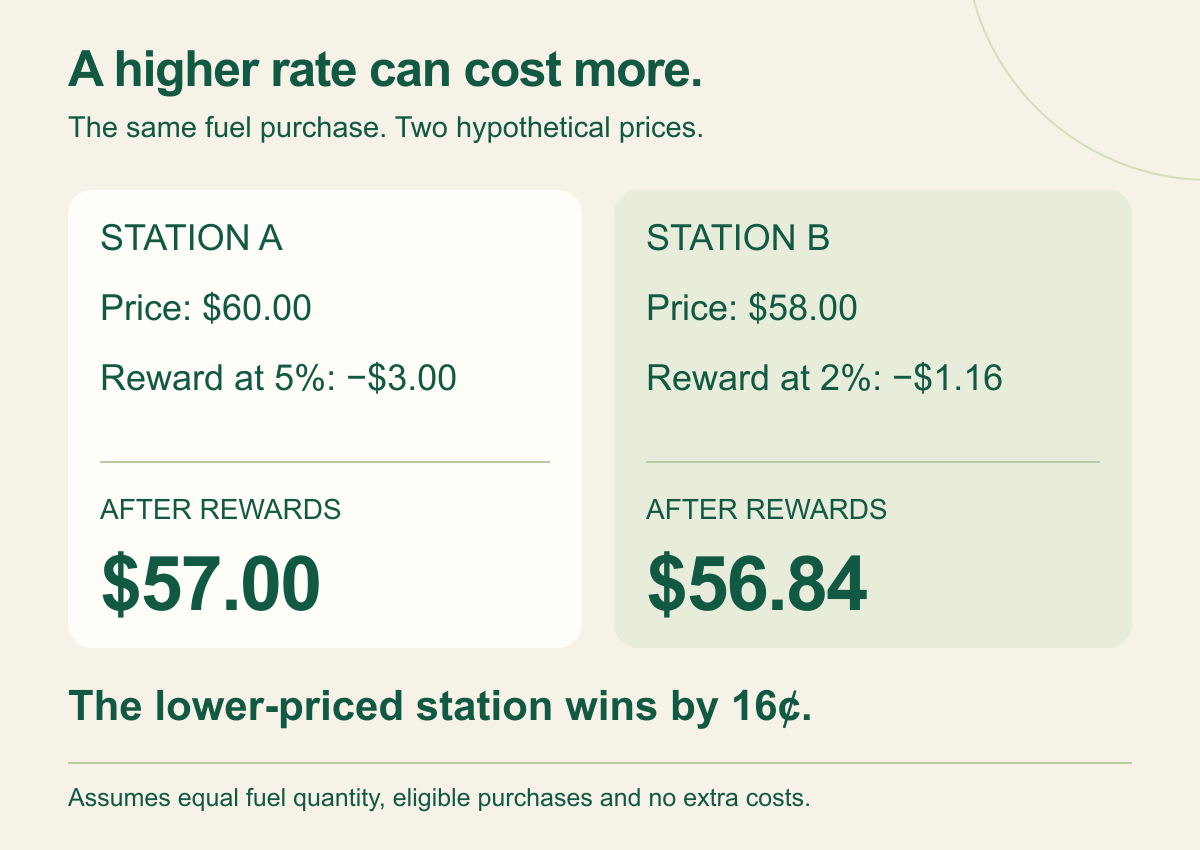
Here is a useful receipt comparison. Assume the same amount and grade of fuel costs $60 at one station and $58 at another, and each full charge is eligible for the stated reward:
| Choice | Charged | Reward | Net cost |
|---|---|---|---|
| Higher price, 5% card | $60 | $3 | $57 |
| Lower price, 2% card | $58 | $1.16 | $56.84 |
The lower-price station wins by 16 cents even with the lower card rate. Add a detour to the higher-price station and the case becomes weaker still.
Loyalty discounts deserve the same treatment. If a valid station discount reduces the amount charged, calculate the card reward on that reduced amount. Do not add a cash-only discount to a credit-card reward unless the station actually allows that combination.
The goal is a lower final cost for the trip. The rewards line is only one part of the receipt.
Give the card a job you can maintain
For our shared household, PNC Cash Rewards used on every purchase earns $383 a year because the $8,000 allowance is shared and many later purchases earn 1%. Give it just $2,400 of qualifying gas and $3,600 of dining, then use a suitable 2% card for the other $18,000: $96 + $108 + $360 = $564. That adds $84 over a one-card $480 baseline. The PNC review shows the allocation rules and full calculation.
That is a manageable two-card instruction: gas and restaurants here, everything else on the fallback. It also leaves the shared allowance less crowded than using the card for groceries simply because groceries have a bonus label.
Before committing, check cash access. Costco’s reward arrives as an annual certificate; Sam’s rewards are generally issued within one to two billing cycles and require an active membership, with in-club cash redemption subject to limits and availability. Sam’s Cash cannot be spent directly on fuel. A reward you cannot conveniently use is less attractive than the modeled number. Costco rules Sam’s rules
After the first ordinary fill-up, inspect its posted reward. Then keep an eye on the relevant cap and membership renewal. Our one-card or two-card guide helps decide whether the annual improvement deserves another account.
Frequently asked questions
Does every gas station qualify for a gas bonus?
No. Merchant classifications and issuer exclusions control. Warehouse, supermarket and superstore pumps are common reasons to check the terms before assuming a higher rate.
Which gas cards cover public EV charging?
The reviewed Costco, AAA Travel, Sam’s Mastercard, Autograph and Altitude Connect terms include qualifying public EV charging, with their respective conditions. Do not assume another card’s gas category includes charging without an explicit rule.
Does charging my car at home earn the same reward?
Usually the charge is part of your household utility bill, so the utility-payment category and fees matter. The use of the electricity does not make the merchant a public charging station.
Can I use PNC’s full allowance separately for gas and groceries?
No. Gas, dining and grocery purchases share one $8,000 anniversary-year allowance. The reward allocation follows PNC’s Reward Date rule, explained in the full review.
Is a gas card worthwhile for a low-mileage driver?
Possibly, especially if it also improves other planned purchases. But $1,200 in eligible fuel earns only $36 more at 5% than at 2%, before costs. A simple card you already use may be the more comfortable choice.
How we reviewed it: We screened ordinary-station, warehouse and EV options using official issuer and membership sources, then applied the same planned spending to documented earning and cash-redemption rules. Models exclude interest, returns, optional credits and bonuses, assume full statement payments that preserve the purchase grace period, and distinguish annual from quarterly and shared caps. No personal card-use claim is implied.
Sources & references14 sources
The issuer terms and other references behind this article.
- Citi Costco Anywhere Visa linked application pricing and full reward agreement
- PNC Cash Rewards full agreement and Reward Date allocation rule
- AAA Daily Advantage and Travel Advantage current rewards and conditions
- U.S. Bank Altitude Connect product and cash value conditions
- Citi Costco Anywhere Visa merchant exclusions
- Synchrony Sam’s Club card product and current reward disclosures
- Blue Cash Everyday current application pricing, reward and benefit terms
- Wells Fargo Autograph product and reward disclosures
- PenFed Platinum Rewards product and redemption options
- Costco membership levels and annual fees
- Sam’s Club current membership fees and joining requirements
- Sam’s Club current membership and reward program terms
- Sam’s Club joining offers and recurring standard membership prices
- Citi Custom Cash new-application closure notice