
In this article
There is a version of credit-card optimization that ends with a spreadsheet, a wallet full of cards and an awkward pause at every checkout. You do not need that version to earn a useful return.
One suitable everyday card can be a perfectly good setup. Two can also work well when the second has an obvious job: groceries and restaurants, household bills or a particular checkout route you already use.
The decision is not whether two cards can earn more in theory. It is whether the extra dollars are worth the extra routine in your household.
Our take: start with one, add one clear rule
We would begin with a suitable broad cash-back card that you can use and redeem comfortably. The examples here use a 2% cash-value baseline, not a promise that every reader will qualify for a particular product. Wells Fargo Active Cash is one purchase-based 2% option to evaluate. The no-annual-fee comparison explains account, acceptance and redemption conditions across the market.
Add a specialist only when you can state its role simply and calculate a meaningful annual improvement after costs. “This card for qualifying groceries and restaurants” is useful. “This card for everything because it has a high category rate” is how a 1% fallback can quietly undo the benefit.
This article covers reward routing. It does not prescribe a universal number of credit accounts or replace the broader how-many-credit-cards guide, which addresses a different account-management question.
The second card adds the difference, not the whole reward
If a purchase already earns 2%, moving it to a 3% specialist adds one percentage point. On $100, that is an extra $1, not an extra $3.
That sounds obvious until a two-card comparison gives the baseline card credit for the entire household, then adds all the specialist’s rewards on top. The same purchase cannot be charged to both cards in the model.
Use this rule:
Two-card improvement = extra rewards on rerouted purchases − specialist fees − other added costs.
Keep the total spending unchanged. Opening a new account should not create a new shopping budget.
What a second card adds to the same household
Our annual budget is $24,000: $4,800 qualifying supermarkets, $2,400 gas, $3,600 dining, $2,400 online retail, $1,200 Amazon, $1,200 warehouse, $1,800 utilities, $600 each for internet, phone and transit, $360 streaming, $240 drugstores and $4,200 other purchases. The groups do not overlap. Purchases are spread evenly through the year, and the warehouse example uses Sam’s Club for cross-network comparison.
One suitable 2% card earns $480. In each pairing below, the specialist handles only the purchases where its rate is useful, and the fallback handles the rest. Welcome bonuses and optional credits are excluded.
| Specialist paired with a suitable 2% card | Its job in this model | Annual net cash | Gain over one 2% card |
|---|---|---|---|
| Savor | Qualifying groceries, dining and streaming | $567.60 | $87.60 |
| Cash+ | Selected home utilities and TV/internet/streaming | $562.80 | $82.80 |
| Blue Cash Everyday | Qualifying supermarkets, gas and online retail | $588 | $108 |
| Blue Cash Preferred | Qualifying supermarkets, gas, streaming and transit | $621.40 after $95 fee | $141.40 |
| PNC Cash Rewards | Qualifying gas and dining | $564 | $84 |
| AAA Daily Advantage | Eligible groceries, gas, warehouse, drugstores and streaming | $666 | $186 |
| PayPal Cashback | The modeled $3,000 qualifying PayPal checkout | $510 | $30 |
| Prime Visa with existing useful Prime | The modeled $1,200 qualifying Amazon purchases | $516 | $36 |
Sources: Savor, Cash+, Everyday, Preferred, PNC, AAA, PayPal, Prime. These are model results under stated conditions, not a ranking of approval likelihood or a promise that every merchant qualifies. Any warehouse membership is assumed to be independently useful. PayPal’s $3,000 subset consists of the $2,400 online-retail bucket plus $600 from Other; it does not include the separate Amazon bucket.
Put the gains in monthly terms before deciding: $30 annually is $2.50 a month; $87.60 is $7.30; $186 is $15.50. A small benefit can still be worthwhile, especially for a card you already hold. It should not be described as a major household saving.
A simple Savor pairing shows the method
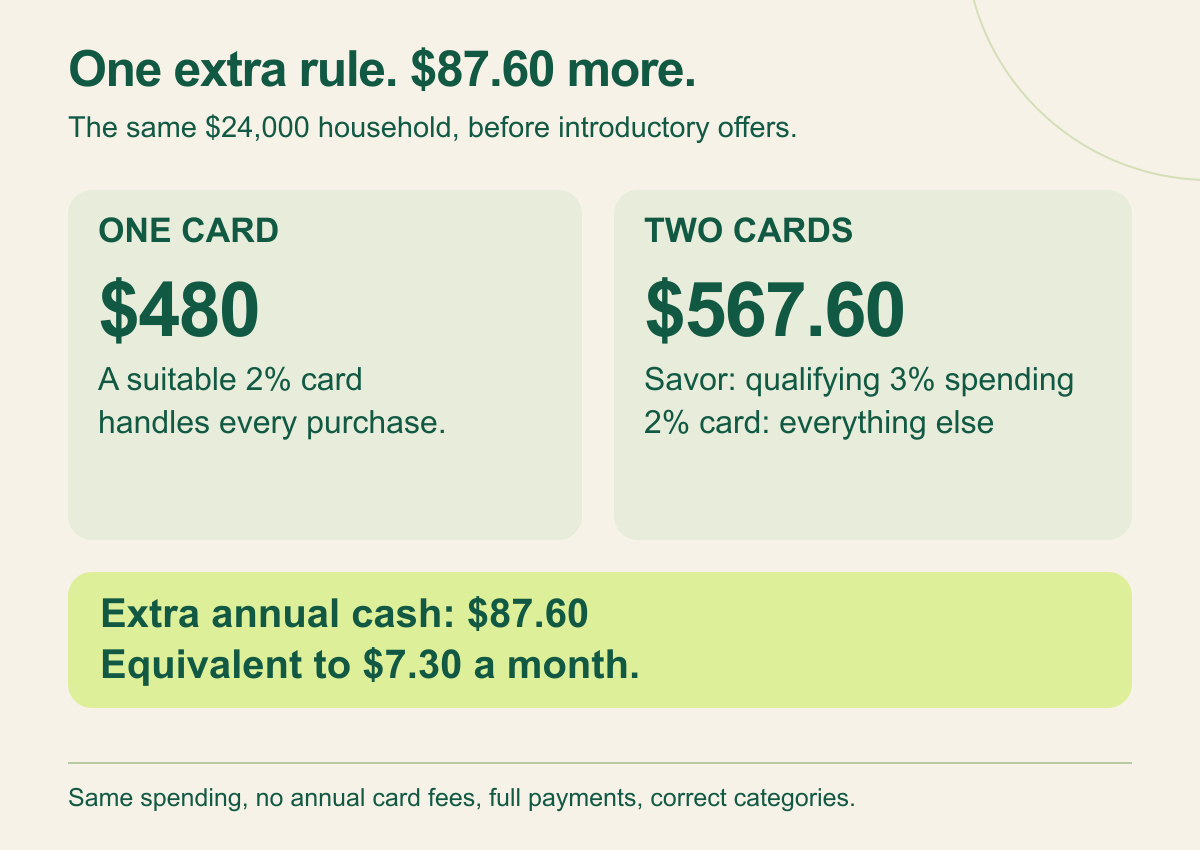
The shared household has $8,760 in qualifying Savor categories: $4,800 groceries, $3,600 dining and $360 streaming. At 3%, those earn $262.80. The other $15,240 earns $304.80 on the 2% fallback.
Total rewards are $567.60. The increase over $480 is $87.60, which is exactly one extra percentage point on the $8,760 specialist subset.
The practical rule is short: Savor for qualifying groceries, dining and streaming; the 2% card for other eligible purchases.
You still need to know which stores qualify. If $3,000 of the assumed grocery spending is at an excluded superstore and you correctly send it to the fallback, the specialist subset shrinks to $5,760. The gain becomes $57.60, and the pair earns $537.60. A smaller qualifying category does not ruin the setup; it changes what the extra account is worth.
The merchant guide helps establish those store rules before you rely on them for a year.
The biggest modeled gain deserves a cap check
AAA Daily Advantage earns $240 on the model’s $4,800 qualifying groceries, $72 on $2,400 eligible gas and $36 on $1,200 warehouse purchases. Those $348 of rewards use part of the shared $500 calendar-year reward cap for those categories. Eligible streaming and drugstores add $18 at 3% outside that shared group. AAA rates and cap
The remaining $15,000 earns $300 on the fallback. Total: $240 + $72 + $36 + $18 + $300 = $666.
AAA membership is not required under the reviewed offer, but check the current application route, merchant eligibility and cash access. The $500 cap is measured in rewards across categories with different rates, not a universal $10,000 spending limit. The grocery guide explains the mixed-category calculation.
Preferred’s $621.40 result also needs context: it already subtracts the $95 recurring annual fee and assumes the qualifying supermarket purchases remain under the $6,000 calendar-year cap. Optional Disney credits are worth $0 in the base case. Compare the free Everyday pairing and other suitable specialists rather than assuming a fee card is automatically the upgrade.
Price the mistakes you are likely to make
If $2,000 of Savor-eligible 3% purchases accidentally goes on the 2% card, the lost reward is $20. The modeled $87.60 gain falls to $67.60.
If $2,000 of ordinary purchases accidentally goes on a specialist’s 1% fallback instead of the 2% card, that also costs $20. Those errors are different, but the lesson is similar: make the broad-rate card the default when you are unsure.
| Household friction | Illustrative effect |
|---|---|
| $2,000 in missed one-percentage-point opportunities | −$20 annually |
| Twelve applicable $1.99 paper-statement fees | −$23.88 annually |
| One extra hour of administration valued at a hypothetical $30 | −$30 in your personal decision |
The time figure is a judgment aid, not a universal price on your time. Some people enjoy maintaining a simple rewards routine; others would happily give up $30 to remove a task.
These costs need not all apply to the same setup. The paper-statement example reflects the conditional fee on PayPal and Venmo, not a fee charged by every specialist. Include only the costs you actually expect. Wallet-card fee comparison
Make the payment routine as simple as the routing rule
Keep a short note or label for the specialist’s job. Update saved checkout cards and recurring payments deliberately, rather than leaving a mixture you no longer understand. If more than one person uses the accounts, agree on the same rule.
For repayment, reminders and full-statement autopay can help when backed by enough available cash. Check the first scheduled payment and continue reviewing statements; automation does not guarantee that a changed bank balance or payment instruction will work.
The reward is earned on planned purchases, not on carrying debt. If interest-bearing balances are likely, start with the interest and rewards guide before adding another account to manage.
For annual-fee specialists, put renewal on the calendar and compare the coming year with a suitable free alternative. The annual-fee guide explains why a good first year does not settle the renewal decision.
Give the setup a trial with ordinary statements
After a few normal statement periods, compare the actual category treatment and rewards with the plan. You are checking whether the stores qualify, the household follows the rule and cash can be redeemed comfortably.
If the gain is smaller than expected, adjust the estimate. Perhaps a regular store receives the fallback, a bill has a payment fee or a category is less important than last year. There is no need to defend an old calculation simply because it looked good when the account opened.
One card is a reasonable choice when simplicity improves reliability or a second account adds little. Two are useful when a clear specialist role produces a meaningful net gain. The main collection comparison helps find candidates; the final choice should fit the way you actually live.
Frequently asked questions
Are two cash-back cards always better than one?
No. Extra rewards must outweigh added fees, payment costs, administration and likely mistakes. One suitable card can be the more comfortable and reliable setup.
Why count only the extra reward from the specialist?
Because the baseline already earns something on the same purchase. Moving $100 from a 2% card to a 3% card adds $1, not $3.
Should the two cards have different categories?
A specialist plus a broad fallback is often easier to use than two overlapping specialists. The right pairing depends on rates, caps, merchant eligibility and the purchases you make.
Can the welcome bonus justify a second card?
It can improve first-year value if earned on planned purchases, but it does not repeat every year. Decide whether the second card still has a useful role afterward.
What if the extra card adds only $30 a year?
Compare $2.50 a month with the extra account and payment routine. It may be worthwhile for a card you already hold, but a small modeled gain need not justify a new application.
How we reviewed it: We used a single non-overlapping household ledger, current issuer cash values and explicit specialist routing, with relevant caps and recurring fees applied. Welcome bonuses, optional benefits and interest are excluded unless illustrated. Models assume planned eligible purchases, no returns and full statement payments that preserve the purchase grace period; they are not personal card-use results or a universal account-count recommendation.
Sources & references8 sources
The issuer terms and other references behind this article.
- Capital One Savor Rewards offer and category definitions
- U.S. Bank Cash+ offer, categories and reward disclosures
- Blue Cash Everyday current application pricing, reward and benefit terms
- Blue Cash Preferred current application pricing, reward and benefit terms
- PNC Cash Rewards full agreement and Reward Date allocation rule
- AAA Daily Advantage and Travel Advantage current rewards and conditions
- Synchrony PayPal Cashback Mastercard rewards agreement
- Chase Amazon and Prime Visa current rewards program agreement