
In this article
The appealing thing about earning rewards on a utility bill is that you were going to pay it anyway. There is no extra shopping to justify, no restaurant choice to change and no reason to fill a rewards cap with something you do not need.
The less appealing part is that the word “bill” means very little to a card’s reward program. Electricity, phone service, insurance and a streaming subscription can all follow different rules.
We would sort out those rules first, then test the payment cost. A higher category rate is useful only when it leaves you paying less overall.
Our take: a bill specialist needs both eligibility and a lower net cost
U.S. Bank Cash+ and Elan Max Cash Preferred deserve a look for qualifying home utilities and TV/internet/streaming. Their selected 5% categories can give predictable household bills a useful role within a shared quarterly allowance. Initial selection or enrollment is required, and their ongoing operational rules differ. Cash+ terms Elan program
If your main opportunity is a phone plan or streaming rather than electricity, a broader fixed-category card such as Wells Fargo Autograph may be easier. If the biller charges a card fee or removes a bank-payment discount, the existing payment method can still be better. Autograph categories
This guide answers which bills and cards may fit. The bill-payment fee guide then calculates whether the route saves money. A correct category is necessary; it is not the whole decision.
“Recurring” is a schedule, not a reward category
A monthly charge can be a utility, a phone provider, an insurer or a retailer. The issuer sees merchant information and applies its own category rules. Setting a payment to repeat does not turn it into a bonus category.
| Bill or payment route | What to check |
|---|---|
| Electricity, household gas, water or waste paid directly | Does the card’s home-utilities definition include the biller? Is there a processing fee? |
| Cable, internet or eligible streaming | Is it in a separate TV/internet/streaming category? How is a bundle billed? |
| Wireless service | Is a cell-phone-provider or phone-plan category selected or included? Will a discount be lost? |
| Insurance | Is it an eligible ordinary purchase, and is it excluded from any advertised uplift? |
| Taxes or tuition | Does the card allow rewards, what fee applies and how does the processor classify it? |
| Third-party bill-payment service | What information reaches the issuer, and does the card exclude the service? |
| Home EV charging on the electric bill | Treat it as the utility transaction; it is not public charging merely because it powers a car. |
The Elan category guide explicitly separates home utilities, TV/internet/streaming and wireless providers. It also warns that third-party payment arrangements can affect eligibility. Merchant examples illustrate categories; they are not a guarantee that every current bill from a named company posts the same way. Elan category definitions
Two 5% selections do not cover every household bill
Cash+ offers 5% on the first $2,000 in combined quarterly purchases across two selected categories, 2% in one selected everyday category and 1% on other eligible purchases. It requires quarterly category choices, and activation can take up to three business days; the higher earning is not retroactive to purchases before activation. Cash+ product Cash+ selection timing
Choose home utilities plus TV/internet/streaming, and wireless service does not automatically become a third 5% category. You would need to compare whether selecting wireless instead is more useful for your actual bills.
Elan Max Cash Preferred, available through participating financial institutions, has a comparable broad 5%/2%/1% structure and shared $2,000 quarterly allowance. Its reviewed standard rules require initial category enrollment. Read the current institution-specific selection process instead of assuming every Cash+ operating rule applies. Fulton Bank provides a current public application route for the standard Visa product. Elan rules Fulton product
Compare redemption too. Elan’s eligible deposit route is tied to the financial institution associated with the card, rather than any bank you choose; statement credits are another option. The reviewed rules allow one to two billing cycles for either cash route. Its inactivity rule can expire rewards after 12 statement cycles without reward, purchase or balance activity. Cash+ rewards instead expire at the end of the calendar month 36 months after the billing cycle in which they were earned; closure can forfeit them sooner. Elan redemption and expiry Cash+ redemption and expiry
Put a realistic set of bills through the choices
Our shared household pays $1,800 annually for home utilities, $600 for internet, $360 for eligible streaming and $600 for wireless service. Assume payments go directly to qualifying billers, are spread evenly through the year, and have no fees or lost discounts.
If Cash+ selects home utilities plus TV/internet/streaming:
| Annual bill | Amount | Modeled rate | Reward |
|---|---|---|---|
| Home utilities | $1,800 | 5% | $90 |
| Internet | $600 | 5% | $30 |
| Eligible streaming | $360 | 5% | $18 |
| Wireless service, unselected | $600 | 1% | $6 |
| Total | $3,360 | $144 |
A suitable 2% card would earn $67.20 on those same bills. The specialist’s advantage is $76.80, rather than the whole $144.
Select wireless instead of TV/internet/streaming and $2,400 earns 5% while $960 earns 1%. That produces $120 + $9.60 = $129.60, which is $14.40 less than the first selection. The better choice follows the bill totals, not which category sounds more important.
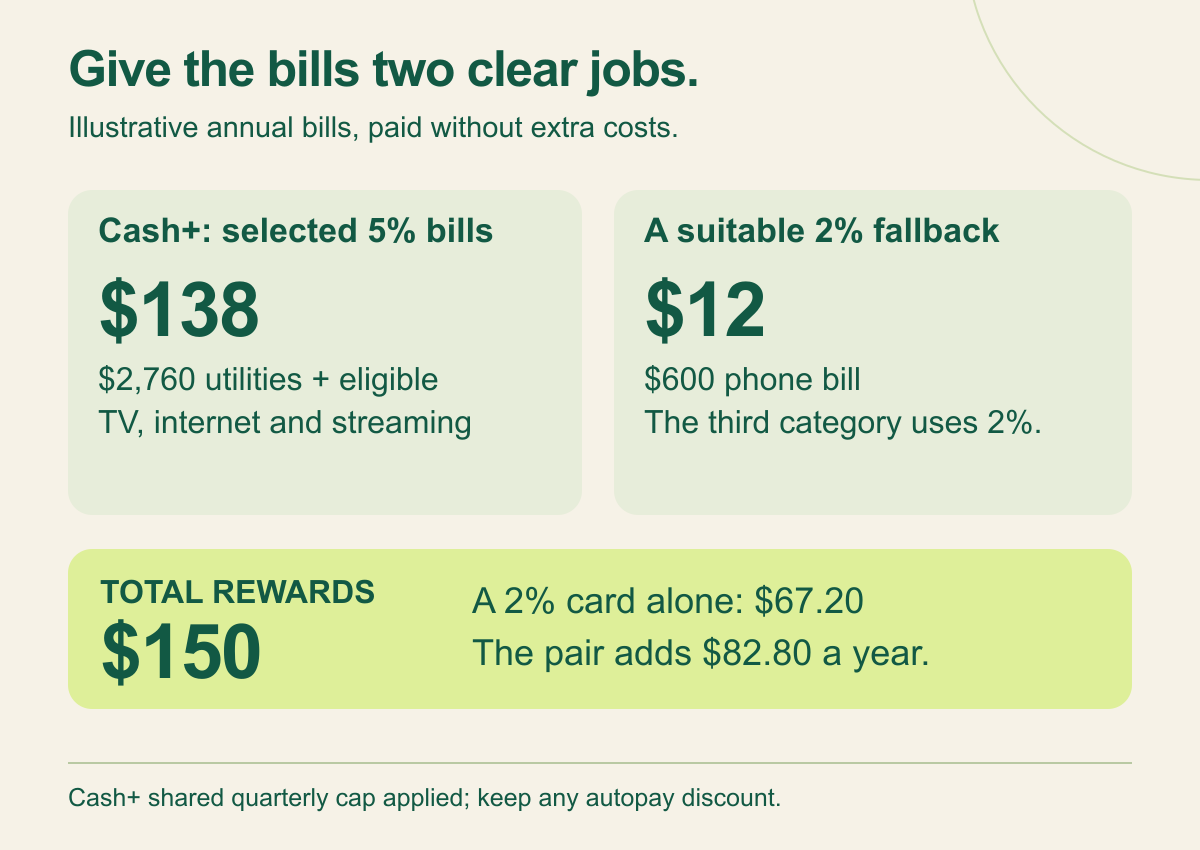
With a 2% fallback, keep the $2,760 of selected bills on Cash+ for $138 and put the $600 phone bill on the fallback for $12. The combined bill-only return is $150, adding $82.80 over the $67.20 flat-rate result–$6.90 a month before payment costs.
A larger quarter needs an overflow plan
The $2,000 limit is shared across the two selected 5% categories. It is not $2,000 for electricity plus another $2,000 for internet.
If selected-category bills total $2,400 in one quarter, the first $2,000 earns $100 and the remaining $400 earns $4 at 1%. Total: $104. Applying 5% to all $2,400 would incorrectly predict $120, overstating the return by $16.
Put the $400 overflow on a suitable 2% card and it earns $8, bringing the combined result to $108. That extra $4 is useful only if the routing is practical and does not create a payment problem.
Seasonal heating or cooling bills, an annual subscription renewal and other purchases in the same selected categories can crowd the allowance. Check the actual quarter rather than dividing a large annual bill by four and assuming every part fits.
Other cards can fit a narrower bill job
| Card or structure | Potential fit | Important limitation |
|---|---|---|
| Wells Fargo Autograph | Eligible phone plans and select streaming at 3 points per dollar | The documented 1-cent cash value matters; electricity does not become a phone charge. |
| Customized Cash Rewards | Eligible telecom and streaming within the selected online-shopping category | Shared quarterly cap; many insurance, government, school and service categories are excluded. |
| Venmo Credit Card | Defined Bills & Utilities category | 3% only when highest, 2% when second in the statement period, otherwise 1%. |
| Smartly | Eligible direct purchases at the actual relationship tier | Insurance, education, taxes and third-party bill-payment services are among uplift exclusions. |
| Suitable flat 2% card | Eligible ordinary bills without special category work | Still check acceptance, transaction fees and lost discounts. |
Sources: Autograph, Customized, Venmo, Smartly. Smartly’s excluded-but-otherwise-eligible purchases may still earn the 2% base and do not consume the uplift allowance; do not apply its highest advertised rate to every bill.
Venmo’s ranking is particularly easy to overestimate. In our broader household, eligible grocery spending is $500 per statement period, dining $300 and Bills & Utilities $280. Bills are third and earn 1%, even though the category appears in the program’s higher-rate list. The rate follows the actual ranking.
Check the existing discount before changing autopay
T-Mobile’s current AutoPay rules illustrate why this matters. Eligible methods include a linked bank account, debit card and the T-Mobile Visa; other credit cards and digital wallets are not eligible for the discount under the support page. Paying early with an ineligible method can cause the discount to be removed on the next bill. Check your plan and current rules rather than relying on an old workaround. T-Mobile AutoPay conditions
For a hypothetical $200 monthly bill, 5% earns $10. If using that card removes a $20 discount, you are $10 worse off each month, or $120 a year, before other costs. The 5% category is working exactly as advertised; the payment decision still loses money.
Combined phone and internet invoices need care too. A single charge does not automatically earn two category rates or meet every cellphone-protection condition. Ask how the provider submits it and read the benefit’s exact requirement.
Phone protection is a separate benefit to evaluate
Some cards offer conditional cellphone protection when the eligible wireless bill is paid with the card. Active Cash, for example, has coverage timing, a deductible, claim limits and exclusions in its guide. Wells Fargo benefit guide
That benefit may be valuable to someone who would otherwise pay for comparable coverage. It is not guaranteed cash back and should not be assigned the maximum claim amount every year.
We give optional insurance value $0 in the base model. If you value it separately, compare the coverage you actually gain, the cost you would otherwise pay and any lost bill discount. Keep those three lines visible so an uncertain future claim does not silently erase a certain monthly expense.
A five-minute bill audit is a useful first step
- List each biller, annual amount, current payment method and any discount you receive.
- Match the bill to the exact card category, including required selection or enrollment.
- Identify whether payment is direct or goes through a third-party processor, and record the final fee.
- Check the first normal posted charge and credited reward before projecting a year of savings.
- Recheck after a category reset, biller change, account change or price increase.
Keep the money available to pay the card as required. Moving an ordinary bill onto credit without a funded repayment plan can turn a small reward opportunity into expensive debt. The interest guide explains that tradeoff.
If a bill does not earn the expected rate, check activation timing, cap use, merchant information and exclusions before assuming an error. Contact the issuer for an explanation when the posted result appears inconsistent, then update your routing rule once resolved.
The useful setup is usually a short instruction, such as “eligible electricity and internet on this card, other payments where they cost least.” The wallet guide helps keep that instruction manageable.
Frequently asked questions
Does paying a bill online make it online shopping?
No. Online-shopping reward definitions exclude many service, insurance, government and school transactions. The merchant and card agreement control, not the fact that you used a website.
Are phone bills part of home utilities?
Often they are separate. Cash+ and Elan distinguish wireless providers from home utilities and TV/internet/streaming, so verify the selected category.
Does home EV charging earn a public-charging bonus?
Electricity included on a household utility bill follows that utility transaction. The use of the electricity does not make it a public charging-station purchase.
Can a bill-payment service guarantee the reward category?
No. Its acceptance and fee schedule do not establish how the issuer will classify the charge or override reward exclusions. Check both the service and card terms.
What if the bill earns 5% but costs 3% to pay?
Calculate the actual reward after the fee, lost discounts and any cap. The payment-fee guide shows the math; equal-looking percentages are not always applied to the same amount.
How we reviewed it: We compared official category guides, program rules, redemption conditions and a current biller’s payment-discount policy. Examples use explicitly defined direct eligible bills, shared caps and cash values; they exclude optional insurance, bonuses and interest unless discussed. Reward-only models assume full statement payments that preserve the purchase grace period and do not imply personal card use.
Sources & references12 sources
The issuer terms and other references behind this article.
- U.S. Bank Cash+ offer, categories and reward disclosures
- Elan Max Cash Preferred standard card program rules
- Wells Fargo Autograph product and reward disclosures
- Elan Max Cash Preferred Visa category definitions
- U.S. Bank Cash+ program rules and redemption
- Fulton Bank Visa Max Cash Preferred current product
- Customized Cash Rewards linked acquisition terms
- Synchrony Venmo Credit Card rewards agreement and category definitions
- U.S. Bank Smartly current tiers, eligible balances and exclusions
- T-Mobile AutoPay eligibility and discount rules
- Wells Fargo Active Cash Guide to Benefits
- Cash+ category selection and effective timing