
In this article
If you are carrying a balance, a cash-back notification can feel like a small win in an otherwise expensive account. The reward is real. It just may be much smaller than the interest accumulating beside it.
That does not mean you did something foolish by needing credit. It means a rewards comparison is answering the wrong question when the more pressing issue is how much the debt costs and how to repay it.
The useful order is borrowing cost first, rewards second. Here is what that looks like in dollars.
Our take: do not add interest-bearing purchases for rewards
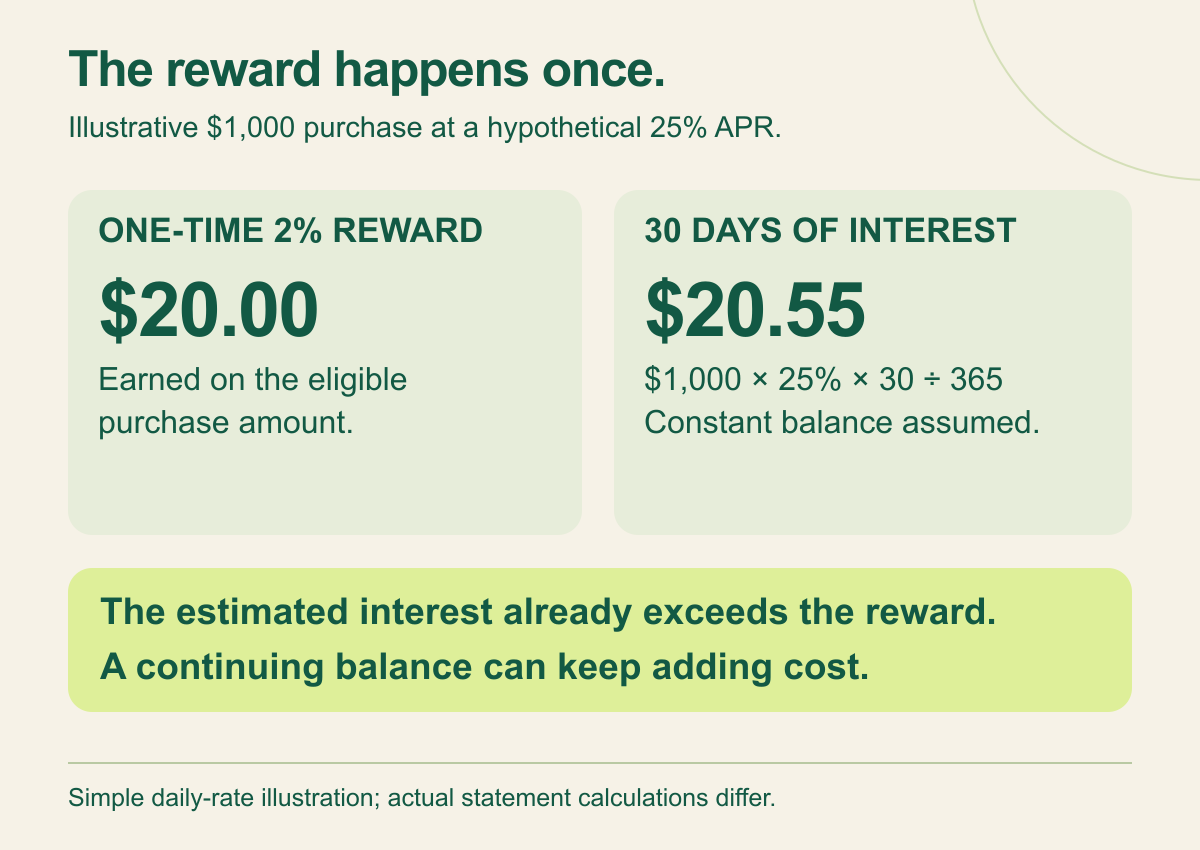
A 2% reward on a $1,000 eligible purchase is $20. At a hypothetical 25% APR, a constant $1,000 interest-bearing balance for 30 days produces about $20.55 using a simple daily-rate estimate. The month’s interest is already larger than the one-time reward.
That example is not an exact statement forecast. Payments, daily balances, posting dates, compounding and the issuer’s calculation method affect the actual amount. It shows the scale of the tradeoff. The CFPB explains that many issuers calculate interest using daily rates and average daily balances. CFPB interest guidance
If you can avoid the additional borrowing through a suitable payment method, a lower-cost option or a realistic delay in a nonessential purchase, compare that choice before chasing a category rate. If the expense is necessary and borrowing is unavoidable, evaluate the financing on its own terms; a small reward does not make the debt inexpensive.
Compare dollars over the same period
APR is an annual rate, while a purchase reward is usually a one-time percentage of that purchase. Simply saying “24 is bigger than 2” does not calculate the bill. You need the amount outstanding and how long it remains there.
For a simple illustration with a constant balance and no compounding:
Estimated interest = balance × annual rate × days ÷ 365.
On a constant $1,000 at 24% APR, that is about 66 cents per day. Over 30 days, the estimate is $19.73. Over 31 days, it is $20.38–more than the one-time $20 reward from a 2% purchase.
| Hypothetical APR | Estimated 30-day interest on constant $1,000 | One-time 2% reward | Reward minus this interest |
|---|---|---|---|
| 18% | $14.79 | $20 | $5.21 |
| 24% | $19.73 | $20 | $0.27 |
| 25% | $20.55 | $20 | −$0.55 |
| 30% | $24.66 | $20 | −$4.66 |
These are hypothetical rates, not offers or predictions about approval. A small positive amount after 30 days does not establish a good borrowing strategy. Another month can reverse it, and the reward does not repeat merely because the balance remains unpaid.
Even a higher category reward has a limit
A 5% reward produces $50 on a $1,000 purchase. At the same constant-balance 24% example, approximately 76 days of simple estimated interest would consume that amount.
This is a way to understand the cost, not a recommendation to borrow for 75 days. The actual account may have other balances, fees or different interest treatment, and a repayment delay can extend longer than planned.
For a $3,000 constant balance at 24%, 30 days of simple estimated interest is about $59.18. That is roughly the entire annual gain of improving $12,000 of purchases from 1.5% to 2%. A small optimization elsewhere can be overwhelmed by the borrowing cost in one account.
The most useful “reward” may therefore be the interest avoided by reducing the balance sooner, when your budget allows. Because many cards accrue interest daily, payment timing can affect the cost. CFPB daily-interest explanation
The purchase grace period is the important distinction
Many credit cards provide a purchase grace period when you pay the statement balance in full by the due date and meet the account’s conditions. That can let ordinary purchases earn rewards without accruing interest. The CFPB notes that grace periods are not required on every card and generally apply to purchases rather than cash advances. CFPB grace-period guide
If you lose the grace period by carrying a balance, new purchases can begin accruing interest from their transaction dates. Paying only the minimum may keep the account current while leaving interest-bearing debt.
That is why a new grocery purchase on an account already carrying a balance can be more expensive than the same purchase on an account whose purchase grace period applies. The 3% or 5% category label does not change that interest rule.
Ask the issuer what is required to restore the purchase grace period and whether residual interest may appear after a payoff. Do not assume one payment resolves every timing issue. Your agreement and account status determine the answer.
Statement balance and current balance are different
The statement balance is the amount at the last billing-cycle close. The current balance changes as newer purchases, payments, fees and credits post.
For an ordinary purchase grace period, paying the required statement balance in full by its due date is generally the relevant condition. It does not automatically mean every purchase made after that statement closed must be paid early too. Special financing plans and transferred balances can change how the account works. CFPB grace-period explanation
For example, a statement closes with $800 owed and you make another $100 purchase afterward. Under a qualifying ordinary purchase grace period, the $800 statement amount is the figure to pay by that statement’s due date; the newer $100 normally belongs to the next statement. Confirm the account’s displayed payment requirement and terms.
A reward statement credit may reduce the balance but generally does not replace the required minimum payment. A wallet reward transfer also does not automatically pay a linked credit-card bill. Keep rewards and repayment as separate actions in your routine.
A 0% balance transfer is not necessarily 0% shopping
A card can offer a promotional 0% APR on transferred debt while charging its regular purchase APR on new spending. Citi Double Cash’s reviewed offer illustrates this distinction: it has 0% on balance transfers for 18 months from account opening, but no matching 0% purchase offer. Its introductory transfer fee is 3% with a $5 minimum for transfers completed in the first four months; later transfers cost 5% with a $5 minimum. Citi current pricing
The outstanding transferred balance can also affect the grace period on new purchases. The CFPB warns readers to check that interaction before using a transfer card for shopping. CFPB transfer guidance
Keep the transferred debt, transfer fee and payoff deadline in their own plan. A $3,000 transfer with a 3% fee starts at $3,090 if the fee is added to the account. Having 18 available payment dates would imply roughly $171.67 per payment to clear it, with final rounding; a later transfer can leave fewer dates before the promotion ends.
Do not use the card’s rewards structure as a reason to keep the transferred debt outstanding. Citi’s eligible-payment reward, for example, does not require paying interest, and transfers are not ordinary reward-earning purchases under the reviewed rules. Citi reward agreement
A genuine 0% purchase offer needs a funded plan
A real introductory purchase APR can change the interest calculation during its stated period. The reviewed Freedom Unlimited offer, for example, includes 0% on purchases for 15 months from account opening, followed by its variable standard APR. Payment obligations continue, and other transaction types and fees have separate terms. Chase offer
Suppose you have a necessary $1,000 purchase and a qualifying purchase promotion that comfortably covers a ten-month repayment plan. A $100 monthly target repays the purchase over ten months without relying on rewards, assuming no other balances, fees or disqualifying events.
That plan is different from making an unaffordable purchase and hoping the reward helps later. Check the exact promotion end date, count the actual payment dates and leave a buffer before expiry. The required minimum may be lower than the amount needed to clear the balance on time.
Also distinguish a bank card’s 0% introductory APR from a deferred-interest offer. A deferred-interest promotion can charge interest back to the purchase date if its conditions are not met. Read the exact financing disclosure rather than treating every “no interest” headline as the same product. CFPB deferred-interest explanation
If you already owe money, make the next step manageable
Write down the current balance, actual APR, minimum payment, due date and an amount you can realistically pay. If there are several balances or APR categories, use the statement’s breakdown instead of one assumed rate.
Avoid adding purchases merely to preserve a rewards habit. When suitable, move new planned spending to a payment method that does not add interest-bearing debt, while keeping enough cash for essential expenses and the existing payment plan.
If you are struggling to make the minimum, contact the issuer promptly about available assistance. You do not need to wait until the account is late to explain the situation. The CFPB recommends contacting the card company and discussing what you can afford; nonprofit credit counseling may also help assess options. CFPB payment-difficulty guidance
A new application is not guaranteed to provide enough credit, a promotional rate or an affordable payoff schedule. Compare any transfer fee and the full repayment plan before treating another card as the solution.
Return to rewards when the financing is under control
For planned purchases that will be paid without interest, cash back can be a useful small reduction in everyday costs. The main card comparison helps choose an earning pattern, and the wallet guide keeps the routine simple.
If the purchase is a bill with a processing charge, include the payment-fee calculation. If a welcome offer is involved, make sure its spending requirement fits the existing budget using the bonus planning guide.
Rewards work best as a small benefit attached to a sound payment plan. They should not be the reason the balance gets larger.
Frequently asked questions
Do I need to carry a balance to earn cash back?
No. Ordinary eligible purchases can earn rewards when the statement is paid in full. Paying interest is not a requirement for those rewards.
Does paying the minimum avoid interest?
Usually not. It can satisfy the payment requirement while leaving a balance that accrues interest under the agreement. Check the statement balance and purchase grace-period conditions.
Can a reward statement credit pay the bill for me?
A credit can reduce the balance but generally does not replace the required minimum payment. Follow the account’s payment instructions and confirm the amount still due.
Can I shop interest-free on a card with a 0% transfer offer?
Do not assume so. Purchases may have a different APR, and the transfer can affect their grace period. Verify the exact purchase promotion and account rules first.
Are the interest figures exact statement forecasts?
No. They hold the balance constant and use a simple daily-rate estimate to show scale. Actual interest depends on daily balances, payments, posting dates, compounding, rate changes and the issuer’s method.
How we reviewed it: We checked official CFPB explanations and current issuer examples, then used clearly labeled constant-balance calculations to compare one-time rewards with borrowing costs. The figures are educational illustrations rather than personalized repayment advice, exact statement forecasts or approval predictions. Reward-only examples elsewhere in the collection assume purchases paid under the applicable grace-period conditions.
Sources & references8 sources
The issuer terms and other references behind this article.
- CFPB explanation of deferred-interest financing
- CFPB steps when unable to pay credit-card bills
- CFPB explanation of daily credit-card interest calculations
- CFPB explanation of credit-card grace periods
- Citi Double Cash linked acquisition pricing and reward agreement
- CFPB explanation of new purchases during promotional balance transfers
- Citi Double Cash ThankYou reward terms
- Chase Freedom Unlimited current offer and reward rules