In this article
You bought groceries. Your card paid the ordinary 1% rate. From your side of the checkout, that can look like a mistake.
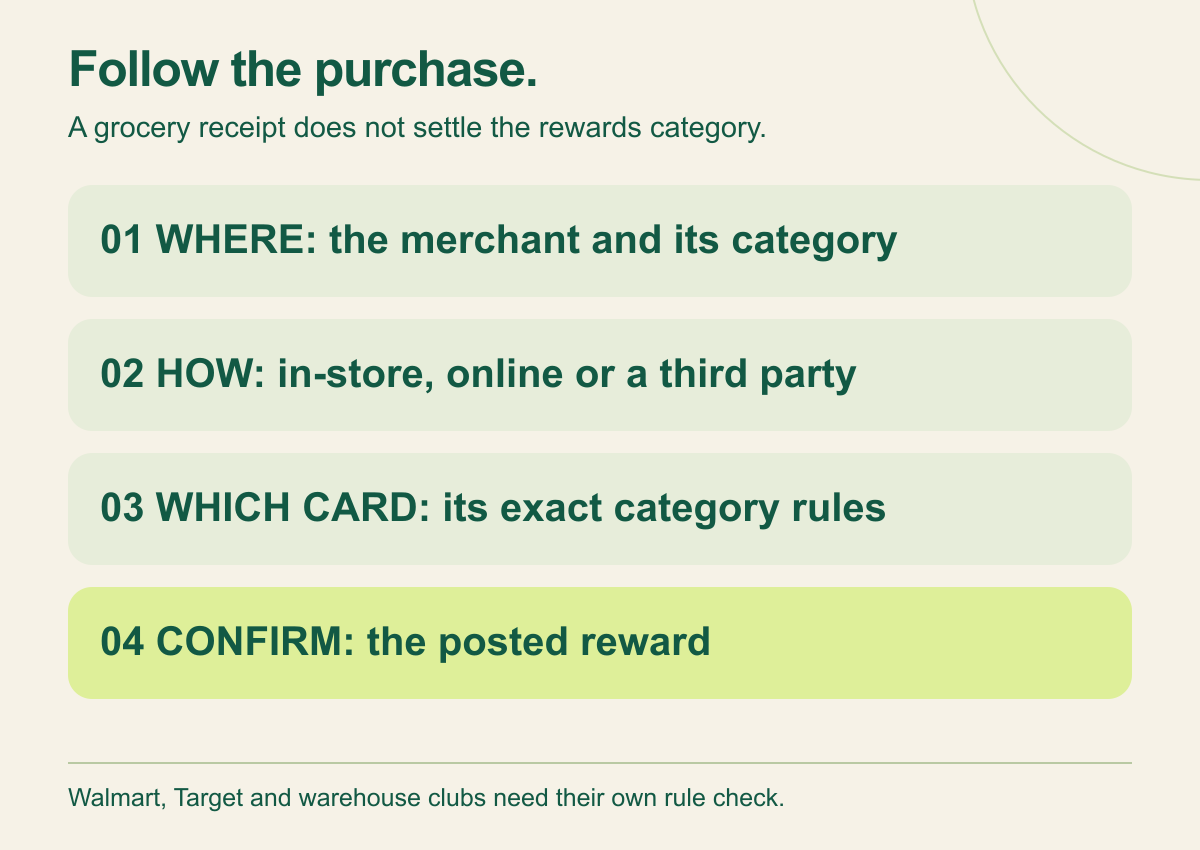
From the reward program’s side, the store may have been classified as a superstore or warehouse club rather than a supermarket. The milk and vegetables in the basket do not change the merchant’s business category.
The useful response is to work out which rule applied, then choose the right card for that store. You do not need to change where you shop simply because your grocery card has a narrower definition of groceries than you do.
The short answer for the three common stores
| Store and purchase | What to expect from the rule | What to compare instead |
|---|---|---|
| Walmart in-store merchandise | Savor and Amex supermarket exclusions mean food does not automatically earn their supermarket bonus. | The card’s ordinary rate or an explicitly eligible store/category benefit. |
| Target in-store merchandise | The same superstore issue applies to those supermarket categories. | An ordinary flat-rate card or the qualifying Target Circle Card discount, including its debit option. |
| Costco warehouse merchandise | It is a warehouse-club purchase, not an Amex supermarket purchase. Acceptance is a separate check. | An accepted Visa with a useful flat or explicit warehouse rate. |
| Eligible retailer website purchase paid online | It may qualify under an online-retail category even when the supermarket category excludes the store. | Exact online-payment and merchandise rules, plus any shipping or price difference. |
Sources: Savor definitions, Amex category guide, Everyday online-retail terms, Target discount rules, Costco payment acceptance. This table describes the relevant rules; it does not guarantee how every location or transaction posts.
The merchant category does not inspect your shopping list
The payment system carries information about the merchant and transaction. The issuer groups eligible merchant classifications into reward categories and adds exclusions. A retailer selling food, televisions, clothes and household goods may be treated as a superstore. A membership warehouse can be treated as a wholesale club. Amex explanation Capital One explanation
A $150 basket containing only groceries does not automatically receive a different merchant category from a $150 basket containing household supplies at the same checkout. Conversely, a qualifying supermarket purchase can be governed by that store category even when some items are not food, subject to the program’s terms.
That is why budgeting-app labels are not enough. “Groceries” in your household budget is a useful spending description. “U.S. supermarket” in a card agreement is a defined reward category.
Do not transfer one issuer’s definition to another. Venmo’s Grocery category explicitly includes eligible wholesale clubs, while Amex’s supermarket category excludes them. The same merchant can therefore receive different reward treatment on two cards without either issuer making an error. Venmo category definitions
An online order can use a different rule
Blue Cash Everyday has a separate 3% eligible U.S. online-retail category, up to $6,000 in purchases each calendar year, then 1%. It is distinct from the card’s supermarket category. Everyday terms
The online-retail rule requires eligible physical merchandise sold directly to consumers by a qualifying U.S. retail merchant, online payment and appropriate internet-transaction identification. It excludes several merchant types, including restaurants, supermarkets, gas stations, travel, entertainment and services. A bill paid online is not automatically online retail.
| How the order happens | Why it matters |
|---|---|
| Choose merchandise online and pay online | Potentially eligible if the merchant, goods and transaction identification satisfy the terms. |
| Pay online and pick up in store | Eligible if the retail purchase meets the rule and the merchant identifies it as an online transaction. |
| Reserve online but pay at the store | Excluded from the online-retail category; choosing the goods online is not enough. |
| Pay by phone | Not the same as paying through a qualifying website or app under the online-retail rule. |
| Use an in-store mobile wallet | Excluded from Amex’s online-retail category under the published rule. |
| Use a third-party buy now, pay later installment program | Excluded from Amex’s online-retail category under the published rule. |
Walmart Pay, Apple Pay or another wallet is a payment tool. Amex’s published online-retail rule excludes in-store mobile-wallet payments. Older anecdotes about a checkout route do not make it a dependable exception. Amex online-retail rules and pickup FAQ
For a $100 eligible merchandise purchase, 3% earns $3, 2% earns $2 and 1% earns $1. The improvement from a verified 3% route over a flat 2% card is only $1. Do not pay a $5 shipping fee just to collect it.
Delivery introduces another merchant and another price
A grocery order through a delivery platform may follow the platform’s transaction information and the issuer’s specific service rules. It should not automatically be treated as a direct supermarket purchase just because the shopper picked up the items at a supermarket.
Check whether the card explicitly covers the service or its payment route. The grocery-card comparison includes delivery-specific alternatives and their caps. That is a card-selection question after classification has been established.
Also compare the final order price. If a basket costs $100 directly and $108 through another channel, 5% on the $108 order returns $5.40 and leaves a $102.60 net cost. A 2% reward on the $100 purchase leaves $98. The higher-rate route still costs $4.60 more.
Convenience may be worth paying for. The reward should be treated as a small offset to that cost, rather than proof that the delivery order is cheaper.
At Costco, acceptance comes before the percentage
Costco’s current U.S. payment page lists Visa cards for warehouse and gas-station credit-card purchases, with other permitted methods listed separately. Costco.com also lists Mastercard. The exact venue matters; do not assume a card accepted online will be accepted at a U.S. warehouse checkout. Costco payment methods
This is why our shared household illustration uses Sam’s Club for warehouse purchases when comparing the same purchases across card networks. It does not assume every reviewed card can pay for Costco warehouse merchandise.
Costco Anywhere Visa has explicit Costco merchandise and fuel rewards, but its 2% merchandise rate is not automatically better than another suitable 2% Visa. Fuel, dining, membership and annual certificate timing may provide the more useful distinctions. Citi Costco terms
Venmo’s explicit warehouse inclusion can make its Visa relevant, but its Grocery category earns 3% only when it ranks highest in the statement period, 2% when second and otherwise 1%. A generous category definition does not guarantee the highest rate every month. Venmo ranking rules
The fuel pump may have another set of exclusions
A store’s merchandise category and its fuel treatment deserve separate checks. Amex’s U.S. gas-station definition excludes fuel sellers such as superstores, supermarkets and warehouse clubs. A pump that looks like an ordinary gas station does not override those exclusions. Amex gas definitions
Other cards have explicit club-fuel or qualifying public-EV rules. The gas-card comparison separates ordinary stations, club pumps and charging so you can choose around the places you actually use.
Home EV charging is different again: electricity on a household utility bill follows the utility merchant. It does not become a gas or public-charging transaction because you used some of the electricity for a vehicle.
Diagnose a disappointing reward in five steps
- Let the transaction and reward finish posting. A pending authorization or an in-cycle estimate may not show the final result.
- Record the basics. Keep the merchant name, date, amount, payment route and reward credited. Note whether you paid directly, through a wallet or through another service.
- Read the exact rule. Check the current card’s category definition, exclusions, activation timing and remaining cap for that period.
- Ask the issuer about an apparent mismatch. Request an explanation of the category and eligibility applied to the posted transaction, and keep the case reference.
- Update the practical rule for that merchant. Once resolved, use the card that provides the better available return and recheck when the payment route changes.
An unexpected reward is not always a merchant error. The transaction may be correctly classified but excluded by the issuer, above a cap or outside an activation window.
The cashier may not know the card’s reward rules, and an issuer inquiry does not guarantee that a merchant code will be changed. You are looking for a reliable explanation, not a way to force every grocery purchase into a supermarket category.
Keep the cheaper store in the comparison
Suppose the same basket is $150 at a qualifying supermarket and $145 at an excluded superstore. At 3%, the supermarket reward is $4.50, making the net cost $145.50. At 2%, the superstore reward is $2.90, making the net cost $142.10. The lower-price store remains $3.40 cheaper after rewards.
That simple receipt comparison can save more than finding a clever payment route. Include membership costs, shipping, delivery and the time you value when those differ between choices.
At Target, the Circle Card’s qualifying 5% discount is available through a debit version as well as credit options, subject to exclusions. A new credit account is therefore not necessary merely to seek that particular discount. It is a store-price benefit, not general cash back. Target discount terms
Once you know which merchants qualify, choose a card around them. Blue Cash Everyday, Savor and Venmo have different useful roles. A simple specialist-and-fallback setup can handle exceptions without making checkout a research project.
Frequently asked questions
Why did my grocery purchase earn only 1%?
The merchant may fall outside the card’s supermarket definition, or a cap, activation rule or payment route may apply. Wait for final posting, then check the exact agreement and ask the issuer about an apparent mismatch.
Does Walmart or Target ever qualify for higher rewards?
A separate eligible online-retail, store or other category may apply, even when a supermarket category excludes the merchant. Verify the exact transaction and card rule rather than treating the store name as a universal rate.
Does using a mobile wallet make an in-store purchase online shopping?
No. A wallet is a payment method; it does not by itself establish the internet-transaction identification required by a card’s online-retail program.
Can I use a Mastercard at Costco?
Costco’s U.S. website lists Mastercard for Costco.com, while U.S. warehouse and gas-station credit-card acceptance centers on Visa. Check the current page for the exact location and permitted payment method.
Should I change stores to earn a supermarket bonus?
Compare the same basket’s final cost first. A lower-priced store earning 1% or 2% can leave you spending less than a higher-priced supermarket earning a bigger reward.
How we reviewed it: We compared official issuer category definitions, online-payment conditions, store discount rules and current Costco acceptance information. Examples illustrate transaction classification and net basket cost without guaranteeing a particular location’s coding. Reward calculations assume eligible planned purchases, no interest or returns and full statement payments that preserve the purchase grace period.
Sources & references7 sources
The issuer terms and other references behind this article.
- Costco current U.S. warehouse, gas station and online payment methods
- Capital One Savor Rewards offer and category definitions
- American Express eligible retail and rewards category definitions
- Blue Cash Everyday current application pricing, reward and benefit terms
- Target Circle Card discount rules including debit-card alternative
- Synchrony Venmo Credit Card rewards agreement and category definitions
- Citi Costco Anywhere Visa product and reward conditions