
In this article
You can fill a cart with the same milk, eggs and cereal at four stores and earn four different rewards rates. That is an irritating detail to discover after choosing a “grocery” card.
The card issuer generally cares about the merchant and its transaction information, not your shopping list. A supermarket, a superstore, a warehouse club and an app order can land in different categories. The first useful step is therefore wonderfully unglamorous: look at the store names on your statements.
Once you have that list, the choice gets much easier. Here is how we would narrow it down without turning every grocery run into homework.
Our take: match the card to the receipt
For a household that wants one easy rule for qualifying groceries and dining, Capital One Savor is a sensible starting point. Its ordinary 3% rate in those categories has no spending cap, and there is no annual fee. The tradeoff is the 1% return on many other purchases. Savor terms
For someone who already uses a suitable 2% card elsewhere, a grocery specialist can make more sense. Blue Cash Preferred earns more at qualifying U.S. supermarkets, but its $95 ongoing annual fee needs to earn its place. AAA Daily Advantage deserves a look alongside it: no annual fee, a strong grocery rate and a shared reward cap that requires its own calculation. Preferred terms AAA terms
If most of your food comes from Costco, Walmart or Target, pause before applying for either Amex supermarket rate. Your best starting point may be a card that explicitly covers that merchant, an accepted flat-rate card or a store discount available without opening a credit account.
The best grocery card should reward your existing shopping routine. Moving to a more expensive store to improve the percentage is a poor trade.
Divide one food budget into four useful buckets
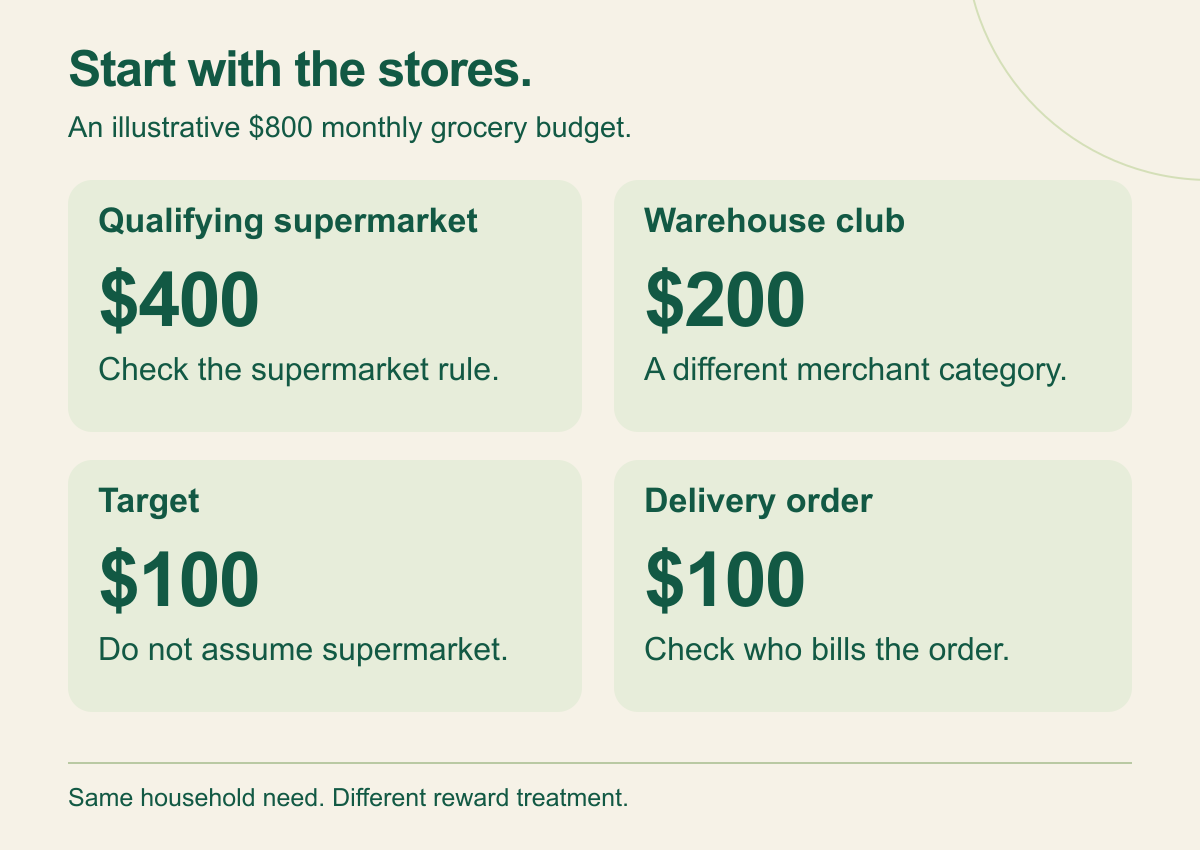
Consider an $800 monthly grocery budget:
| Where the money goes | Monthly amount | What to check |
|---|---|---|
| Standalone supermarket | $400 | Does this merchant meet the issuer’s supermarket definition? |
| Warehouse club | $200 | Does the card include clubs, and is its network accepted? |
| Target | $100 | Compare a qualifying store discount with the card’s actual category. |
| Delivery service | $100 | Which merchant or platform processes the order, and what does that channel cost? |
| Total food purchases | $800 | Only $400 is clearly in the supermarket bucket before verification. |
Calling the whole $800 “supermarket spending” can double the amount you expect to receive a supermarket bonus on. That does not mean the other $400 cannot earn a good return. It means it needs the right rule.
Amex explicitly excludes superstores and warehouse clubs from its U.S. supermarket category. Savor’s grocery definition excludes superstores such as Walmart and Target. Venmo, by contrast, includes wholesale clubs in its defined Grocery category, although its monthly category ranking and card acceptance still matter. Amex category definitions Savor definitions Venmo categories
For a confusing transaction, our Walmart, Target and Costco rewards guide walks through the classification problem. For choosing a card, work from verified buckets rather than hoping a store will qualify.
A shortlist for the way you actually shop
| Your routine | Start here | The catch worth reading |
|---|---|---|
| Supermarkets and restaurants, without tracking a grocery cap | Savor | Ordinary purchases outside bonus categories earn 1%. |
| Supermarkets, gas and online merchandise | Blue Cash Everyday | Each of those 3% categories has its own $6,000 calendar-year spending limit, then 1%. |
| Substantial qualifying supermarket spending | Blue Cash Preferred; AAA Daily Advantage | Preferred has a fee; AAA’s grocery, gas and club rewards share a cap. |
| Warehouse groceries | Venmo; AAA Daily; an accepted 2% card | Ranking, shared caps and payment-network acceptance can change the result. |
| Existing Prime member buying at Whole Foods or Amazon | Prime Visa | The enhanced rate requires eligible Prime and a qualifying purchase. |
| Regular Target shopping | Target Circle Card debit or credit option | The 5% store discount has exclusions; the debit option is a relevant alternative. |
| Existing Instacart user | Instacart Mastercard | Its qualifying 5% category has a $6,000 annual spending cap defined by billing cycles. |
| A useful announced grocery quarter | Freedom Flex or Discover it Cash Back | Activation and a quarterly cap apply; this is not a promised year-round grocery rate. |
Sources: Everyday, Preferred, AAA, Prime, Target, Instacart, Flex, Discover. These are starting points by use case, not a ranking based on the biggest welcome offer.
What the supermarket rate earns after the fee
This table isolates qualifying supermarket purchases. It excludes welcome offers, optional credits and every other spending category. AAA’s column assumes groceries alone use its shared cap. Figures are annual cash rewards after the stated recurring card fee.
| Annual qualifying supermarket spend | Suitable 2% card | Savor at 3% | Blue Cash Everyday | Preferred after $95 | AAA Daily, groceries only |
|---|---|---|---|---|---|
| $3,600 | $72 | $108 | $108 | $121 | $180 |
| $6,000 | $120 | $180 | $180 | $265 | $300 |
| $9,600 | $192 | $288 | $216 | $301 | $480 |
At $3,600 in supermarket spending, Preferred beats Everyday by just $13 after its ongoing fee. That is a much calmer basis for a decision than “6% versus 3%.”
At $9,600, Preferred earns $360 on the first $6,000 and $36 on the remaining $3,600. Subtract $95 and the result is $301. Savor’s uncapped 3% produces $288, only $13 less on these grocery purchases. Everyday’s corresponding result is $180 plus $36, or $216.
A fallback changes the high-spend comparison. Put Preferred’s first $6,000 of qualifying groceries on the card and the remaining $3,600 on a suitable 2% card: $360 + $72 − $95 = $337. That is $49 more than Savor’s $288, before considering the rest of the household.
None of these examples requires additional shopping. The cap tells you when the reward changes; it is not a target to fill.
AAA’s cap is measured in rewards, not one spending limit
AAA Daily Advantage’s 5% grocery category shares a $500 calendar-year cash-reward limit with its eligible 3% gas/EV-charging and wholesale-club categories. Those categories earn 1% after the limit. The reviewed FAQ says AAA membership is not required. AAA eligibility and cap
If groceries are the only purchases using that allowance, $10,000 at 5% produces $500. But “a $10,000 cap” is misleading when you also use the card for gas and warehouse purchases.
For example, $8,000 of qualifying groceries earns $400. Another $3,000 of eligible gas and club purchases earns $90. You have then used $490 of the reward allowance, leaving $10 before the capped categories step down. The category and sequence of further qualifying purchases determine how quickly you use that last $10.
That is manageable for an organized household. It is also a reason to compare the card with an uncapped option if you would rather never think about an allowance. A higher potential return and a better personal fit are not always the same thing.
The rest of the household can overturn the grocery winner
Our shared $24,000 annual household spends $4,800 at supermarkets, $2,400 on gas, $3,600 on dining, $3,600 on online merchandise including Amazon and $1,200 at Sam’s Club. The remaining $8,400 includes utilities, internet, phone, streaming, drugstores, transit and other purchases. We use Sam’s for this cross-network illustration; that does not establish acceptance at Costco.
On that complete budget, the ordinary annual results are:
| Card setup | Annual cash after recurring card fees | Difference from $480 on a suitable 2% card |
|---|---|---|
| Savor alone | $415.20 | −$64.80 |
| Everyday alone | $456 | −$24 |
| Preferred alone | $463 | −$17 |
| AAA Daily alone | $516 | +$36 |
| Everyday plus a 2% fallback | $588 | +$108 |
| Preferred plus a 2% fallback | $621.40 | +$141.40 |
| AAA Daily plus a 2% fallback | $666 | +$186 |
The complete household comparison provides the category ledger and assumptions. Preferred’s results include its $95 ongoing fee. Any warehouse membership is assumed to be independently useful; a membership bought solely for rewards would be an additional cost. Optional credits and introductory bonuses contribute $0 here. These are modeled results, not a claim that an editor personally earned these amounts.
Notice how Everyday and Preferred are only $7 apart when used alone. Online retail helps Everyday catch up. With a suitable fallback, Preferred’s lead over Everyday becomes $33.40 a year–about $2.78 a month.
That difference may be worthwhile. It is simply a much smaller decision than the front-of-card grocery percentages suggest.
Keep delivery convenience separate from delivery savings
Delivery can be worth paying for. A busy parent, someone without a car or someone who cannot comfortably shop in person may reasonably value the service. The rewards calculation should still use the final price.
Suppose the same basket costs $100 in one channel and $108 in another. The $108 order earning 5% returns $5.40, leaving a net cost of $102.60. The $100 purchase earning 2% returns $2, leaving $98. The higher-reward order costs $4.60 more.
Instacart Mastercard’s current qualifying 5% allowance is $6,000 across the defined 12 billing cycles, then 1%. Starting in 2026, those cycles run after the previous December statement through the following December statement. That is more precise than assuming the counter resets on January 1. Instacart offer and annual definition
Prime Visa can be useful for existing eligible Prime members shopping at qualifying Whole Foods or Amazon channels. Compare its 5% with the Amazon Visa’s 3% on those purchases without Prime before buying a membership solely for rewards. Prime and Amazon Visa
For an existing Sam’s member, the Mastercard earns 3% in Sam’s Cash on eligible club purchases with Plus, versus 1% with Club membership. That makes the membership level decisive: the card’s 1% merchandise rate is weaker than an accepted 2% fallback. Plus membership has its own separate reward; do not count all of that benefit as an improvement created by the credit card. Cash access and purchase exclusions still apply. Sam’s issuer and program Sam’s membership rewards
At Target, the debit Circle Card’s qualifying 5% discount deserves a look before deciding a new credit account is necessary. It is a store discount, not transferable cash back, and exclusions apply. Target discount rules
Citi Custom Cash is an existing-holder option: new applications closed May 28, 2026. We also screened Shopper Cash Rewards and Kroger-family cards, but have not established a current Shopper acquisition offer or Kroger variant’s complete earning and application terms. They stay outside this numerical shortlist. The wider comparison explains those limits and the focus on consumer cash value rather than business, rebuilding or travel-transfer strategies. Citi availability
Make one choice, then check one statement
We would start with three months of purchases and sort them into merchant/channel buckets. Estimate a full year, including seasonal changes, then compare ordinary cash after the recurring fee. Keep any welcome offer on a separate first-year line.
If Preferred looks appealing, use Everyday versus Preferred to include online shopping and usable credits. If restaurants are a substantial part of the food budget, Savor versus Preferred is the more useful comparison.
After choosing, check how the first normal grocery purchase posts. You want evidence that your regular store earns the expected rate before multiplying it by 12 months. There is no need to change the entire household routine on day one.
And if the improvement is modest, keeping a simpler setup is a respectable decision. A grocery card should make the weekly shop a little more rewarding, not give you another errand.
Frequently asked questions
Do Walmart and Target count as supermarkets?
Not automatically. Major supermarket reward programs often exclude superstores, and the card’s merchant definitions control. An online purchase may qualify under a separate online-retail category, but that is a different rule to verify.
Is Blue Cash Preferred always better above $3,167 in groceries?
No. At roughly $3,166.67 of annual qualifying supermarket spending, Preferred’s extra 3 percentage points over Everyday cover its $95 ongoing fee, within their supermarket caps. Other categories, alternative cards, credits and spending above the cap can change the decision.
Can warehouse groceries earn a bonus?
Yes, with a card that explicitly covers the relevant club or category and is accepted there. Venmo and AAA Daily are candidates with conditions. Do not assume an Amex supermarket rate or a Mastercard is suitable for every warehouse checkout.
Should I get a separate card for delivery orders?
Only if your existing orders generate enough extra value after fees and account-management work. Compare the order’s final price first. A better rewards rate does not compensate for every markup or delivery charge.
Is a grocery card worthwhile if I carry a balance?
Interest can exceed the rewards. Prioritize a repayment plan and financing costs before optimizing grocery percentages. Our rewards and credit-card balance guide shows the tradeoff in dollars.
How we reviewed it: We compared current issuer definitions and public terms, screened supermarket, warehouse, store and delivery alternatives, and modeled planned purchases at documented cash values. Examples exclude interest, returns, optional credits and bonuses unless stated; full on-time statement payments preserve the purchase grace period. We did not claim hands-on card use or count speculative travel redemptions.
Sources & references15 sources
The issuer terms and other references behind this article.
- Capital One Savor Rewards offer and category definitions
- Blue Cash Preferred current application pricing, reward and benefit terms
- AAA Daily Advantage and Travel Advantage current rewards and conditions
- American Express eligible retail and rewards category definitions
- Synchrony Venmo Credit Card rewards agreement and category definitions
- Blue Cash Everyday current application pricing, reward and benefit terms
- Chase Prime Visa and Amazon Visa offers and reward terms
- Target Circle Card discount rules including debit-card alternative
- Chase Instacart Mastercard rewards and offer terms
- Chase Freedom Flex offer, category calendar and reward rules
- Discover it Cash Back offer and Cashback Match terms
- Sam’s Club Mastercard reward program terms
- Synchrony Sam’s Club Mastercard category and reward terms
- Sam’s Club membership and separate reward terms
- Citi Custom Cash current availability notice