In this article
There is something appealing about a card that never asks which category your purchase belongs in. Groceries, a dentist appointment, new tires: the ordinary earning rule is the same.
Quicksilver does that job well. It just is not the only card with a simple earning rule. Before choosing it, put a dollar amount on the gap between 1.5% and 2%. Then decide whether its other features make that gap worthwhile for you.
For an existing cardholder, the answer might be to keep using an account that works. For someone choosing a first everyday rewards card, the alternatives deserve a closer look.
Our take: an easy card to use, with a measurable tradeoff
Our recommendation: Consider Quicksilver when straightforward redemption and purchases abroad matter to you, or when keeping an existing account makes more sense than chasing a small rewards increase. If you are applying mainly for domestic cash back, compare a suitable 2% card first. Quicksilver product terms
- Good fit if: You want one ordinary earning rate, value Capital One's account setup and prefer a card without a foreign transaction fee.
- Consider another card if: You have substantial annual spending, rarely buy from foreign merchants and want the highest uncomplicated ongoing return available to you.
- The tradeoff: The difference between 1.5% and 2% is $5 per $1,000 of eligible purchases. Decide using that number, rather than treating half a percentage point as either enormous or meaningless.
We would also separate the decision to open Quicksilver from the decision to keep one. An existing no-fee account does not need to win every comparison to remain useful. Applying for a new account creates a different decision about credit, payments and any new-card offer.
First, make sure you are looking at the right Quicksilver
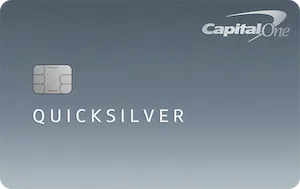
This review covers the unsecured Quicksilver Rewards card in Capital One's excellent-credit category. The catalog also lists products with similar names, including Quicksilver Rewards for Good Credit, QuicksilverOne, student and secured versions. Their annual fees, offers and borrowing terms can differ. Capital One's card catalog
The similarity is easy to miss when the artwork looks familiar and the word Quicksilver dominates the page. Before using any comparison, check the complete product name and the rates-and-fees box on the application you are considering.
Capital One's credit category describes its intended audience. It is not a promise that a particular score will secure approval or a particular credit limit. Preapproval and final approval are also different steps.
If you already have another Quicksilver variant, use your own agreement for your current costs. Do not assume that an advertised new-account offer changes an existing account automatically.
Quicksilver rewards and fees at a glance
| Feature | Reviewed Quicksilver Rewards terms |
|---|---|
| Annual fee | $0 |
| Ordinary purchase rewards | Unlimited 1.5% cash back on eligible purchases |
| Specified Capital One platforms | 5% on eligible Travel bookings and Entertainment tickets; restrictions below |
| Foreign transaction fee | None |
| Public welcome offer reviewed | $200 after $500 in purchases within three months |
| Introductory purchase and transfer APR | 0% for 15 months from account opening |
| Later purchase and transfer APR | 18.74%–28.74% variable on the public product page |
| Introductory transfer fee | 3% on transfers in the first 15 months |
| Cash redemption | Any amount; rewards do not expire for the life of the account |
The application channel matters. An offer reached through an eligibility check or a different promotion may differ from the public catalog. The reviewed public offer also excludes existing or previous cardmembers who received a new-cardmember bonus for this product within the past 48 months. Read the offer attached to your application. Catalog and offer conditions Product and redemption terms
After the first 15 months, the reviewed transfer terms charge 4% for transfers at another promotional APR and no fee for transfers at the purchase APR. Cash advances have separate pricing: a fee of the greater of $5 or 5%, with a 28.74% variable APR in the reviewed disclosure. Late fees can reach $40. A $0 annual fee does not make borrowing free. Full application pricing
The 5% platform rates have narrower jobs: hotels, vacation rentals and rental cars booked through Capital One Travel, and qualifying tickets on Capital One Entertainment. Cardholder-exclusive presales and direct Capital One Hall or Arena ticket purchases are excluded from the entertainment bonus. Compare the total price and cancellation terms before choosing either platform. Our everyday examples assign no spending to them. Platform reward rules
How much does the lower ordinary rate cost?
The useful comparison is not whether 2 is larger than 1.5. It is how much extra money the difference would produce on purchases you already make.
| Monthly eligible purchases | Annual purchases | Quicksilver at 1.5% | A 2% card | Annual difference |
|---|---|---|---|---|
| $500 | $6,000 | $90 | $120 | $30 |
| $1,000 | $12,000 | $180 | $240 | $60 |
| $2,000 | $24,000 | $360 | $480 | $120 |
| $5,000 | $60,000 | $900 | $1,200 | $300 |
These examples assume the same eligible purchases, cash redemption and no fees on either card. A suitable 2% alternative might have different qualification or redemption requirements, so confirm those before treating the comparison as interchangeable.
At $500 a month, the gap is $2.50 a month. An existing cardholder may reasonably decide that changing a working setup is not urgent. At $5,000 a month, the gap is $25 a month. That is enough to deserve a deliberate choice.
Our shared household spends $2,000 a month, or $24,000 a year. Quicksilver earns $360 in ordinary annual rewards. If the household is eligible for the reviewed $200 offer and earns it through planned purchases, the first-year total becomes $560. The following year returns to $360 with the same purchases and terms.
Do not compare that $560 first-year figure with an alternative's ongoing return without checking whether the alternative also has an opening offer. Put both cards on the same timeline. Our welcome-bonus guide walks through the spending deadline without turning it into a reason to shop more.
All examples here are modeled, not observed cardholder results. They assume eligible planned spending, no returns, cash redemption and full payments preserving the purchase grace period. Optional offers, travel benefits and insurance claims receive no guaranteed annual value.
Foreign purchases can change the result
Quicksilver's lack of a foreign transaction fee gives it a practical advantage over a higher-rate card that charges one. That can matter on a trip and on eligible purchases from foreign merchants while you are at home. Check the merchant and transaction terms rather than assuming location alone settles the fee.
Consider a hypothetical $1,000 foreign purchase. Quicksilver earns $15. A 2% card with a 3% foreign transaction fee earns $20 but charges $30, leaving a $10 net loss before exchange-rate differences. Quicksilver finishes $25 ahead on that transaction. Quicksilver foreign-fee policy Example 2% alternative's fee disclosure
There is also a useful whole-year threshold. Keep annual spending fixed at $24,000 and assume the competing 2% card charges 3% on foreign purchases. It starts $120 ahead in ordinary rewards. At $4,000 of foreign purchases, the $120 foreign fee uses up that advantage. Above $4,000, Quicksilver leads in this limited comparison.
That is not a universal case for accepting 1.5%. PNC Cash Unlimited is a 2% option without a foreign transaction fee, subject to its application, credit-line and account conditions. Compare the choices you can actually obtain and use. PNC product terms
No foreign transaction fee also does not guarantee the cheapest conversion at a checkout. A merchant's offer to charge you in your home currency can involve its own exchange pricing. Review the actual amounts and payment terms before accepting that choice.
Would Savor make more sense for your routine?
Within Capital One's cash-back lineup, Savor is the natural alternative for qualifying groceries, dining, entertainment and popular streaming. Its standard higher categories earn 3%, while other eligible purchases ordinarily earn 1%. Quicksilver earns its ordinary 1.5% across both groups. Current Savor offer
Ignoring special booking platforms, Savor beats Quicksilver as the only card when more than one-quarter of spending qualifies for the 3% categories. At exactly one-quarter, they tie.
For example, on a $2,000 monthly budget, $500 in eligible Savor categories produces $15 and the other $1,500 produces $15. Total: $30, matching Quicksilver's $30. At $730 in eligible categories, Savor earns $34.60 against Quicksilver's $30.
That $730 is the food-and-streaming portion of our shared household: $400 of qualifying supermarkets, $300 of dining and $30 of eligible streaming. It gives Savor an annual advantage of $55.20 as the only card. Actual store definitions matter; groceries purchased at excluded superstores do not automatically belong in the higher-rate column.
If you already have Quicksilver, adding Savor only for those $730 of monthly qualifying purchases increases rewards by 1.5 percentage points on that spending. The modeled improvement is $131.40 a year, or $10.95 a month, before any opening bonus. That is the relevant gain for that two-card arrangement–not Savor's entire reward total.
We would use a simple rule: Savor for its qualifying categories, Quicksilver for the rest. If remembering that rule feels burdensome, the extra $10.95 a month may not be worth another account. Our Savor versus Quicksilver comparison puts the one-card and two-card choices side by side.
Cash redemption is one of its useful features
You can request cash back as a statement credit or a check, in any amount. Capital One also offers automatic redemption at a chosen annual time or reward threshold. Rewards do not expire for the life of the account, although closing it can forfeit an unredeemed balance. Other redemption choices can have different values, which is why this review uses cash. Redemption rules
A statement credit lowers the card balance but does not satisfy the minimum-payment obligation. That distinction deserves a place in the monthly routine: redeem rewards, then check the payment still due rather than assuming the credit took care of it.
For modest spending, no redemption threshold can be more useful than it sounds. Someone earning $7.50 a month does not need to wait several months to reach a large minimum. That does not erase a lower earning rate, but it helps explain why usability belongs beside percentages in a comparison.
We would redeem periodically and keep card rewards out of the emergency-fund calculation. A reward balance belongs to an account with terms and conditions; it is not a substitute for accessible savings.
Use the introductory rate with a repayment date
The reviewed 15-month introductory purchase APR can help with a planned purchase when you have a credible repayment plan. It should not set the size of the purchase. Minimum payments remain due, and the regular variable APR applies after the promotional period under the agreement.
For a hypothetical $1,500 eligible purchase made near opening, setting aside $125 a month would repay it in 12 payments. That leaves some room inside a 15-month promotion, assuming the actual billing dates support the schedule and there are no other balances or charges.
A transfer adds another cost. A $3,000 transfer with a 3% fee begins at $3,090. Dividing that across 15 payments gives $206 per payment, but a later transfer leaves fewer payments before the deadline. Count the dates on your own account and aim to finish early.
If you expect to carry a balance after the introductory period, focus on borrowing costs and repayment first. Ordinary 1.5% cash back will not make an expensive revolving balance economical. The balance-and-rewards guide explains that comparison in dollars.
Which alternatives deserve a look?
| Alternative | Consider it when | Main tradeoff to check |
|---|---|---|
| Wells Fargo Active Cash | You want an uncomplicated 2% domestic purchase rate | Foreign transaction fee, current offer and redemption rules |
| Citi Double Cash | You want a broad 2% result and pay eligible purchase balances in full | Reward arrives through purchase and eligible-payment stages |
| PNC Cash Unlimited | You want a flat 2% option without a foreign transaction fee | Application, minimum credit line and account requirements |
| Capital One Savor | Food and entertainment make up a meaningful share of your budget | Eligible merchant definitions and 1% fallback purchases |
The first three alternatives challenge Quicksilver's ordinary earning rate. Savor asks a different question: whether your spending is concentrated enough to make a category card worthwhile. Active Cash Double Cash PNC Cash Unlimited Savor
Our choice would start with the annual dollar gap and the existing wallet. If you want a fresh domestic everyday card, investigate the 2% options. If you already have Quicksilver and the difference is small, keeping a familiar no-fee account can be a reasonable choice. If food spending dominates, compare Savor using the stores you actually visit.
Frequently asked questions
Is QuicksilverOne the same as Quicksilver Rewards?
No. They are separate variants with their own fees, eligibility and offers. This review's $0 annual-fee analysis applies to the specified Quicksilver Rewards version. Check the full name before applying or comparing an existing account.
Is Quicksilver's 1.5% rate capped?
The reviewed ordinary purchase earning is unlimited. Eligible-purchase rules, returns and account terms still apply. A larger purchase does not become sensible simply because it earns rewards.
Is Quicksilver worth keeping if I get a 2% card?
It can remain useful, particularly if the new card charges a foreign transaction fee. Review account costs, remaining rewards and your broader credit situation before closing or changing an account. A rewards comparison alone does not settle that decision.
Does Quicksilver require quarterly activation?
No activation is needed for the ordinary 1.5% purchase rate. Separate promotions or platform offers can have their own conditions, so check those individually rather than assuming the standard rule applies to every promotion.
Can a statement credit cover my minimum payment?
No. Capital One says reward statement credits reduce the balance but cannot meet minimum-payment obligations. Confirm the required payment and due date after redeeming.
How we evaluated this card
We reviewed the issuer terms and sources linked below and compared modeled, planned household purchases at documented cash-redemption values. Examples distinguish introductory offers from ongoing value and show relevant caps, exclusions and costs. They are illustrations, not personal card-use claims or approval predictions.
Product, offer and linked pricing checked September 15, 2026.
Sources & references7 sources
The issuer terms and other references behind this article.
- Capital One Quicksilver Rewards product
- Capital One card catalog, variants and acquisition offer conditions
- Wells Fargo Active Cash application rates, fees and rewards terms
- PNC Cash Unlimited product and cash redemption conditions
- Capital One Savor Rewards offer and category definitions
- Wells Fargo Active Cash product and rewards disclosures
- Citi Double Cash product and rewards terms