
In this article
There is a quiet advantage to a card that does not send you an annual bill for keeping it. You can use it where it helps, leave it out of the rotation when it does not and avoid mentally assigning value to benefits just to justify a renewal fee.
Still, “no annual fee” answers only one question. It does not tell you whether the card charges for a foreign purchase, requires a paid membership or gives its best cash value only through another account.
Those details do not automatically make a card bad. They tell you what kind of customer it suits. Here is how to find a useful free-to-hold card without overlooking what it costs to use.
Our take: start with the simplest option you can use well
If your priority is everyday domestic cash back, Wells Fargo Active Cash and Citi Double Cash are useful 2% benchmarks. Citi earns 1% on purchases and another 1% as you make eligible payments. Neither requires a large banking balance for that ordinary rate. Both charge a 3% foreign transaction fee. Wells Fargo terms Citi terms
If foreign purchases are part of normal life, PNC Cash Unlimited, Fidelity Rewards Visa and Bread Cashback American Express deserve comparison. Their account, approval, redemption and acceptance requirements differ. PNC’s minimum approved credit line is $5,000; that is an underwriting condition, not a deposit or spending target. PNC Fidelity Bread
For category rewards, Savor and Blue Cash Everyday offer useful food or shopping roles without an annual fee. The main cash-back comparison helps choose those roles. This guide focuses on the costs and access conditions that can make an attractive rate less useful.
The shortlist, organized around the fine print that matters
| What you want | Candidates to compare | Read this before choosing |
|---|---|---|
| Straightforward domestic 2% value | Active Cash; Double Cash | Foreign fees and Citi’s purchase/payment distinction. |
| A flat rate with no foreign fee | PNC Cash Unlimited; Fidelity; Bread | Approved credit line, eligible cash destination and payment-network acceptance. |
| Groceries and restaurants | Savor | Exact card version and eligible merchant definitions. |
| Groceries, gas and online retail | Blue Cash Everyday | Separate annual category caps; many other purchases earn 1%. |
| Rewards within an existing bank relationship | BofA cards; Smartly; PNC cards | Eligible accounts, balance measurement, fees and the return you give up. |
| A card for a membership you already keep | Prime Visa; Costco Visa | Membership cost and reward access remain separate from the card’s annual fee. |
| A card linked to an existing wallet | PayPal Cashback; Venmo | Required wallet, redemption flow and conditional paper-statement fee. |
| A credit-union option | Navy Federal cashRewards Plus; PenFed Power Cash | Membership, approved limit or qualifying relationship can determine the rate. |
Sources: Capital One variants, Everyday, BofA Rewards, Smartly, PNC TotalRewards, Prime, Costco, PayPal, Venmo, Navy Federal, PenFed. These are conditional starting points, not a promise of approval or the same offer for every applicant.
A foreign fee can outweigh the reward
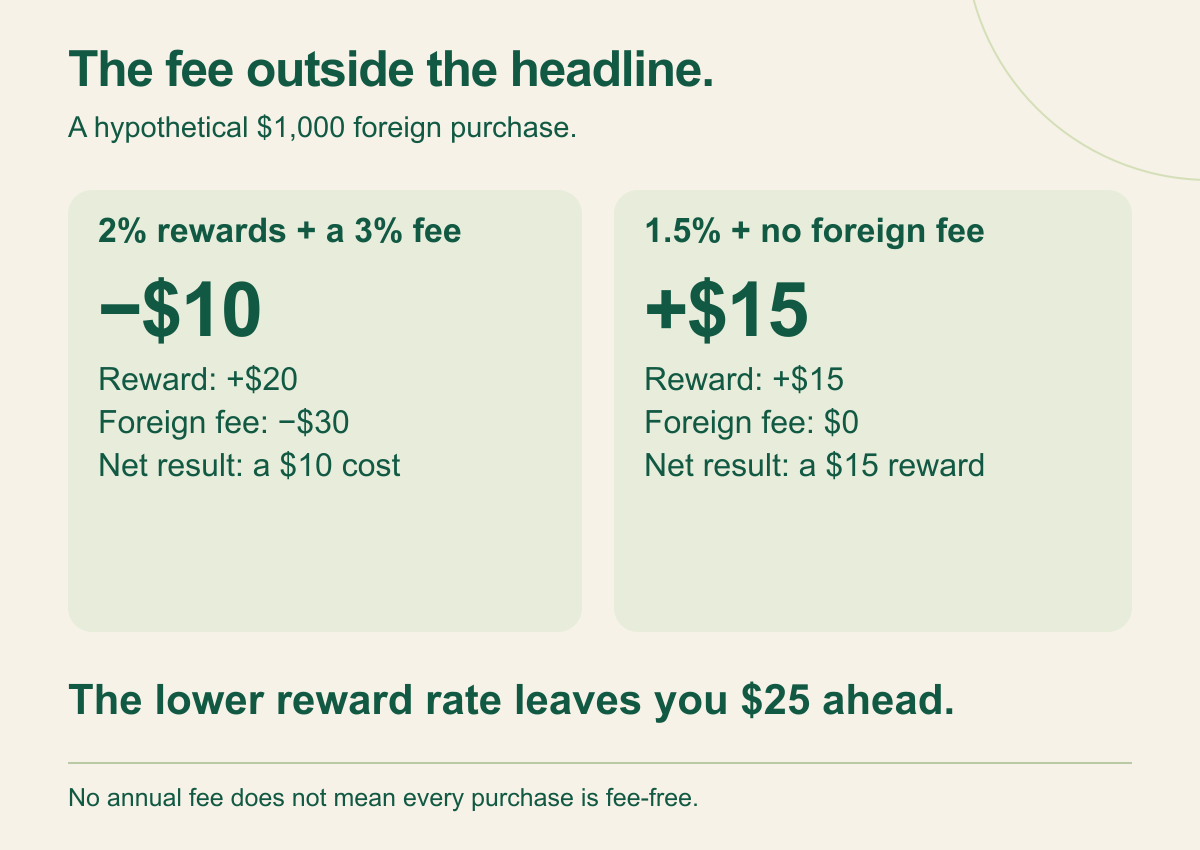
Imagine a $1,000 eligible foreign purchase. A card earning 2% returns $20. If it also charges a 3% foreign transaction fee on that purchase, the fee is $30. You finish $10 behind before interest or any other cost.
| Hypothetical card terms | Reward on $1,000 | Foreign fee | Net result |
|---|---|---|---|
| 2% rewards, 3% foreign fee | $20 | $30 | −$10 |
| 1.5% rewards, no foreign fee | $15 | $0 | $15 |
| 2% rewards, no foreign fee | $20 | $0 | $20 |
The 1.5% card beats the fee-charging 2% card by $25 on the same purchase. This is why we would rather choose a suitable card for the transaction than defend the highest headline rate everywhere.
Check how the agreement defines a foreign transaction; it can matter for online purchases as well as a trip abroad. Also compare the merchant’s actual price and currency-conversion choices. A fee-free card does not make every checkout conversion a good deal.
Cash access is part of the product
The reward is useful when it becomes money you can comfortably use. A statement credit, a bank deposit and a store reward are different experiences.
Fidelity’s full 2% value depends on depositing rewards into an open and funded eligible Fidelity account. You can choose automatic monthly deposits or request a deposit on demand. That can be convenient for someone already using one. It does not require buying investments simply to receive the cash, but it is a real account condition for someone who only wants a credit on the card bill. Fidelity redemption rules
PNC Cash Unlimited permits cash redemption without a minimum. Active Cash and Double Cash have their own available cash routes and payment rules. Synchrony Premier is another flat 2% candidate with automatic statement-credit redemption, which can take up to two billing periods. That automation may be appealing if you dislike managing points. It also charges a 3% foreign transaction fee. PNC redemption Wells Fargo Citi rewards Synchrony Premier
For any points-based option, check the dollar amount shown for your intended redemption. “Two points” is not a cash percentage until the value of a point is established. The extra step is particularly relevant when different redemption choices pay different amounts.
A membership should earn its own place
Prime Visa has no annual card fee, but its enhanced Amazon and Whole Foods earning requires eligible Prime. If you would otherwise use the no-Prime Amazon Visa’s 3% at those same qualifying merchants, Prime’s 5% adds two percentage points. Prime and Amazon Visa terms
At the regular $139 annual Prime membership price, the card-reward-only break-even against that 3% alternative is $139 ÷ 0.02 = $6,950 in qualifying annual purchases. This narrow example excludes tax, rewards on the membership charge and other membership benefits. Prime pricing
If you already keep Prime for shipping or other services you value, its incremental cost for the card decision may be zero. If you join solely for the reward, the membership expense needs to be included. Do not count the same cost twice in separate parts of your household budget.
Costco Anywhere Visa similarly requires a paid Costco membership. Gold Star costs $65 annually. Its ordinary 2% return on Costco purchases does not beat another suitable 2% Visa just because the card has Costco in its name; fuel, restaurants and other differences may provide the useful role. Costco membership Citi terms
For a prospective member, decide whether the store itself fits your shopping habits before using card rewards to justify joining. Buying larger quantities or changing stores can affect spending far more than the card’s reward rate.
Small statement fees can consume a small advantage
The reviewed PayPal and Venmo credit agreements include a $1.99 paper-statement fee when their specified conditions apply, including a balance above $2.50. Twelve applicable charges total $23.88. Electronic-only delivery avoids that charge under the terms. PayPal agreement Venmo agreement
Suppose a card improves your ordinary annual rewards by $30. After $23.88 in paper-statement fees, only $6.12 remains. If the improvement is $60, the fees leave $36.12.
Electronic statements may be a comfortable solution. Choose a delivery method you will actually read and manage reliably; avoiding a small statement fee is not helpful if it makes you miss a much more important payment.
The two wallet cards also work differently. PayPal rewards qualifying checkout use, while Venmo ranks spending categories within each statement period. Our PayPal versus Venmo comparison explains the difference before you choose based on a familiar app name.
A deposit is your money, but its location has a cost
Do not subtract an entire required bank balance as though it were a fee. The money remains an asset under the account’s rules. Instead, count account charges, foregone returns, investment costs and any practical restrictions created by moving it.
For example, $100,000 earning one percentage point less than an otherwise suitable alternative gives up about $1,000 a year before tax and compounding. An extra $480 in card rewards would not cover that hypothetical difference.
Smartly’s current enhanced rates require Smartly Savings plus qualifying Smartly Checking or Safe Debit balances. The checking balance tiers are $10,000, $50,000 and $100,000 for 2.5%, 3% and 4% respectively, with the uplift limited to the first $10,000 of eligible purchases per billing cycle. Exclusions apply, and unrelated investment balances do not count. The Savings opening deposit is $25; it does not itself qualify you for the higher card rate. Smartly current terms
BofA and PNC relationship programs use different eligible accounts and measurement rules. That can produce a different result for someone who already holds qualifying assets there. The relationship-rewards guide compares the additional reward with the whole arrangement.
Credit-union eligibility deserves a precise check
Navy Federal cashRewards Plus offers its 2% structure on approved credit lines of at least $5,000; the lower-line cashRewards version earns 1.5%. Credit-union membership is required. You cannot assume the Plus version simply because you prefer its rate. Navy Federal product terms
PenFed Power Cash’s higher 2% rate depends on Honors Advantage eligibility; otherwise the ordinary rate is 1.5%. Qualifying military status or the required checking relationship can establish eligibility. Under the reviewed Free Checking route, a $500 minimum daily balance or $500 in monthly direct deposits is relevant, with the program’s ownership and measurement rules. PenFed Honors Advantage
If you already qualify, these can be sensible comparisons. If you would need to reorganize banking for another half percentage point, calculate the actual gain. On $12,000 of annual purchases, that extra half point is $60. On $24,000, it is $120. Compare that with the work and any costs of qualifying.
Other $0-fee cards still deserve a look
A short list should save you time without hiding a card that fits your habits. These alternatives add specific jobs or conditions to the comparison:
| Other candidates | The useful question |
|---|---|
| AAA Daily Advantage and Travel Advantage | Do the grocery, warehouse or fuel categories fit? Neither requires AAA membership, but category reward caps still matter. AAA terms |
| Cash+ and partner-bank Elan Max Cash Preferred | Will selected categories improve recurring bills enough to justify managing selections and quarterly caps? Elan offers and cash-deposit access depend on the issuing partner. Cash+ Elan example |
| Wells Fargo Autograph and U.S. Bank Altitude Connect | Do the dining, transit or fuel categories help? Check the intended cash route: Connect’s full cash value uses an eligible U.S. Bank deposit, and its higher fuel rate is capped quarterly. Autograph Connect |
| Apple Card and Alliant Visa Signature | Apple’s ordinary 2% route requires Apple Pay; the physical card ordinarily earns 1%. Alliant’s current offer earns 1.5%, so an old 2.5% comparison is not a current application offer. Apple Alliant |
| Sam’s Club Mastercard and Instacart Mastercard | Would you keep the membership or use the delivery service anyway? Sam’s requires paid membership and has distinct cash-access rules; Instacart’s enhanced platform rate is capped, and delivery costs can exceed extra rewards. Sam’s issuer Instacart |
Robinhood Gold Card is especially relevant to this cost check. The card has no annual card fee, but it requires a $50 annual Gold subscription and access through a waitlist or invitation. Its advertised 3% does not make the arrangement cost-free. Full-value cash redemption uses an eligible Robinhood brokerage account, and new accounts opened on or after July 1, 2026 have a 3% foreign-currency transaction fee. Compare those conditions before treating it as an ordinary flat-rate substitute. Robinhood access and fees
Citi Custom Cash is an existing-holder option; new applications closed May 28, 2026. We have not established a current Shopper Cash Rewards acquisition offer or complete current Kroger-family variant terms, so neither is a numerical recommendation here. The wider market comparison records those limits. This guide focuses on consumer cash value; business cards, secured-card rebuilding choices and travel-transfer strategies need a different comparison. Citi availability
Build a shortlist you would still like next year
Choose two or three cards whose account and redemption conditions fit without unwanted changes. Apply each card’s ordinary rates to the same planned purchases, subtract the costs you would actually incur and keep the welcome offer separate.
On $24,000 of eligible purchases, 2% earns $480 and 1.5% earns $360. The annual gap is $120. A category specialist can improve the result, but only on the purchases it handles well; the one-card or two-card guide shows the incremental dollars.
A paid card can also win after its fee. “No annual fee” is a useful preference, not a requirement to reject a demonstrably better fit. Our annual-fee decision guide uses the same net-value approach.
Finally, if you expect to carry interest-bearing debt, borrowing cost comes first. A $0 annual fee does not make a card inexpensive financing, and rewards do not replace a repayment plan. CFPB grace-period explanation
Frequently asked questions
Does no annual fee mean the card is free to use?
No. Interest, foreign fees, transfers, cash advances, late payments, paper statements or a required membership can create costs. Check the exact card version and the transactions you expect to make.
Is a required deposit the same as an annual fee?
No. A deposit generally remains your asset under the account’s terms. Compare account fees and the return or flexibility you give up by keeping the money there.
Should I choose a lower rate to avoid a foreign fee?
Often that can produce a better result on foreign purchases. Compare the reward and fee in dollars on the same charge, and consider a suitable card that combines a competitive rate with no foreign fee.
Can a debit-card discount be a better alternative?
Yes. A qualifying Target Circle debit-card discount may be relevant to Target purchases without opening a credit account. It is a store discount with exclusions, so compare the final price rather than treating it as general cash back. Target rules
Should the welcome bonus decide the choice?
It can affect first-year value, provided planned purchases meet the requirement. Decide whether the card still has a useful role afterward and use our welcome-bonus guide to check the spending deadline without adding purchases.
How we reviewed it: We compared official product, pricing, membership and reward-access terms across flat-rate, category, wallet and relationship options. Examples use planned eligible purchases, documented cash values and explicitly stated hypothetical costs; bonuses and optional benefits are separate. Full on-time statement payments preserve the purchase grace period in reward-only models. We do not predict approval or claim personal card use.
Sources & references34 sources
The issuer terms and other references behind this article.
- Wells Fargo Active Cash application rates, fees and rewards terms
- Citi Double Cash linked acquisition pricing and reward agreement
- PNC Cash Unlimited product and cash redemption conditions
- Fidelity Rewards Visa Signature cash deposit requirements
- Bread Cashback American Express product details
- Capital One card catalog, variants and acquisition offer conditions
- Blue Cash Everyday current application pricing, reward and benefit terms
- BofA Rewards current tiers, eligibility and benefits
- U.S. Bank Smartly current tiers, eligible balances and exclusions
- PNC TotalRewards terms effective June 27, 2026
- Chase Prime Visa and Amazon Visa offers and reward terms
- Citi Costco Anywhere Visa product and reward conditions
- Synchrony PayPal Cashback Mastercard pricing and agreement
- Synchrony Venmo Credit Card pricing and agreement
- Navy Federal cashRewards and cashRewards Plus terms
- PenFed Power Cash Honors Advantage requirements
- Wells Fargo Active Cash product and rewards disclosures
- Citi Double Cash ThankYou reward terms
- Synchrony Mastercard products and automatic statement rewards
- Amazon Prime membership pricing
- Costco membership levels and annual fees
- CFPB explanation of credit-card grace periods
- Target Circle Card discount rules including debit-card alternative
- aaa
- cashplus
- elan-fulton
- autograph
- connect
- apple
- alliant
- sams-synchrony
- instacart
- robinhood-access
- custom-cash