
In this article
The bonus is the exciting part. The spending requirement is where the decision gets real.
A $200 reward can be useful. Buying $300 of things you did not need to reach it is a surprisingly efficient way to turn a perk into a bill.
The better plan starts with your calendar and budget. The offer gets to fit into that plan–not stretch it until the numbers look convenient.
Our take: line up the purchases before you apply
Write down the eligible purchases you expect to make during the offer window and the cash available to cover them. If that list comfortably clears the requirement, the bonus may be a useful addition to a card you want.
If the list falls short, do not fill the gap with invented needs. Choose an offer with a lower threshold, wait until a planned expense is closer, or keep the card you already have.
We would also compare the card after the bonus. A good first-year offer can justify a temporary difference in rewards, but it should not hide an ongoing annual fee, an inconvenient redemption system or a rate that poorly fits your spending.
The main cash-back comparison separates first-year offers from ordinary annual value. Use both numbers before deciding.
Read the exact offer, including which card it belongs to
Similar product names can hide different eligibility rules and promotions. A secured version, a fair-credit version and the standard rewards card may not carry the same bonus. A personalized offer may differ from a public application page.
Save the terms you actually see when applying, including:
- The card’s full name and the offered bonus amount.
- The required eligible spending and when the clock starts.
- The deadline and whether transactions must be posted by then.
- Restrictions for existing or former cardholders and previous bonus recipients.
- Excluded transactions, refunds and account-standing requirements.
- The reward’s form and expected posting time after qualification.
For example, the Capital One Savor offer reviewed for this collection advertises $200 after $500 in purchases within three months from account opening, subject to its offer and prior-bonus eligibility rules. That does not make every similarly named Capital One product eligible for that offer. Savor offer Capital One product variants
American Express’s public Blue Cash pages advertise offers as high as $200 for Everyday and $300 for Preferred. The exact offer can differ; the separate member application routes reviewed displayed $100 after $2,000 for Everyday and $150 after $3,000 for Preferred, each in eligible purchases within six months from account opening. Those are not interchangeable amounts. The Amex comparison keeps those channels separate. Everyday public terms Preferred public terms Everyday member terms Preferred member terms
“Up to” or “as high as” is a ceiling, not a promise about the offer you will receive.
A few current offers show why the details matter
The following examples were checked September 15, 2026. They illustrate different hurdles and reward forms; they are not a ranking of the largest bonuses.
| Card and reviewed offer | Main requirement | What to pay attention to |
|---|---|---|
| Wells Fargo Active Cash: $100 cash rewards | $500 in purchases in the first three months | Confirm the exact application offer and eligible net purchases |
| Citi Double Cash: $200 cash back, fulfilled through ThankYou Points | $1,500 in purchases in the first six months | A longer window changes the amount of monthly spending needed |
| Capital One Savor: $200 cash bonus | $500 in purchases within three months | Card version and prior-bonus restrictions matter |
| Bank of America Unlimited Cash Rewards: $250 online cash rewards bonus | At least $1,000 in purchases posted in the first 90 days | Posted purchases and the exact acquisition offer control |
| PNC Cash Rewards: $250 | $1,000 in purchases during the first three months | Qualification and bonus crediting happen at different times |
| Prime Visa: $150 Amazon Gift Card | Eligible approval under the reviewed Prime offer | This is an Amazon gift card, not $150 of unrestricted cash or a purchase-threshold offer |
Wells Fargo offer terms Citi offer and reward terms Savor offer BofA acquisition terms PNC Cash Rewards offer Prime Visa offer
These offers can change. Before applying, compare the live terms with your saved plan and use the amount actually offered to you.
Build a spending plan with room for ordinary life
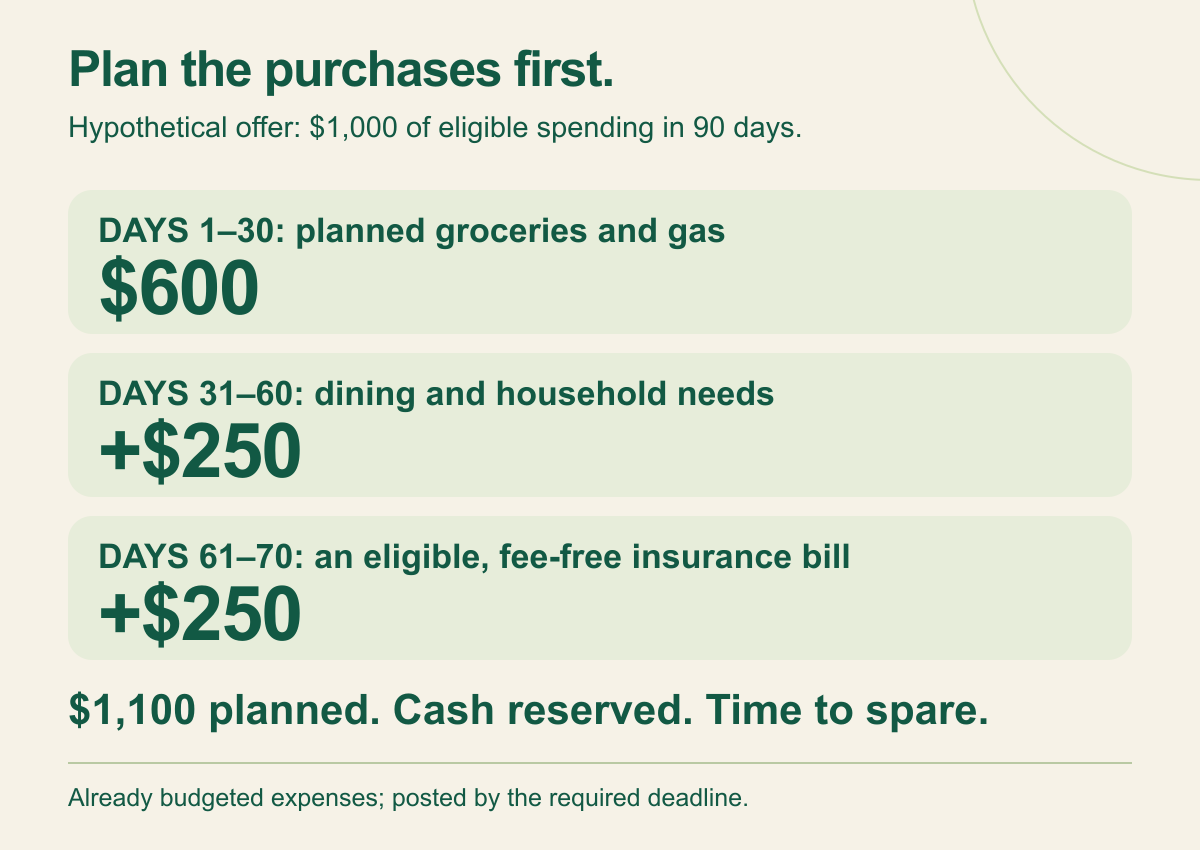
Suppose an offer requires $1,000 in eligible purchases within 90 days. Your budget already includes the following expenses, all payable by this card without extra fees and eligible under this hypothetical offer:
| When you intend to make the purchases | Already planned expenses | Purchases | Running total |
|---|---|---|---|
| Days 1–30 | $400 groceries and $200 gas | $600 | $600 |
| Days 31–60 | $150 dining and $100 household needs | $250 | $850 |
| Days 61–70 | A $250 insurance bill already due | $250 | $1,100 |
The $1,100 total clears the threshold by $100. That margin comes from purchases in the existing budget. It is not a recommendation to buy an extra $100 of something to manufacture a cushion.
Reserve $600, then $250, then $250 to pay those purchases. If that cash is not realistically available by the relevant payment due dates, the plan is not ready merely because the purchases fit the bonus window.
The insurance line needs its own check. Confirm that the issuer counts the payment, the insurer accepts the card, and using it does not add a fee or remove a cheaper payment discount. If any of those assumptions fail, replace the line with another genuinely planned eligible expense or choose a different offer.
A useful plan should still work if a purchase posts a few days later than expected or you return something that does not fit. It should not require everything to go perfectly on the last evening.
Put the purchase deadline and statement due dates on separate calendars
The bonus window and the bill-payment schedule do different jobs. A three-month spending offer does not ordinarily let you postpone every payment for three months.
Here is a hypothetical timeline with dates confirmed by the issuer:
| Event | Example date | Your action |
|---|---|---|
| Account opens and offer clock starts | October 1 | Save the offer and confirmed deadline |
| First statement closes with $600 owed | October 25 | Check the statement and the money reserved for it |
| That statement’s payment is due | November 20 | Pay as required; do not wait for the welcome bonus |
| Your own target for qualifying purchases to be posted | December 9 | Leave time to resolve missing or delayed transactions |
| Issuer-confirmed 90-day offer deadline | December 29 | Rely on the actual terms, not a last-minute pending charge |
These are illustrative dates, not the calendar for every card. Three calendar months and 90 days are not automatically the same interval. Nor should you assume the countdown starts when the physical card arrives.
The CFPB explains how paying the full statement balance by the due date can preserve a purchase grace period when its conditions are met. Carrying a balance or a balance transfer can complicate that treatment. Grace-period guidance Balance-transfer purchase interest
An approved 0% purchase promotion has separate terms and requires its own repayment plan. The welcome bonus itself is not a financing arrangement.
Track net eligible purchases, not the largest number in the app
A card balance can contain items that do not count toward the welcome offer. Depending on the terms, excluded items can include fees, interest, balance transfers, cash advances and cash-like transactions. Refunds can reduce the qualifying purchase total.
Keep a simple record of the purchase date, merchant, amount, posting status and any return. Reconcile it with the issuer’s tracker if one is available, and ask the issuer about discrepancies while there is still time to address them.
In the $1,100 plan above, a $150 return brings net purchases down to $950. You are now $50 short of a $1,000 requirement. Another already planned eligible purchase might close the gap. Buying something you do not want merely to restore the tracker is a different decision, and its cost belongs in the calculation.
Do not assume a gift card, person-to-person payment or other cash-like transaction qualifies because it can be charged to the account. The offer’s definitions control, and some transactions can carry cash-advance fees or immediate interest. If the answer is unclear, ask the issuer before making the transaction.
Calculate the bonus after the costs of earning it
The advertised bonus is the starting figure. The useful figure is what remains after any extra cost and the ordinary rewards you give up elsewhere.
Suppose you shift $1,000 of already planned purchases from a card earning 3% to a new card earning 1.5%, and doing so is necessary to earn a $200 bonus. Ordinary rewards fall from $30 to $15, a $15 opportunity cost. The modeled bonus advantage is $185, before any other costs.
That can still be a good deal. The point is to count it accurately.
Now suppose a $1,000 bill carries a 3% card-payment fee, and the new card earns 2% only on the original bill amount. The $20 ordinary reward is $10 less than the $30 fee. If that payment is necessary to earn a $200 bonus and otherwise makes financial sense, its combined modeled benefit is $190. If you would earn the bonus without it, paying the fee loses $10 unnecessarily.
Whether the fee itself earns rewards changes the arithmetic slightly. Our bill-payment fee guide shows both treatments and accounts for lost autopay discounts.
Interest can overwhelm a bonus too. Do not treat a future reward as the cash needed to pay a statement today. The guide to rewards while carrying a balance explains why the timing matters.
Know when the reward becomes usable
Reaching the purchase threshold and receiving the reward are separate events. PNC’s reviewed offer, for example, allows up to 90 days after the qualifying requirement is met for the bonus to be credited, subject to its account conditions. PNC offer terms
The reward’s form matters as well. Citi’s cash-back offer is delivered as ThankYou Points redeemable at the documented cash value. Amex Blue Cash bonuses are Reward Dollars under the applicable offer, with redemption required; the reviewed member offers allow 8–12 weeks after the spending threshold is met for those dollars to be applied. They are not automatically money in your checking account. Prime’s advertised gift card is for Amazon spending under its terms. Citi rewards Amex offer terms Prime Visa
Discover’s Cashback Match uses a different structure. If an eligible first-year account earns $300 in ordinary qualifying cash back, the match adds $300 within two billing periods after the first 365 days from account approval, if the rewards satisfy the match’s processing and account rules. That produces $600 in combined first-year rewards, but it does not mean the card earns $600 every following year or provides the extra $300 immediately. The Discover review explains which rewards count and when they become usable. Discover Cashback Match
Value each reward according to how you will actually use it, and keep your payment plan independent of its arrival.
Give the card a job after the offer ends
Before applying, decide whether the card has a useful ongoing role. It might become your default purchase card, handle a specific category, or replace a card that no longer suits you.
If an annual fee applies after an introductory waiver, put that renewal into your calendar. Compare the card’s ordinary rewards and usable benefits with a suitable alternative before the next fee changes the economics. Our annual-fee guide makes that comparison in dollars.
You do not have to chase the largest available headline to make a good decision. An attainable bonus on a card that fits your household can be more useful than an impressive offer that turns the next few months into a spending assignment.
Frequently asked questions
Should I spend more than usual to earn a welcome bonus?
Extra spending reduces the bonus’s value. Start with purchases already in your budget and cash available for their payments. If those purchases do not meet the requirement, a lower-threshold offer or waiting may be the better choice.
Do purchases have to post before the deadline?
Follow the exact offer. Some explicitly require posted purchases by the deadline, and pending transactions can create problems. Aim to complete qualifying purchases early and confirm the issuer’s timing rules.
Do refunds count against the spending requirement?
They can reduce net eligible purchases and affect qualification or a credited reward under the offer terms. Track returns and recalculate your qualifying total instead of relying on the amount originally charged.
Can I use the welcome bonus to pay the first bill?
Do not depend on it. The first statement may be due before the reward posts, and the reward may require redemption or be a restricted gift card. Have the payment money available independently.
Is a bigger bonus always better?
No. Compare the actual offer you qualify for, the required spending, fees, foregone rewards and ongoing card value. A smaller bonus can leave you better off if it fits purchases you were already going to make.
How we reviewed it: We checked the issuer offers and consumer-finance sources linked below, separated public and member offer channels, and modeled spending plans with explicit eligible-purchase and payment assumptions. Calendar dates and budgets are hypothetical. We assume no unnecessary purchases, no returns unless specified and full on-time payments in the base examples; we did not apply for cards or personally earn these bonuses for this article.
Sources & references15 sources
The issuer terms and other references behind this article.
- American Express Blue Cash Everyday member offer terms
- American Express Blue Cash Preferred member offer terms
- Capital One Savor Rewards offer and category definitions
- Capital One card catalog, variants and acquisition offer conditions
- Blue Cash Everyday current application pricing, reward and benefit terms
- Blue Cash Preferred current application pricing, reward and benefit terms
- Wells Fargo Active Cash application rates, fees and rewards terms
- Citi Double Cash linked acquisition pricing and reward agreement
- Unlimited Cash Rewards current $250 acquisition offer and pricing
- PNC Cash Rewards product and offer conditions
- Chase Prime Visa and Amazon Visa offers and reward terms
- CFPB explanation of credit-card grace periods
- CFPB explanation of new purchases during promotional balance transfers
- Citi Double Cash ThankYou reward terms
- Discover it Cash Back offer and Cashback Match terms