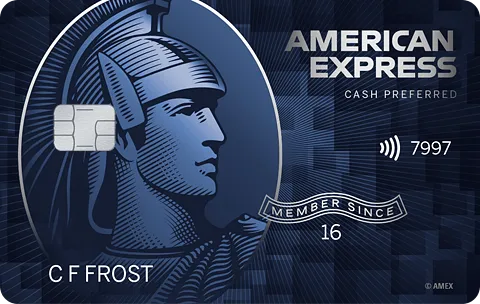
In this article
Six percent back on groceries is an attention-grabbing number. It becomes a more useful number after you answer three questions: which stores qualify, how soon you will reach the cap and what you could earn without paying an annual fee.
For our shared $2,000-a-month household, Preferred earns $463 a year after its recurring fee. That is only $7 more than Blue Cash Everyday and $17 less than a flat 2% card used for the same purchases.
Give Preferred its strongest categories and use a 2% fallback for the rest, however, and the same household earns $621.40 after the fee. This card's role in the wallet matters as much as its headline rate.
Our take: promising for the right stores, stronger with a fallback
Our recommendation: Consider Blue Cash Preferred when qualifying U.S. supermarket purchases are a meaningful, recurring expense and your other spending helps cover the fee. We prefer a calculation that includes the full household budget and a clear plan for purchases that earn only 1%. Current Preferred terms
- Good fit if: You buy substantial groceries at qualifying supermarkets, use eligible streaming or transit and can repay purchases in full.
- Consider another card if: Most groceries come from superstores or warehouse clubs, dining outweighs qualifying supermarket spending, or a no-fee alternative produces similar value with less upkeep.
- The tradeoff: In our example, pairing Preferred with a 2% fallback adds $141.40 a year over using the 2% card alone, after Preferred's $95 fee. That is about $11.78 a month for managing the additional account and category rules.
We would not open the card because an advertised subscription credit makes the annual fee appear to vanish. Start with purchases you already make, then add only the credits that would save you actual money.
Blue Cash Preferred rewards and fees at a glance
| Feature | Reviewed standard consumer card |
|---|---|
| Qualifying U.S. supermarkets | 6% on the first $6,000 per calendar year, then 1% |
| Select U.S. streaming subscriptions | 6% |
| Qualifying U.S. gas stations and transit | 3% |
| Other eligible purchases | 1% |
| Annual fee | $0 introductory first year, then $95 under the reviewed offer |
| Referenced prospect welcome offer | As high as $300 after $3,000 of purchases in the first six months; amount and eligibility vary by offer |
| Introductory purchase and transfer APR | 0% for 12 months from opening in the reviewed offer |
| Later purchase and transfer APR | 19.74%–28.74% variable in the reviewed pricing |
| Transfer and foreign fees | Transfers: greater of $5 or 3%; foreign purchases: 2.7% |
Transfers must be requested within 60 days under the reviewed terms. Cash advances have separate pricing: 28.74% variable APR and a fee of the greater of $10 or 5%. Late and returned-payment fees can reach $40, and a penalty APR can apply. Check the current application disclosure for the offer attached to your application. Pricing and offer conditions
The linked prospect disclosure offers cash back as high as $300. During our September 15 check, the product page also displayed a separate Card Member Offer of $150 after the same $3,000 spending requirement. Both have the first-year fee waiver and allow 8–12 weeks after qualifying spending for the bonus to post. Use the offer actually presented to you. Prospect offer Observed Card Member Offer
This review covers the standard consumer Blue Cash Preferred Card from American Express National Bank, rather than the separate Morgan Stanley variant. Existing accounts and product changes may have different offers. The first-year fee waiver and introductory APR are temporary, so keep them separate from the recurring account decision.
The grocery cap is the first number to understand
The 6% supermarket rate applies to the first $6,000 of qualifying purchases each calendar year across the account. That is an average of $500 a month. Additional cards do not create extra caps. Purchases above the limit earn 1%. Supermarket reward conditions
| Monthly qualifying supermarket spending | Annual spending | Gross supermarket rewards | After the $95 fee, counting no other rewards |
|---|---|---|---|
| $250 | $3,000 | $180 | $85 |
| $400 | $4,800 | $288 | $193 |
| $500 | $6,000 | $360 | $265 |
| $800 | $9,600 | $396 | $301 |
The last row is where a quick estimate can go wrong. Multiplying $9,600 by 6% produces $576, but that ignores the cap. The correct calculation is $360 on the first $6,000 plus $36 on the remaining $3,600, totaling $396 before the fee.
If you have a suitable 2% fallback, shifting that $3,600 above the cap to it earns $72 instead of $36. It adds $36 without buying more groceries. You just need a way to notice when the annual cap has been reached.
This is why a larger grocery budget does not make Preferred better without limit. A competing uncapped rate can gain ground once Preferred's higher-rate allowance is exhausted. The best choice can change as the household grows or the stores change.
Check the store before counting the groceries
Amex excludes superstores, warehouse clubs, convenience stores and meal-kit services from its supermarket category. Buying food at an excluded merchant does not override its classification. Fuel sold by supermarkets, superstores or warehouse clubs also does not qualify as an ordinary U.S. gas-station purchase under these rules. Amex merchant definitions
Suppose $400 of monthly grocery spending qualifies. That produces $288 a year at 6% before the fee. If half the grocery budget moves to an excluded store, only $200 a month receives that rate. Assuming the remaining eligible purchases earn 1%, the same $4,800 annual grocery budget produces $168 before the fee–a $120 reduction.
The basket did not change. The store did. That is enough to change whether the annual fee feels worthwhile.
We would not switch to a more expensive supermarket simply to protect a card's reward estimate. An extra four percentage points over a 2% card is $4 on a $100 basket while below the cap. If the alternative store charges more than that extra reward, the lower-price basket may still be the better choice.
Our merchant-exclusion guide explains the common Walmart, Target and warehouse-club questions. Use actual posted transactions to check your own merchants before projecting a full year at the higher rate.
Streaming, gas and transit can help cover the fee
Preferred's supporting categories matter because the annual fee applies to the account, not only to groceries. Select U.S. streaming earns 6%; qualifying U.S. gas stations and transit earn 3%. Product earning rules
Transit includes specified taxis, rideshare, public transportation, parking and tolls. It is a merchant category, not everything you buy while traveling. A restaurant dinner during a trip ordinarily remains a restaurant purchase, earning Preferred's 1% fallback unless a separate offer applies.
For streaming, check the eligible services and billing channel. A subscription folded into a third-party bundle may not post the same way as a direct charge. We would use a statement to confirm the rate rather than assume every recurring entertainment bill qualifies.
In our shared household, $30 a month of eligible streaming earns $21.60 a year. Compared with a 2% fallback's $7.20, that is $14.40 extra. Useful, but not a reason to keep a subscription you would otherwise cancel.
Likewise, $200 a month of qualifying gas earns $72, which is $24 more than 2%. A commuter's actual gas and transit budget can make these differences meaningful together. A household without those expenses should not borrow their value from someone else's example.
A complete household calculation
Our shared household spends $24,000 a year, distributed evenly. It buys $4,800 at qualifying U.S. supermarkets, $2,400 at qualifying gas stations, $360 on eligible streaming and $600 on transit. The remaining $15,840 earns the ordinary rate.
| Category | Annual spending | Rewards |
|---|---|---|
| Qualifying supermarkets at 6% | $4,800 | $288 |
| Qualifying gas at 3% | $2,400 | $72 |
| Eligible streaming at 6% | $360 | $21.60 |
| Qualifying transit at 3% | $600 | $18 |
| Other eligible purchases at 1% | $15,840 | $158.40 |
| Gross annual rewards | $24,000 | $558 |
| Less ongoing annual fee | – | −$95 |
| Ongoing result | – | $463 |
The result is close to familiar no-fee alternatives. A 2% card earns $480 on the same purchases. Blue Cash Everyday earns $456 because its online-retail category offsets much of Preferred's supermarket advantage. Optional subscription credits are excluded from all three base results.
The first year is different. With the reviewed fee waiver, Preferred's same purchases produce $558 before a bonus. If an eligible applicant receives and earns the referenced $300 maximum offer, that becomes $858. With the observed $150 Card Member Offer earned, it would be $708. Neither bonus belongs in recurring annual value.
These are modeled household results, not observed customer earnings. We assume planned eligible purchases, no returns or transaction fees, cash redemption and full payments preserving the purchase grace period. Optional credits, insurance benefits and travel-point values receive no guaranteed base value.
A two-card setup improves the ongoing case
Use Preferred for the $8,160 of qualifying supermarket, gas, streaming and transit purchases in the example. Those earn $399.60. Use a suitable 2% fallback for the other $15,840, earning $316.80. After the $95 annual fee, the combined result is $621.40.
That is $141.40 more than the flat card's $480. It is the additional value of the arrangement under these assumptions–not the entire $621.40, because the fallback card would have earned rewards on its own.
Compare a similarly arranged Everyday wallet too: Everyday for its qualifying categories and the same 2% fallback elsewhere produces $588. Preferred's advantage over that setup is $33.40 a year after its fee, about $2.78 a month. That smaller difference deserves attention when you are deciding which specialist to add.
We like this version of the card's job: Preferred for its higher categories while they qualify, the fallback for everything else. It avoids sacrificing a percentage point on ordinary spending just because Preferred has the more impressive grocery rate.
The arrangement still requires two payments, attention to the grocery cap and a clear shared rule if someone else uses an additional card. Our one-card versus two-card guide helps decide whether the incremental monthly amount is worth that work.
Be realistic about the Disney streaming credit
The reviewed benefit provides up to $10 monthly in statement credits after qualifying direct U.S. Disney+/Hulu/ESPN subscription purchases on an enrolled card. Eligibility, billing channel and monthly timing matter. Annual billing generates a charge in one month, not an automatic credit in all 12. Full credit terms
If you already keep a qualifying monthly subscription costing at least $10 and use every monthly credit, the benefit can save $120 a year. If the subscription is an expense you would not otherwise keep, the full advertised maximum is not a fair measure of savings.
The comparison with Blue Cash Everyday needs another adjustment. Everyday's reviewed credit is up to $7 monthly. If you would use both fully, Preferred adds $3 a month, or $36 a year. Counting Preferred's whole $120 while ignoring Everyday's $84 exaggerates the reason to pay the fee.
In our shared household's one-card comparison, Preferred's $7 rewards advantage over Everyday becomes $43 if the full $36 incremental streaming credit is useful. That is a clearer decision than saying the credit “pays for” the fee without considering the alternative.
Everyday also offers a separate enrolled Home Chef credit of up to $15 monthly on eligible subscriptions through its specified purchase page. If that saves you money you would otherwise spend, include it on Everyday's side of the comparison. Both cards receive zero Home Chef value in our base example. Everyday's Home Chef terms
Which alternatives deserve a look?
| Alternative | Consider it when | The decision-changing detail |
|---|---|---|
| Blue Cash Everyday | You want no annual fee and buy eligible goods online | Its 3% online-retail category can narrow Preferred's advantage |
| Capital One Savor | Dining is substantial or grocery spending extends beyond Preferred's cap | 3% qualifying food categories, with no annual fee and no comparable supermarket cap |
| A suitable flat 2% card | You want one ordinary rate across the budget | May beat Preferred alone after the fee, while also serving as a fallback |
| A store-specific grocery option | Most groceries come from excluded stores | Store acceptance, membership costs and restricted redemption may matter |
The Everyday versus Preferred comparison is the most useful first stop for a mixed grocery-and-online-shopping household. The Savor versus Preferred comparison is more revealing when dining matters.
For a food-only illustration, $9,600 of qualifying supermarket spending plus $3,600 of dining produces $337 on Preferred after its fee. Savor at 3% on both eligible categories produces $396, leading by $59. That narrow example excludes gas, streaming, transit and optional credits; adding them can change the whole-budget answer. Savor reward terms
Redemption, eligibility and the annual renewal decision
Reward Dollars can be redeemed for statement credits or eligible Amazon checkout purchases with no minimum under the reviewed terms. The rewards-funded portion of a purchase does not earn new purchase rewards, and a statement credit does not satisfy the required minimum payment. Redemption and eligibility terms
Prior ownership of Preferred or specified related variants can affect welcome and introductory offer eligibility, along with other Amex account history. A product change is not automatically the same offer as a new application. Read the amount, spending requirement and terms shown before accepting.
Before the next annual fee, use a year of posted category spending to repeat the calculation. Check whether you reached the grocery cap, whether store habits changed and how many subscription credits actually posted. A card that worked at opening may have a different value after a move, a shorter commute or a canceled subscription.
Our annual-fee guide focuses on that keep-or-change decision. We would keep Preferred when its additional usable value comfortably exceeds the fee and the account still has a clear job.
Frequently asked questions
Does every grocery purchase earn 6%?
No. Purchases must qualify at a U.S. supermarket, and the 6% rate applies only to the first $6,000 per calendar year across the account. Excluded stores and purchases above the cap ordinarily earn 1%.
Is Blue Cash Preferred permanently free?
No. The reviewed public offer has a $0 introductory first-year annual fee followed by a $95 recurring fee. Use the recurring fee for an ongoing comparison.
How much grocery spending makes the fee worthwhile?
It depends on the alternative and other categories. Against a 3% no-fee grocery rate, the extra 3% covers $95 at about $3,166.67 of qualifying supermarket spending below the cap, ignoring every other difference. Online retail, dining, streaming and credits can move that threshold.
Does transit include restaurant purchases during travel?
No. Transit covers specified transportation merchants. Dining is a separate category and ordinarily earns Preferred's 1% fallback unless another offer applies.
Is the maximum $300 welcome offer automatic?
No. The referenced prospect offer says as high as $300, while a separate Card Member Offer displayed $150 during our check. The actual offer and eligibility shown to you control, and qualifying spending must meet its deadline.
How we evaluated this card
We reviewed the issuer terms and sources linked below and compared modeled, planned household purchases at documented cash-redemption values. Examples distinguish introductory offers from ongoing value and show relevant caps, exclusions and costs. They are illustrations, not personal card-use claims or approval predictions.
Product, benefits and the identified offer disclosures checked September 15, 2026.
Sources & references6 sources
The issuer terms and other references behind this article.
- American Express Blue Cash Preferred product and benefit terms
- Blue Cash Preferred current application pricing, reward and benefit terms
- American Express eligible retail and rewards category definitions
- Capital One Savor Rewards offer and category definitions
- Blue Cash Preferred observed Card Member Offer and benefit terms
- Blue Cash Everyday offer and Home Chef benefit terms